

 0
0
Goalkeepers Played Bare-Handed for a Century Before Anyone Bothered Making Real Gloves
In 1885, a British manufacturer named William Sykes patented what he described as “leather gloves or gauntlets used in football playing,” complete with a thin layer of India rubber for cushioning. It was, as far as the historical record shows, the first serious attempt to design gloves specifically for goalkeeping. Sykes never put the design into production, for reasons nobody fully knows.
What followed was nearly a century of elite goalkeepers catching heavy leather balls with nothing but bare hands, or occasionally borrowed winter gloves that offered no grip advantage whatsoever.
A problem nobody urgently tried to solve
Through the early 20th century, goalkeepers who wore anything at all typically reached for ordinary winter gloves purely for warmth in cold conditions, not performance.
The 1950s brought the first specialized attempts at goalkeeping gloves, though these remained focused on weather protection rather than genuine grip enhancement. It wasn’t until the mid-1960s that Stanno released what’s generally considered the first recognizably modern design: leather construction with rubber inserts specifically intended to improve grip rather than just provide warmth.
Even then, adoption was slow and inconsistent. Some of the era’s most respected goalkeepers, including England’s Alex Stepney and Northern Ireland’s Pat Jennings, continued playing entirely bare-handed well into the 1970s, treating gloves as an unnecessary accessory rather than genuine performance equipment.
Gordon Banks reportedly experimented with a design at the 1970 World Cup that resembled ordinary garden gloves more than anything purpose-built for football.
The material that finally changed everything
The real transformation arrived in the 1970s with the introduction of latex as a palm coating material. West Germany’s Sepp Maier wore early latex-palmed gloves during the 1974 World Cup, and the improved grip in both wet and dry conditions helped cement the technology’s credibility among elite goalkeepers watching from other national teams.
Brands like Reusch, founded back in 1934 but only reaching wide popularity in the 1970s, alongside newer entrants like Uhlsport, began mass-producing gloves specifically engineered around latex performance rather than simple weather protection.
The 1980s pushed the technology further still, as manufacturers experimented aggressively with materials, testing everything from terry cloth to actual table tennis bat rubber, searching for the ideal grip surface.
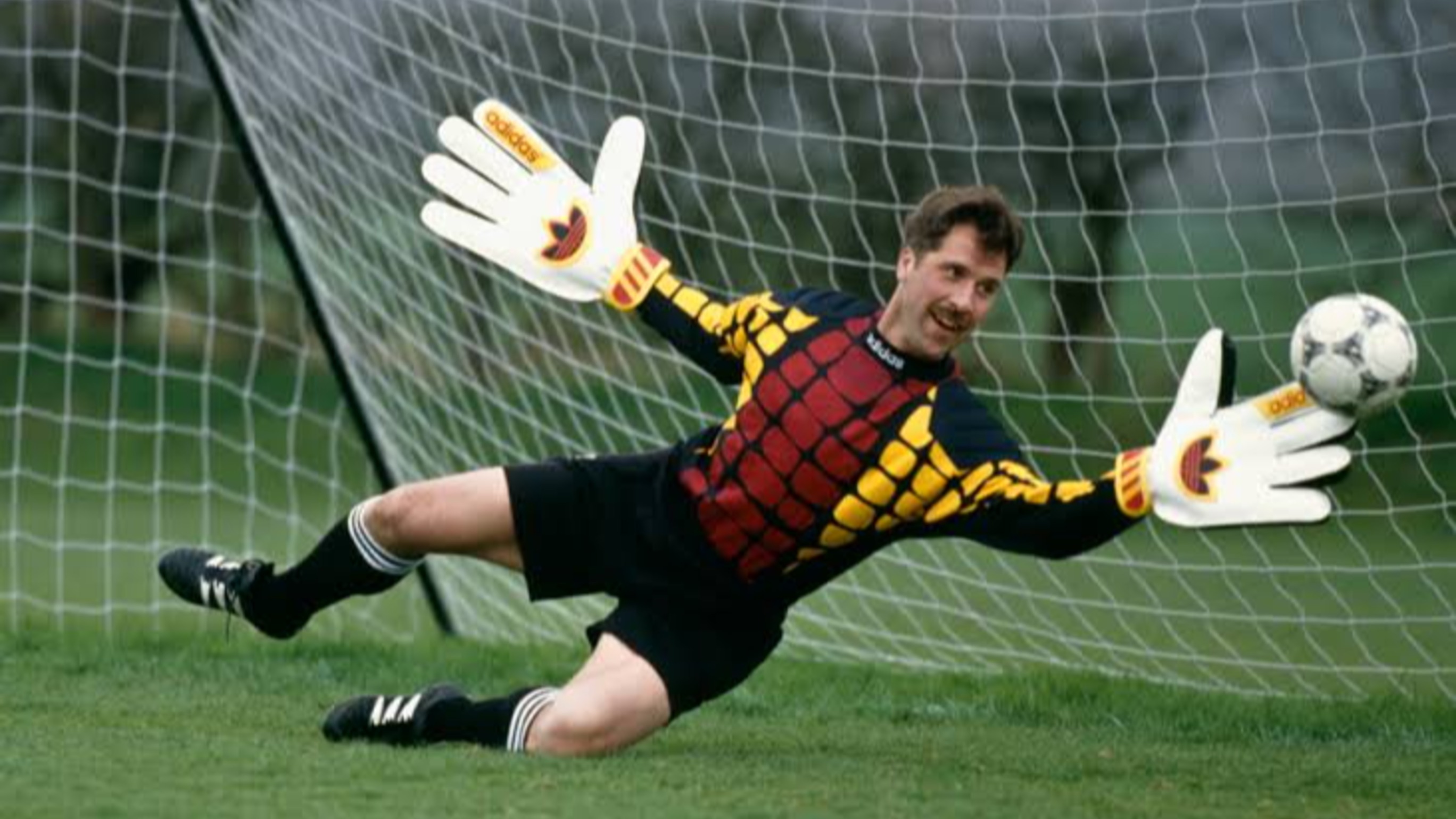
That decade also introduced heavier padding designed explicitly to help goalkeepers control high-speed shots rather than merely catch them, a direct response to footballs themselves becoming lighter and faster as ball technology moved away from heavy, water-absorbing leather toward modern synthetic materials.
A century-long gap that’s easy to overlook
It’s genuinely strange, viewed from the present, that a sport built around a goalkeeper’s hands went nearly a hundred years between the first patented glove design and elite players actually adopting specialized gloves as standard equipment.
Part of the explanation traces to the balls themselves: heavy, water-logged leather footballs common through the mid-20th century behaved differently than the lighter synthetic balls that emerged later, meaning the grip problem gloves eventually solved wasn’t nearly as severe under earlier conditions.
Today’s goalkeeper gloves represent a genuinely sophisticated category of sports equipment, engineered latex compounds, specific cut designs, padding calibrated to shot velocity. That level of technical refinement makes the century-long gap between Sykes’s ignored 1885 patent and the sport’s eventual full embrace of specialized gloves look even stranger in hindsight.
Why do you think it took nearly a century between the first patented goalkeeper glove design and the point where elite goalkeepers actually considered gloves essential rather than optional?


 4
4