




 0
0
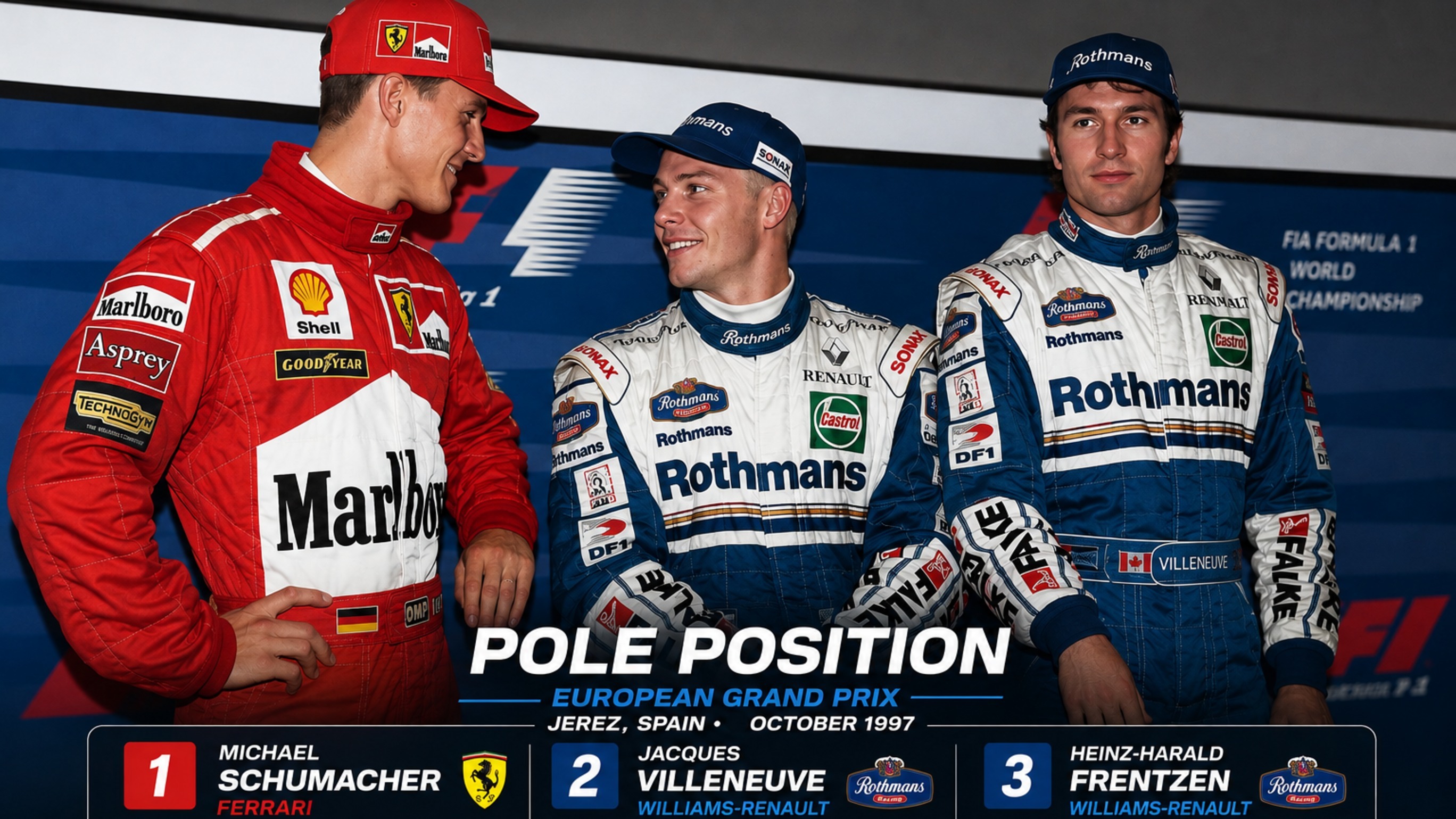
Three F1 Drivers Set Exactly the Same Pole Time. One Still Had to Start First
Qualifying in Formula 1 is supposed to separate drivers by fractions so small they're basically invisible to the naked eye.
At the 1997 European Grand Prix in Jerez, it did the opposite.
Jacques Villeneuve, Michael Schumacher and Heinz-Harald Frentzen all set exactly the same lap time, 1:21.072, on a track timed to the thousandth of a second.
Pole position came down to something qualifying was never supposed to need: who happened to cross the line first.
A title decider that got stranger by the minute
This was the last race of the season, and the title itself was on the line.
Schumacher led Villeneuve by a single point heading into the weekend.
Fourteen minutes into the hour-long qualifying session, Villeneuve set a 1:21.072 to take provisional pole.
Fourteen minutes later, Schumacher crossed the line and matched it, down to the exact thousandth.
With nine minutes left, Villeneuve's own teammate Frentzen went out and matched it again.
Three different drivers, three different cars from two different teams, the exact same time to the thousandth of a second, something that had never happened before in the sport's history and has never happened again since.
Damon Hill, fourth on the grid, missed out on the tie by just 0.058 seconds.
Settled by a rule nobody expected to need
F1's regulations had an answer ready, even if nobody had ever had to use it.
When drivers set identical times, the rule stated the driver who posted the time earliest in the session gets the better grid slot.
Villeneuve had gone first, so Villeneuve got pole.
Schumacher, despite matching him exactly, lined up second.
Frentzen, last to set the time, started third.
It meant a driver could be objectively as fast as two rivals and still start behind both of them, purely because of when the clock happened to catch him.
It's a strange kind of fairness: entirely logical on paper, and almost impossible to explain to someone watching for the first time.
A race that turned considerably less tidy
The race itself didn't stay so neatly balanced.
Schumacher made the better start and led into the first corner, and the title fight came to a head on lap 48 when Villeneuve attacked down the inside at the Dry Sack corner.
Schumacher turned into him, damaging his own car beyond repair and ending his race in the gravel, while Villeneuve nursed his damaged Williams home in third, enough to secure the championship.
The FIA later stripped Schumacher of his points for the entire season over the incident, though his results stood for the constructors' title.
The three-way tie remains the closest qualifying session in F1 history, a genuine statistical impossibility that happened anyway, in the one race where it mattered most.
A tie that modern timing would probably prevent
Part of why this can't easily happen again comes down to how much timing technology has changed since 1997.
Modern F1 timing systems can, in principle, measure to even finer resolution than the thousandth of a second used that day, and the sport's data-gathering has become so granular that a genuine tie at any level of precision would be treated as almost as newsworthy now as it was then.
Teams also approach qualifying laps with far more granular telemetry feedback today, constantly adjusting fuel loads, tyre pressures and engine modes lap to lap in ways that make three completely independent cars landing on an identical number even less likely than it already was in 1997.
That's part of what makes the Jerez tie such a lasting piece of trivia rather than a forgotten footnote.
It sits at the intersection of pure chance and a title decider, in an era of F1 precise enough to measure the coincidence exactly, but not yet quite precise enough to prevent it from happening in the first place.
Should a sport built around measuring fractions of a second have a backup rule for the moment its own instruments simply can't separate the competitors?


