



 0
0The Comprehensive History of Football: From Ancient Rituals to a Global Phenomenon
Introduction: The Universal Language of the Pitch
Football, or soccer as it is known in some parts of the world, is far more than just a competitive sport; it is a profound cultural phenomenon that transcends borders, languages, and socioeconomic status. It is a game that evokes intense passion, creates national heroes, and stops time for ninety minutes. To understand why football holds such a powerful grip on the human imagination, we must journey back through thousands of years of history to uncover its diverse origins and its remarkable evolution into the "Beautiful Game."
Ancient Origins: The Seeds of Competition
While modern football was codified in England, the act of kicking a ball for sport and ritual is as old as civilization itself.
In Ancient China, during the Han Dynasty (206 BC – 220 AD), a game called "Cuju" (literally "kick ball") was widely practiced. It involved kicking a leather ball filled with feathers through a small opening in a net. Cuju was used for military training and later became a form of entertainment for the elite classes.
In Ancient Greece, a game known as "Episkyros" featured players attempting to throw a ball over a line, often involving kicking as well.
The Romans developed "Harpastum," a fast-paced and often violent game played with a small, hard ball, which spread across Europe as the Roman Empire expanded.
In Mesoamerica, various indigenous cultures played ball games with rubber balls, often linked to religious myths and cosmic cycles, where the stakes could sometimes be life or death.
The Medieval Era: Shrovetide and "Mob Football"
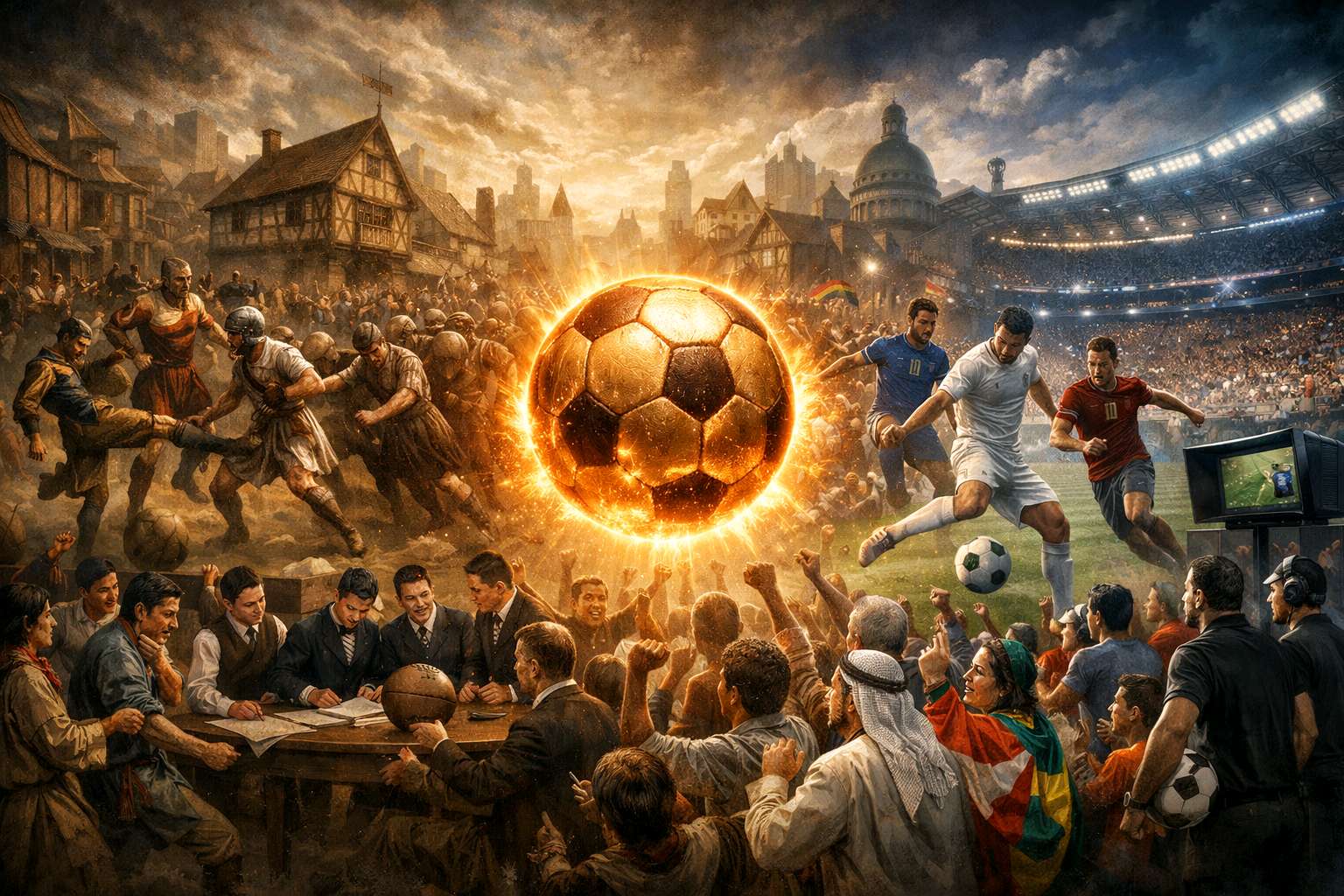
During the Middle Ages in England, football existed in a raw and chaotic form known as "Mob Football." These matches took place between entire villages or towns during festivals like Shrove Tuesday. There were few rules, hundreds of players, and the "goal" could be a landmark miles away. The games were so violent and disruptive that several English monarchs, including Edward II and Henry IV, attempted to ban the sport, fearing it distracted from archery practice and caused civil unrest. Despite these royal decrees, the people’s love for the game ensured its survival.
The 19th Century: The Birth of Modern Rules
The transformation of football from a chaotic pastime into a structured sport occurred in the public schools and universities of 19th-century England. Each school had its own set of rules, leading to confusion when they played against each other.
In 1848, the "Cambridge Rules" were established at Cambridge University, emphasizing a game based on kicking rather than carrying the ball.
The most pivotal moment occurred on October 26, 1863, at the Freemasons' Tavern in London, where the Football Association (FA) was formed. This led to the official separation of "Association Football" from "Rugby Football."
Key innovations followed: the introduction of the penalty kick in 1891, the use of nets in 1891, and the standardization of pitch dimensions and player numbers.
Global Expansion and the Rise of FIFA
As the British Empire expanded, sailors, soldiers, and traders brought football to every corner of the globe. From the docks of Buenos Aires to the plains of Africa, the game’s simplicity made it easy to adopt.
In 1904, the Fédération Internationale de Football Association (FIFA) was founded in Paris to provide international oversight.
The first-ever FIFA World Cup was hosted and won by Uruguay in 1930, marking the beginning of football as the premier international sporting event.
The post-war era saw the rise of legendary players like Pelé, who won three World Cups with Brazil, and the tactical mastery of European clubs in the newly formed European Cup (now the UEFA Champions League).
The Modern Era: Icons, Technology, and Industry
In the 21st century, football has evolved into a multi-billion dollar global industry.
Tactical Revolutions: From "Total Football" pioneered by the Netherlands in the 1970s to the "Tiki-Taka" style of Barcelona, the game has become increasingly strategic and athletic.
Global Superstars: Icons like Diego Maradona, Zinedine Zidane, Lionel Messi, and Cristiano Ronaldo have become household names, reaching levels of fame comparable to Hollywood stars.
Technological Integration: The introduction of Goal-Line Technology and the Video Assistant Referee (VAR) has aimed to increase fairness, though these innovations remain topics of intense debate among fans.
Social Impact: Football has the power to promote peace, fight racism, and provide a platform for social change, proving that its influence extends far beyond the stadium walls.
Conclusion: The Future of the Beautiful Game
As we look to the future, football continues to grow. The expansion of the Women’s World Cup, the rise of football in North America and Asia, and the continuous evolution of sports science ensure that the game will remain vibrant. Whether played in a state-of-the-art stadium or on a dusty street with a ball made of rags, the essence of football remains the same: a simple ball, a shared goal, and an undying passion.

🔥 READ THIS BLOG UNTIL THE END… THE REASON MAY SURPRISE YOU 🔥

💡 How to Earn Money from Writing Blogs on Buzzer: Turn Your Words into Real Income! 💰📝

Hockey Uncovered: From Ancient Fields to Frozen Arenas

The Importance of Sports: Building Health, Discipline, and Community

🏀 The Ultimate History of Basketball: From Humble Beginnings to a Global Phenomenon 🌍✨

Volleyball: The Story of a Flying Game
The History and Origins of Tennis 🎾


 -1.069

