



 1

The Algorithm's Eye: How AI, xG, and Predictive Data Models Have Conquered Football Scouting
For more than a century, football scouting was an industry of intuition. It was a romanticized world of seasoned scouts braving freezing rain on Sunday mornings, relying on the "eye test" to spot the next generational talent. But in the hyper-competitive, billion-dollar landscape of 2026, intuition has been replaced by empirical truth. The cigar-smoking scout has been superseded by the data scientist. Football is no longer just a physical battle; it is a complex statistical puzzle, solved by artificial intelligence and advanced probability distributions.
The foundation of this modern revolution was built upon Expected Goals (xG) and Expected Assists (xA). Initially dismissed by purists as a passing trend, these metrics fundamentally altered how we evaluate performance. Rather than looking at the unpredictable outcome of a shot, xG measures the quality of the chance itself, stripping away the chaotic variance of luck, goalkeeping heroics, or a striker’s temporary slump. It provided the first objective lens into underlying team performance. However, in 2026, xG is merely the alphabet of a much more complex data language.
Today, the smartest clubs in the world operate like high-frequency trading firms. They utilize sophisticated linear regression models and predictive analytics to identify undervalued market inefficiencies. This is how smaller, financially constrained clubs consistently outsmart heavyweights. By analyzing vast datasets, algorithms can pinpoint a midfielder in a second-tier league whose underlying metrics—such as progressive passing, ball-retention under pressure, and space-creation variance—mirror those of a €100 million superstar. These clubs buy the statistical profile, not the name, acquiring elite output for a fraction of the cost. Once the player’s traditional output catches up to their underlying data, they are sold for exponential profit.
But the true frontier of modern football analytics goes far beyond basic events like passes and shots. We have entered the era of spatial and tracking data. Companies deploy advanced optical tracking systems and live data collectors to map the exact coordinates of all 22 players and the ball multiple times per second. AI models process this massive live data stream to calculate "Pitch Control" and "Expected Threat" (xT). These algorithms evaluate the probability of a team scoring based on how they manipulate space, identifying players whose off-the-ball movements consistently fracture defensive structures, even if they never touch the ball.
Furthermore, this technological revolution is no longer confined to pre-match scouting or post-match review; it has invaded the dugout. Managers now receive real-time data feeds processed by AI on their tablets during the 90 minutes. If a predictive algorithm detects that an opponent's right-back is suffering a drop in acceleration and losing their defensive duels at a higher frequency, the manager is alerted instantly, triggering a targeted substitution to exploit that exact weakness.
We have reached a point where live data collection and statistical analysis are as crucial to a team's success as the boots on the players' feet. The beautiful game has been digitized, and those who refuse to speak the language of algorithms will inevitably be left behind in the tactical dark ages.
What do you think, Buzzer community? Does the heavy reliance on data and AI scouting remove the magic and unpredictability from football, or does it elevate the game to a higher tactical level? Which club do you think is currently the smartest in the transfer market using these metrics? Drop your thoughts below!

The Architects of the Pitch: Tracing the Ancestry of Football's Tactical Revolutions

The Final Dance of GOAT : Lionel Messi’s Journey from Beijing Gold to a Legendary Farewell
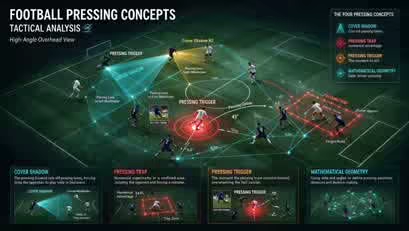
The Geometry of High Pressing: How Defending Became Football’s Deadliest Playmaker

The 2026 Ballon d'Or: The Most Unpredictable and Fiercely Contested Race in History

Beyond the Box: The Rise of the Complete Forward and the Death of the Traditional Number 9

The Architect of Chaos: The Tactical Evolution and the Grand Return of José Mourinho


 4


