

 0
0
The Marathon Record Nobody Agrees How to Count
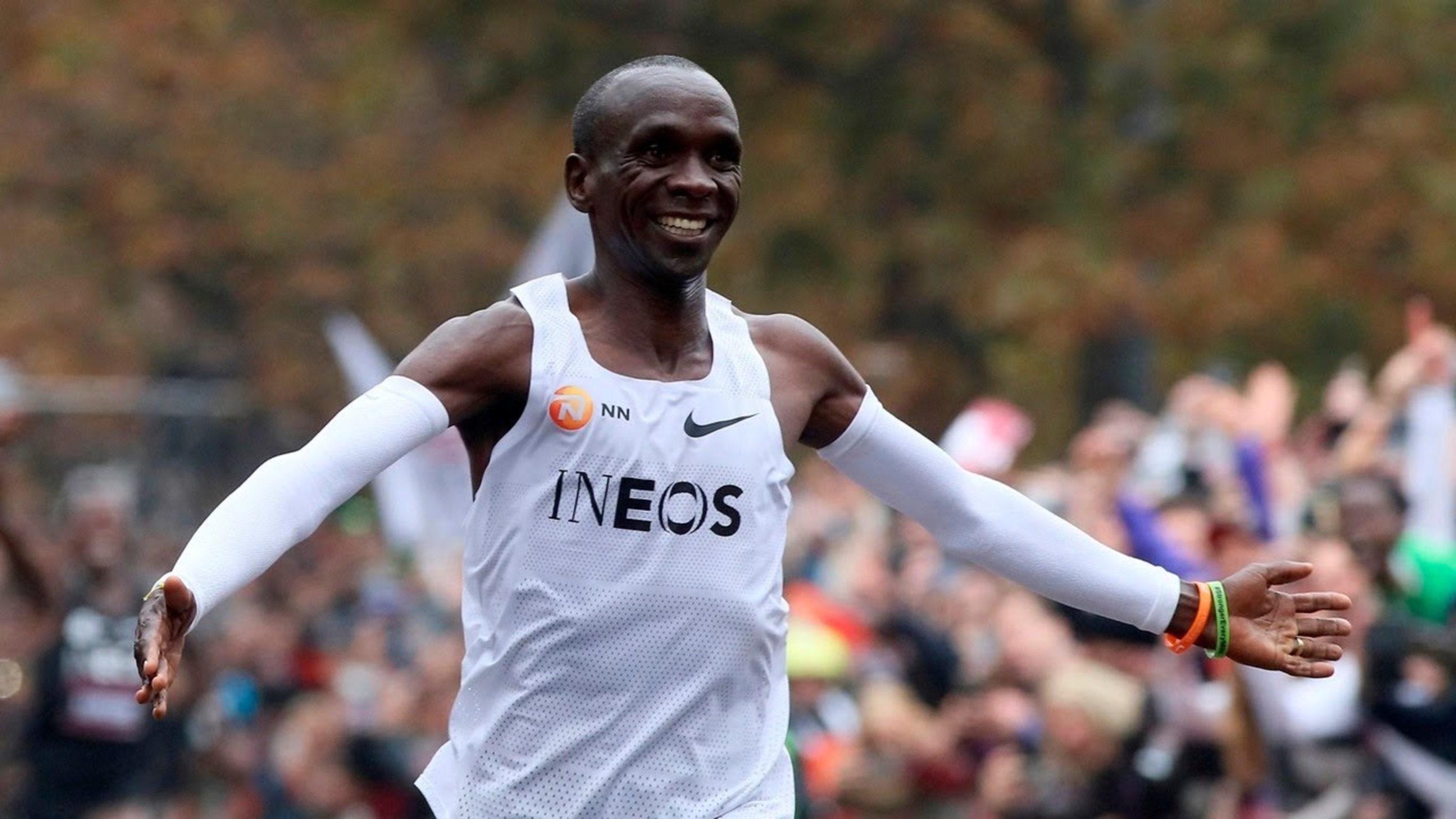
On October 12, 2019, in a Vienna park, Eliud Kipchoge ran a marathon in one hour, 59 minutes, and 40.2 seconds. He became the first human ever to cover 26.2 miles in under two hours.
It’s not the official world record. It never will be.
Why the fastest marathon ever run doesn’t count
The INEOS 1:59 Challenge was designed from the ground up to break the two-hour barrier, and everything about it was built for exactly that. Kipchoge ran surrounded by a rotating team of 41 elite pacemakers, arranged in a shifting formation to shield him from wind resistance.
A pace car projected a green laser line onto the road ahead of him, marking the exact position he needed to hold for a sub-two-hour finish. He received hydration handed off by cyclists riding alongside him rather than having to slow down at fixed stations.
None of that is allowed in a record-eligible marathon under World Athletics rules, which require an open competition without that level of engineered pacing support. Kipchoge’s actual world record, set at the Berlin Marathon in 2018, stands at 2:01:39, a full 118 seconds slower than what he ran in Vienna under ideal, manufactured conditions.
The steady march toward two hours anyway
Strip away the Vienna asterisk and the record’s official progression tells its own story of relentless, incremental improvement.
Kenya’s Wilson Kipsang broke 2:03 in 2013. Countryman Dennis Kimetto broke 2:03 outright in 2014. Kipchoge then broke 2:02 in Berlin in 2018, and broke his own record again in 2022, running 2:01:09 at the same race. Kelvin Kiptum then broke 2:01 entirely, running 2:00:35 at the 2023 Chicago Marathon, a mark that still stands as the official world record.
Kipchoge attempted the sub-two barrier once before Vienna too, running 2:00:25 at a similarly engineered event called Breaking2 in Monza in 2017, missing the mark by just 26 seconds on that first try.
Does the asterisk actually matter
There’s a real debate buried in here about what a “real” athletic achievement is supposed to mean. Purists argue the Vienna run, whatever the time on the clock, isn’t comparable to a genuine competitive marathon, since the entire event existed purely to produce one specific number under conditions no ordinary race allows.
Others point out that Kipchoge still ran every single one of those 26.2 miles himself, on his own legs, with nobody carrying him. The pacing help reduces wind resistance and psychological strain, sure, but it doesn’t run a single step for him.
Kipchoge himself has leaned into the symbolic weight over the technical asterisk, comparing his run to Roger Bannister breaking the four-minute mile barrier in 1954. “I am the happiest man in the world to be the first human to run under two hours,” he said afterward. “I can tell people that no human is limited.”
Statistical models built on the official record’s progression since 1970 currently predict an authentic, fully record-eligible sub-two-hour marathon sometime around 2035, give or take several years. Whoever eventually does it competitively, without a laser pace car or a rotating pacemaker formation, will be running into history Kipchoge already visited once, under different rules.
Should an achievement like Kipchoge’s Vienna run count as a genuine sporting milestone even without official record status, or does the engineered pacing fundamentally change what it represents?


 1
1