




 0
0
The Early UFC Was Basically a Completely Different Sport
Watch a UFC pay-per-view today and you’ll see weight classes, five-minute rounds, ringside judges, and a long list of banned techniques. None of that existed at UFC 1.
Held in Denver in November 1993, the first Ultimate Fighting Championship event had almost no rules at all, and the sport it produced barely resembles the one that carries the same name today.
A question, not a competition
UFC 1 wasn’t originally designed as a sport in the way we’d recognise it now. It was built to answer a single question: which martial art actually wins in a real fight. Eight competitors from wildly different disciplines, boxing, sumo, karate, kickboxing, wrestling, and Brazilian jiu-jitsu among them, were entered into a single-night, eight-man tournament with almost no restrictions.
There were no weight classes at all. Fighters weighing 180 pounds could be matched against opponents well over 250. There were no time limits and no rounds, so a fight could theoretically go on indefinitely. There were no judges, since without rounds or points there was nothing for anyone to score. The only rules were a handful of outright bans: no biting, no eye gouging, no groin strikes. A fight ended only by knockout, submission, or a fighter’s own corner throwing in the towel.
One night, multiple fights, one incredibly small Brazilian
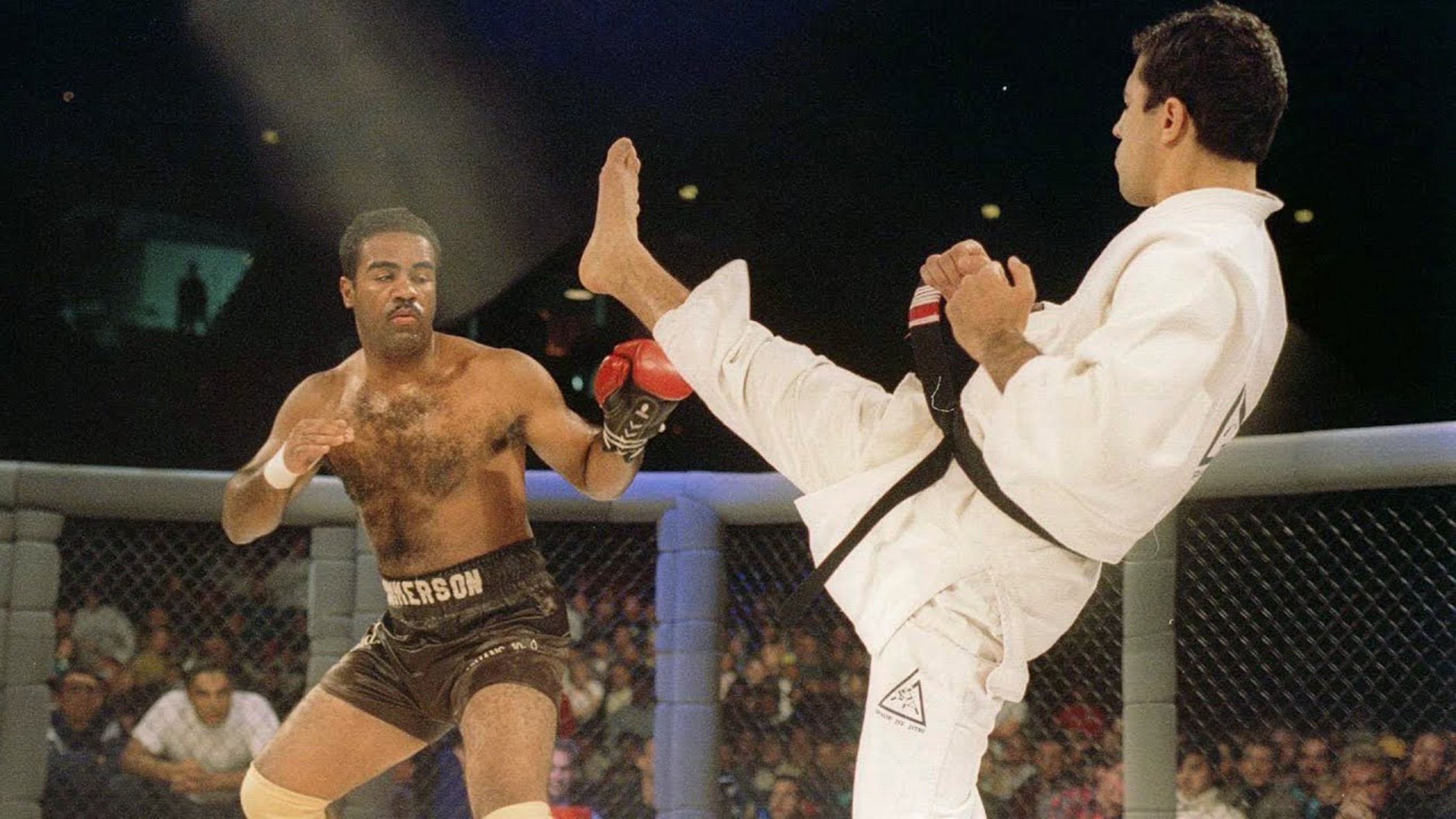
The tournament format meant a fighter could face several opponents in a single evening if he kept winning. Royce Gracie, at 178 pounds and by design the smallest competitor in the field, won three fights in one night to take the inaugural title: submitting boxer Art Jimmerson, who fought wearing a single boxing glove, choking out shootfighter Ken Shamrock in under a minute, and finishing kickboxer Gerard Gordeau in the final.
Gracie’s win did more than crown a champion. It introduced Brazilian jiu-jitsu to an American audience that had never seen a smaller fighter dismantle much larger opponents through leverage and technique rather than size or power, and it helped launch an entirely new sport built around exactly that kind of style-versus-style curiosity.
Chaos that forced its own evolution
The lack of rules produced moments that would be unthinkable in a modern athletic commission’s arena. The opening fight of UFC 1 ended when a head kick knocked out two of an opponent’s teeth, with fragments reportedly ending up lodged in the kicker’s own foot. Later events featured a 668-pound sumo wrestler competing against opponents less than a third his size, with no weight class to separate them.
That early chaos is exactly what forced the sport to change. Judges were introduced within a couple of years to handle fights that went the distance without a finish. Time limits and rounds followed. Weight classes eventually arrived to make matchups safer and fairer. What began as a no-holds-barred spectacle built to prove one martial art superior to all others slowly turned into the heavily regulated, weight-classed sport that fills arenas today, built on the same foundation but almost unrecognisable in its details.
Would a modern audience still find early UFC-style, nearly rule-free fighting compelling to watch, or does the heavy regulation that followed make today’s version a genuinely better sport?


