





 0
Formula 1 Has Another Driver-Team Crash Problem. Why Are Restarts So Dangerous?
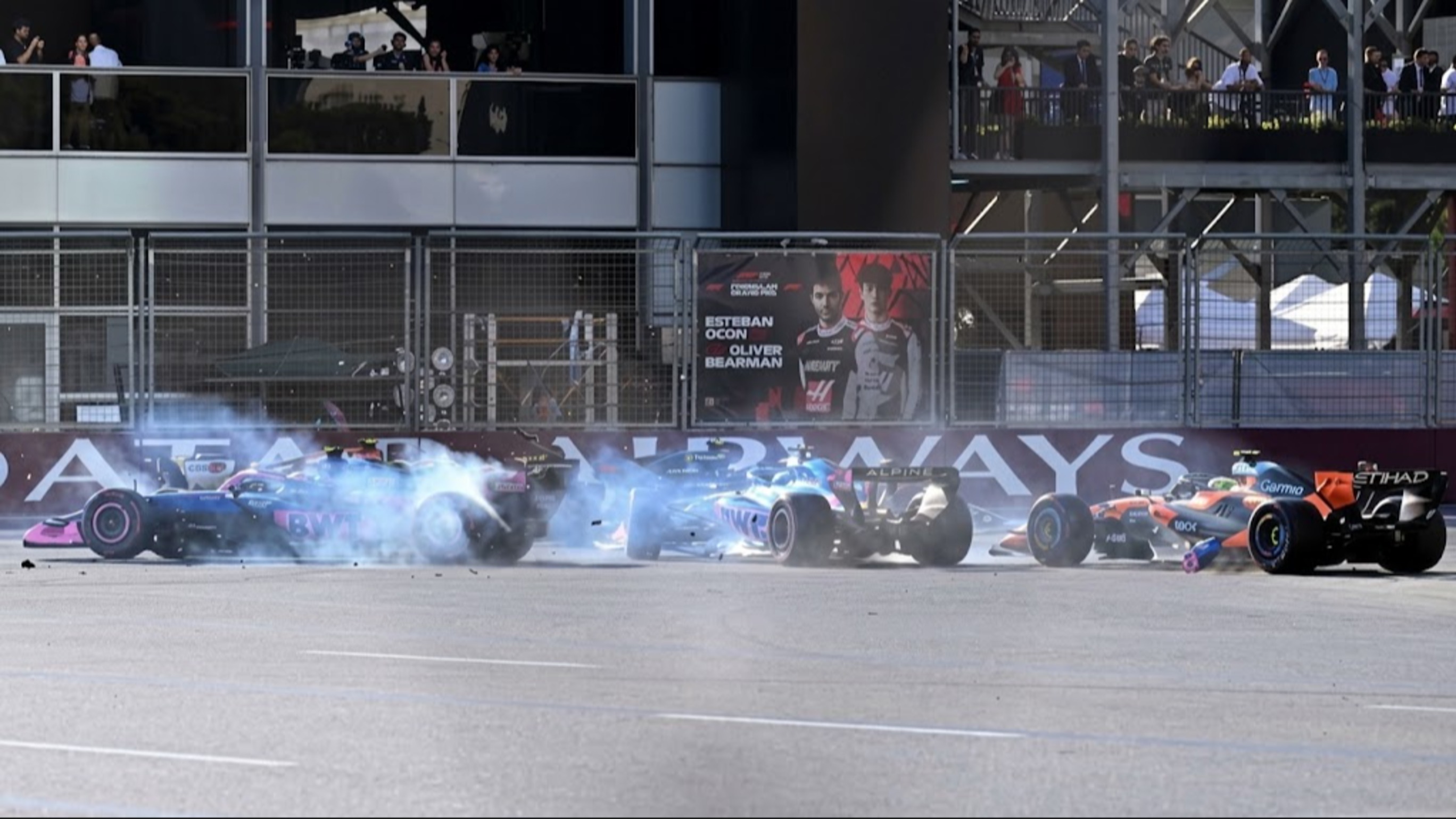
Franco Colapinto's restart error in Baku eliminated both Pierre Gasly and Lando Norris in a single incident. Three drivers, two teams, one restart. That's not a random accident. It's the latest example of a recurring problem F1 keeps running into every time the safety car comes in and the field bunches back up.
Restarts compress a race into its most dangerous moment
For most of a Grand Prix, drivers are running at a settled pace, spaced out, with predictable gaps to the cars around them. A restart erases all of that instantly. The field bunches up, everyone accelerates back to racing speed at once, and the margin for error that existed a lap earlier simply isn't there anymore, often within a matter of seconds.
That compression is exactly why restarts produce a disproportionate share of the season's serious incidents relative to how little total race time they actually represent across a full Grand Prix distance.
Why this specific incident matters beyond the result
Losing Gasly and Norris in the same moment, from what's described as Colapinto's error, isn't just a costly afternoon for the drivers directly involved. It's a data point in a pattern F1 has seen repeatedly: a single mistake at a restart doesn't just affect the driver who made it, it takes out whoever happens to be racing beside them at that exact moment, regardless of how well those other drivers were actually driving.
That's a structural risk built into the restart format itself, not just a story about one driver having a bad moment. Any driver caught next to a mistake at a restart is exposed, regardless of how clean their own race has been up to that point in the afternoon.
Younger drivers carry a disproportionate share of restart incidents
It's worth noting that restart incidents disproportionately involve drivers still building experience at this level, rather than the most seasoned names on the grid. Reading traffic at restart speed, judging braking points with cold tires, and managing the psychological pressure of a compressed field are skills that develop over repeated exposure to exactly these situations. That doesn't excuse any individual error, but it does help explain why restarts keep producing incidents involving a recognizable type of driver rather than a completely random cross-section of the grid.
What F1 actually does with incidents like this
Stewards will review the incident and assign responsibility, likely with some form of penalty for Colapinto if the review confirms driver error. But penalties after the fact don't undo the risk built into the format itself. They address blame, not the underlying mechanism that keeps producing these moments race after race, season after season.
That's the tension F1 hasn't fully resolved: restarts are also some of the most exciting racing moments of any Grand Prix, precisely because of the compressed risk that makes them dangerous in the first place, and removing that risk entirely would likely remove much of the excitement along with it.
Is the danger inherent to restarts an acceptable trade for the excitement they generate, or has F1 reached the point where it needs to actually change how restarts work rather than just penalizing drivers after something goes wrong?

Sarajevo Back at the Heart of Regional MMA: SFC Returns with Explosive Matchups

How Buzzer Karma Works: Levels, Penalties, and What They Mean

Inside Buzzer's Latest Update (and Why It Changes How You Use the App)

Buzzer Introduces Ads Console: A New Era of Advertising Across the Entire Buzzer Ecosystem

Buzzer Is Evolving: From Quantity to Quality

Buzzer Now Has a Games Hub, and Tournaments Are Coming

Al Ittihad SC's Matches Are Now Live on Buzzer

Palm City vs Gulf United Ends in 1–1 Draw in UAE Second Division League Clash

"We Don't Take the Guy With the Camera." He Built His Own Club Anyway. Now He's Coming to Find You.

Building the Infrastructure Sports Tech Forgot


 2


