




 0
0
Cameroon Nearly Didn’t Make It to the World Cup That Made Them Legends
Everyone remembers Roger Milla dancing by the corner flag. Fewer people remember how close Cameroon came to falling apart entirely before that moment ever happened.
Weeks before the 1990 World Cup kicked off, Cameroon’s preparation was, to put it gently, a mess. Training camps in Bordeaux and Yugoslavia produced defeats to obscure club sides that had no business troubling a national team. Players were bickering, partly over unpaid bonuses, partly over the surprise recall of a 38-year-old striker nobody had asked for.
That striker was Roger Milla, who’d retired from international football three years earlier and was playing out his days for a small club on the French island of Réunion. Cameroon’s president personally called him back. Milla said he was always ready to answer his country’s call. Goalkeeper Joseph-Antoine Bell became one of the loudest voices questioning whether bringing him back was even a good idea.
Then they beat the defending champions
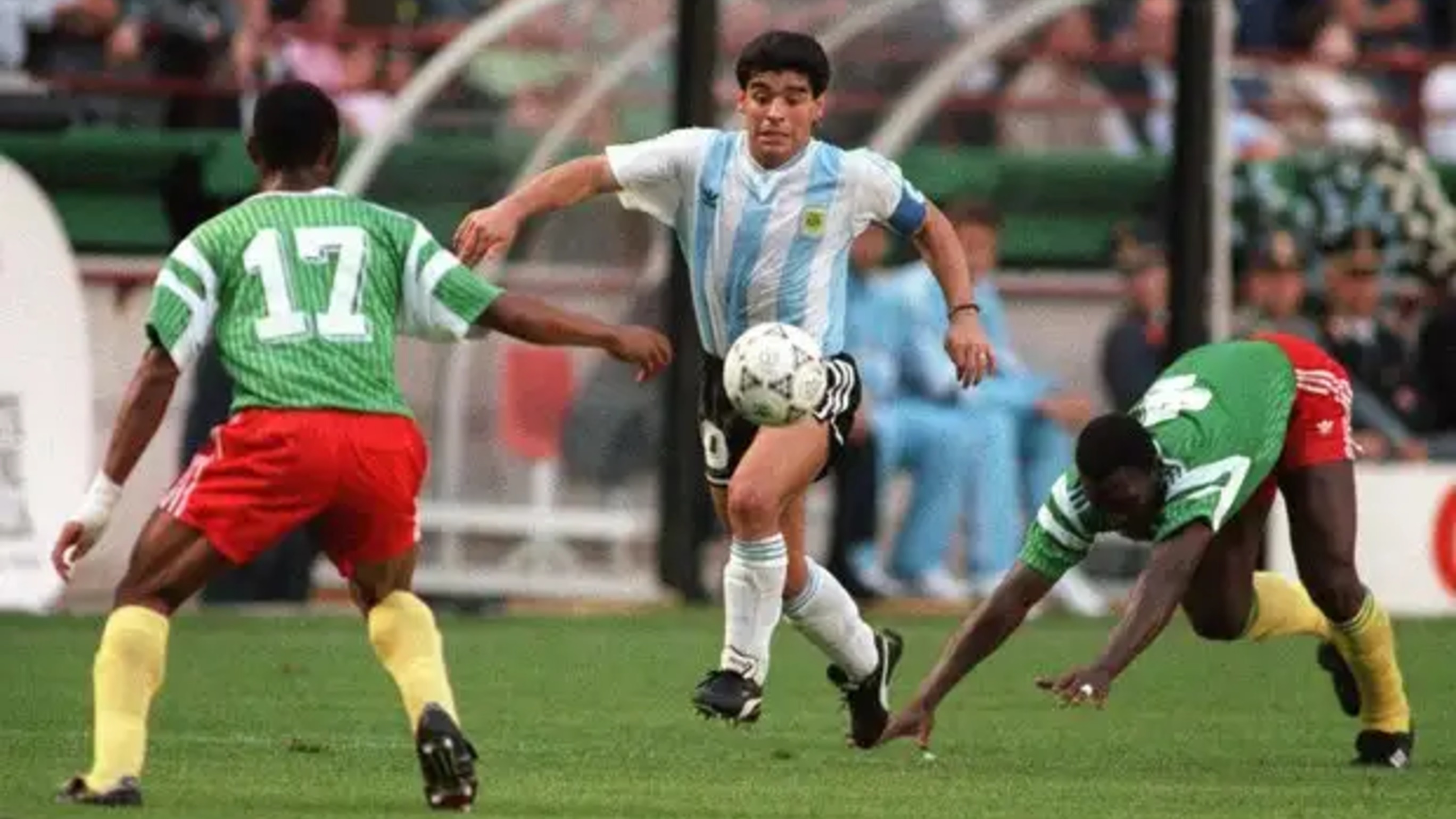
On June 8, 1990, at the San Siro in Milan, Cameroon opened their tournament against Argentina, the reigning World Cup holders, led by Diego Maradona. Nobody outside the Cameroon camp gave them a real chance.
François Omam-Biyik scored the only goal of the match with a header that wasn’t especially powerful or placed with precision.
Argentina’s goalkeeper Nery Pumpido, a World Cup winner himself back in 1986, somehow shovelled it into his own net. Cameroon held on for a 1-0 win, finishing the match with nine men after two red cards, and the football world had its first real earthquake of the tournament.
Milla turns disaster into legend
Milla barely played in that opening match, coming on only for the final nine minutes. He made up for it soon enough. Off the bench against Romania, he scored twice. Against Colombia in the round of sixteen, he scored twice more in extra time, including a moment where he robbed the ball straight off the feet of legendary Colombian goalkeeper René Higuita, who’d wandered dangerously far from his own goal, and finished into an empty net.
Every goal came with the same celebration: a loose, joyful shimmy by the corner flag that got copied by goal-scorers across the football world for years afterward. At 38 years old, Milla became the oldest goalscorer in World Cup history, a record he’d break himself four years later.
Cameroon became the first African nation ever to reach a World Cup quarter-final, eventually falling to England 3-2 after extra time, agonizingly close to a semi-final that would have changed how the entire continent’s football was perceived on the global stage.
Why the chaos matters as much as the football
The tidy version of this story is just “underdog beats champions, elderly hero dances into history.” Good story, sure. Incomplete one.
The fuller version includes a squad that was losing to nobody club sides weeks before the tournament, a captain and manager fighting over unpaid money, and a 38-year-old brought back against the wishes of at least one senior player. That team didn’t just overcome Argentina and Colombia. It overcame itself first.
African football has produced plenty of shock results since 1990. None of them carry quite the same weight, because none of them had to survive that particular level of internal disaster just to make it onto the pitch in the first place.
Given how disorganized that Cameroon camp actually was beforehand, does their run become more impressive or does it just prove talent can paper over almost anything?


