




 1
1The Sport Played Entirely Underwater, With an Actual Puck
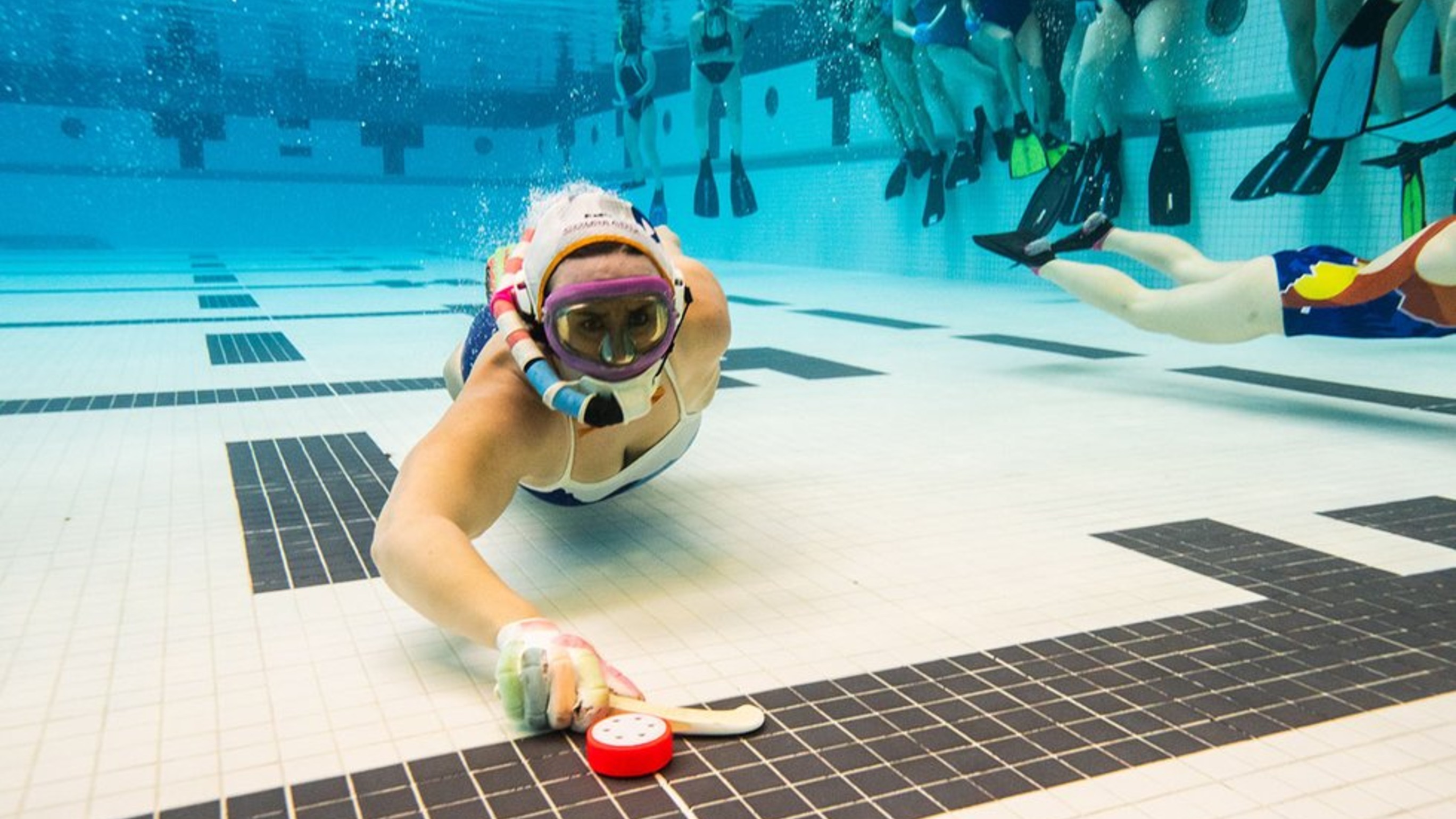
Underwater hockey is played on the bottom of a swimming pool, with players using short sticks to push a weighted puck across the pool floor toward a goal, all while holding their breath.
There is no breathing apparatus allowed. Every player has to surface and dive back down constantly throughout the match. It turns a simple game into a constant battle for breath and positioning.
A sport invented for a very specific problem
The sport was invented in England in 1954 by a diving club looking for a way to keep its members fit and interested in the water during the off-season, when open-water diving wasn't practical.
What started as a fitness exercise for divers gradually developed its own rules, equipment and eventually a full competitive structure with its own world championships.
The breath-holding demand that defines everything
Because there's no breathing equipment, players are constantly cycling between the surface and the pool floor, timing their dives to contribute to play without running out of air mid-possession.
Elite players train their breath-holding capacity extensively, and matches require a level of underwater spatial awareness and coordination that has almost no equivalent in any other team sport played at the surface.
A genuinely global, if under-the-radar, competitive scene
Despite its obscurity to most casual sports fans, underwater hockey has an active international federation, regular world championships, and competitive national teams across dozens of countries, with South Africa, Australia, New Zealand, France and Colombia among the sport's traditional powers.
The sport remains almost entirely unknown outside its own community specifically because it's genuinely difficult to broadcast or spectate, given that virtually all the action happens below the water's surface.
How referees even do their job
Officiating underwater hockey presents its own unique challenge, since referees themselves have to dive down periodically to properly view play at the pool floor, timing their own breath-holding around the flow of the game much like the players do.
Some competitions have experimented with underwater cameras and surface monitors to help spectators and officials alike follow play more easily, though the fundamental broadcasting challenge of a sport played almost entirely out of sight remains largely unsolved.
Enthusiasts within the sport generally accept that trade-off, arguing that underwater hockey was never built to be a spectator product in the first place, and that its appeal has always been about the experience of playing it rather than watching it from the outside.
That philosophy has kept the sport's community small but genuinely committed, with many players describing a level of camaraderie among competing nations that larger, more commercialized sports rarely manage to sustain.
Should sports that are genuinely hard to broadcast, like underwater hockey, still be considered for wider promotion, or will that inherent unwatchability always cap how big they can realistically grow?


