Buzzer Coin$0.00$BUZZER
Search
rimshahealth.writer
rimshahealth.writer
4
Uploads
48
Followers
2
Following
Newbie
Newbie0 minutes0,68 Karma
Arrow Right
rimshahealth.writer
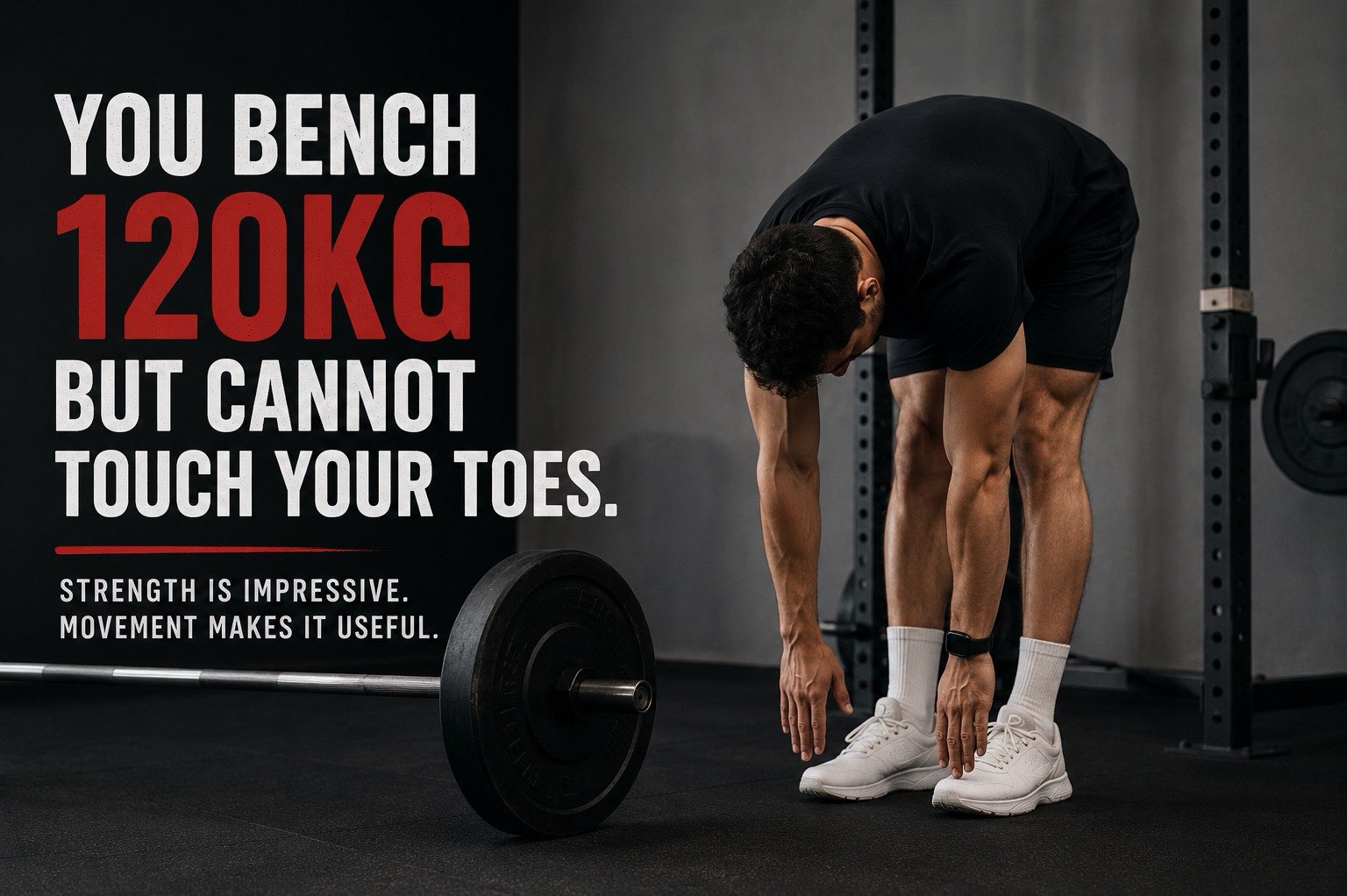
You load the bar, chalk your hands, and press 120 kg like it is nothing. 


Then someone asks you to touch your toes, and suddenly you turn into a robot doing yoga for the first time.


Sound familiar?


Most lifters probably brush it off. Mobility work can feel like something for yoga classes, not for someone who can move serious weight. 


But here’s the funny part: 

**being strong and being mobile are two different things, and you can absolutely be both strong and stiff.**


Here’s why it happens.


Strength training makes you better at producing force in the movements you repeatedly train. But getting stronger doesn’t automatically increase your range of motion. 


If your training rarely takes your joints through certain positions, those movements may continue to feel restricted.


That’s why someone can have an impressive bench press and still struggle to reach their toes.


And for a sportsperson, this isn’t just an embarrassing party trick.

Limited movement can affect how comfortably you perform certain skills. 


Restricted ankle movement can make a deep squat more difficult. Limited hip movement can affect positions that require running, cutting or changing direction. And restricted shoulder movement can make overhead movements, throwing or reaching more challenging.


Your strength is there.


You just need enough movement and control to use it effectively.


Nobody posts their toe touch on social media. Everyone posts their max bench.


But training for mobility doesn’t mean giving up your heavy lifts or spending an hour stretching every day. It can be much simpler than that.

### **Give your body a few extra minutes**

Before you lift, try some controlled leg swings or other dynamic movements to get your hips moving through a comfortable range. You’re not trying to force flexibility; you’re simply preparing your body for movement.


After training, you can spend a few minutes working on movements that feel restricted. 

For example, a slow, comfortable hamstring stretch can help you work on reaching toward your toes without bouncing or forcing the movement.


And don’t forget your ankles. 


A few minutes of controlled knee-to-wall or similar ankle mobility work a couple of times a week can help you gradually become more comfortable moving your knee forward over your foot.


That’s it.


No fancy equipment. No separate mobility day. No abandoning your lifting routine.

Just a few extra minutes added to the training you’re already doing.


And don’t expect a completely different body after one session. Mobility is something you build gradually. 


With consistent practice, you may notice that movements such as squatting, reaching or getting down to the floor feel more comfortable and controlled.


None of this means your strength was the problem.


In fact, strength and mobility can work together.


Keep chasing the big numbers. Nobody is telling you to stop.


Just make sure your body can move well enough to use that strength when your sport actually demands it.


Because a huge bench with limited movement is a little like having a sports car with a very powerful engine but questionable steering.


**All that power is great. Being able to control where it goes is even better.**
ATHLETICS (TRACK & FIELD)

You Bench 120kg But Cannot Touch Your Toes

Like icon
3
Comments icon
Shares icon
rimshahealth.writer
Football tackles you.

Rugby throws you into a ruck.

Hockey sends you into the boards.


Basketball?

Basketball just gives you a little push.


Then another.

Then a grab.


Then a bump while you’re trying to get around a screen.

And somehow everyone goes:

**“Play on.”**


As a physiotherapist, I watch that and think:

**Wait… we’re just pretending none of that happened?**


Because basketball may not look like a contact sport, but watch a game closely and you’ll see contact everywhere.


The fight for a rebound.

The battle through a screen.

The hand-check.

The jersey grab.

The bump on a drive.


Basically, you’re trying to make a perfect play while another human being is doing their absolute best to make your life inconvenient.

And that’s where basketball gets interesting.

## **The contact is sneaky**

Football has tackles.

Rugby has tackles, rucks, and people voluntarily running into each other at impressive speeds.

Hockey has players crashing into boards.

Basketball?

The contact is much sneakier.

It’s hidden inside the game.

Boxing out.

Fighting through screens.

Defending.

Cutting.

Jumping.

Landing.

And because it’s normal, nobody really stops to think:

**“Hey, that’s contact.”**

We just call it:

**“Playing hard.”**

## **But the little push adds up**

When we picture a basketball injury, we usually imagine the dramatic stuff.

A hard foul.

A collision under the basket.

Someone getting wiped out on a fast break.

Those moments get the whistle, the replay, and probably 17 people yelling at the referee.

But not all contact looks dramatic.

Sometimes it’s the little push while boxing out.

The grab on a cutter.

The hand-check.

The tug while fighting through a screen.

One little push?

Probably nothing.

Keep doing it possession after possession, though, and your body might eventually file a complaint.

And the numbers are pretty interesting.


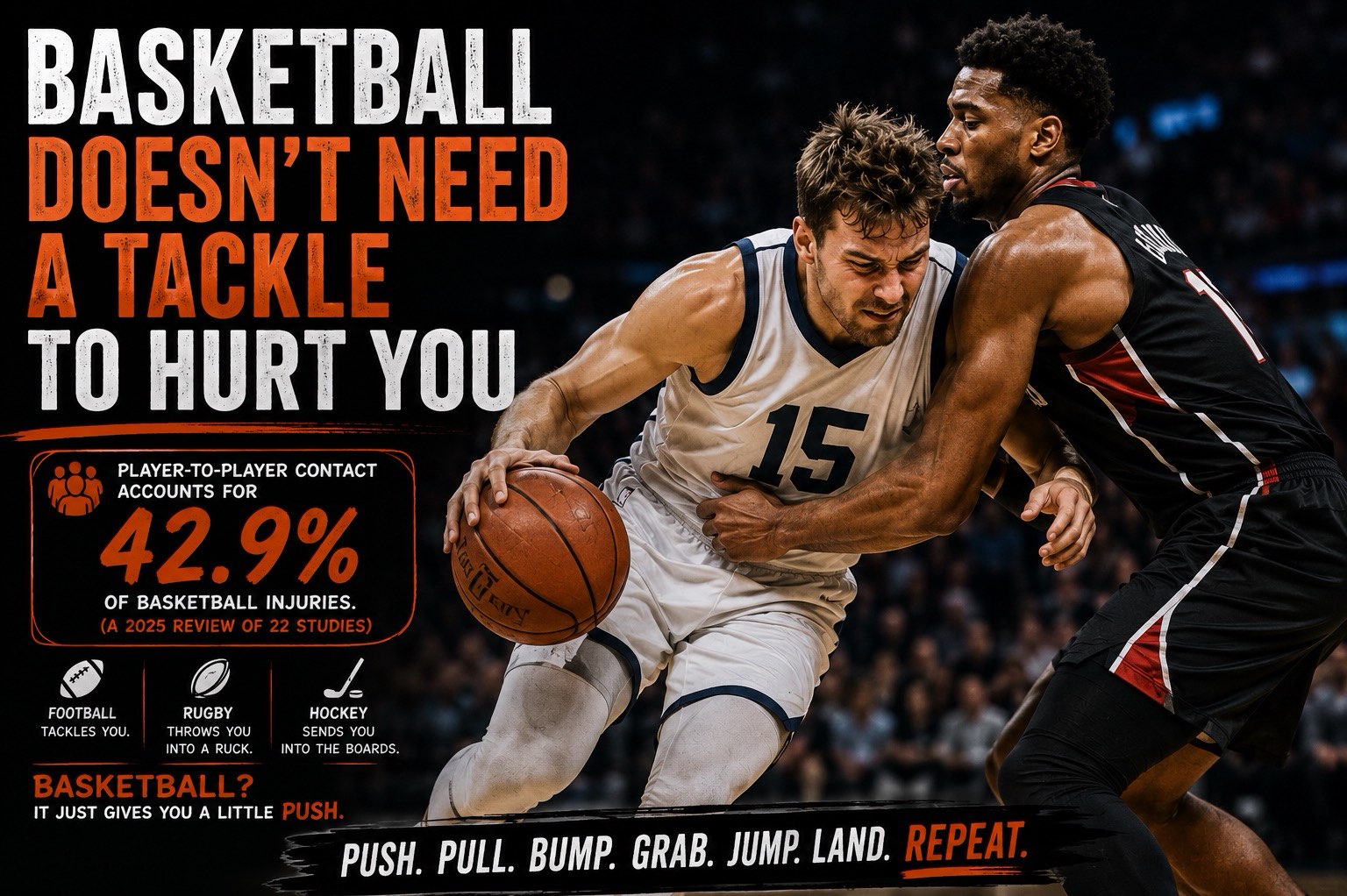
A 2025 systematic review and meta-analysis of 22 studies found that **player-to-player contact accounted for 42.9% of basketball injuries**, making it the biggest reported injury mechanism.

Non-contact mechanisms accounted for about 25%.

So no, basketball isn’t rugby.

But calling it “non-contact” is starting to feel a little generous.

## **And here’s the funny thing about a whistle**

The referee decides whether something is a foul.

Your body doesn’t.

Your ankle isn’t sitting there thinking:

*“No whistle? Excellent. Carry on.”*

Your knee doesn’t care that the contact was “part of the play.”

And your head definitely doesn’t care whether someone meant to make contact.

Force is force.

And sometimes the contact doesn’t even get called.

Head contact has been observed during ordinary basketball situations like defending an attacker and fighting for rebounds, with much of that contact going unpenalized.

So:

**No whistle ≠ no physical stress.**

## **Push. Pull. Jump. Land. Repeat.**

Basketball already asks a LOT from your body.

Sprint.

Stop.

Change direction.

Jump.

Land.

Rotate.

Do it all again.

Now add another athlete pushing, pulling, grabbing, or bumping you while you’re trying to beat them to the ball.


Congratulations.


Your musculoskeletal system has officially entered the group project.

And that’s what makes basketball different from the obvious contact sports.

The contact isn’t always one massive collision.

It’s thousands of tiny battles for space.

You fight for the rebound.

You fight through the screen.

You fight for position.

You fight for the lane.

Basically, everyone is fighting everyone else for approximately 2 square feet of floor.

## **So should basketball become a no-contact sport?**

Absolutely not.

Please don’t make players ask:

*“Excuse me, may I box you out?”*

*“Sure, but gently.”*

That’s not basketball.

The physicality is part of what makes the game what it is.

The point isn’t to remove contact.

It’s to understand it.

Players need to be able to control their bodies when they’re bumped, pulled, pushed, and knocked off balance.

Coaches need to pay attention to how those battles happen.

And officials have a role too, because consistent enforcement of unnecessary pushing and holding isn’t about making basketball “soft.”

It’s about recognizing what’s actually happening on the court.

Because basketball might not have the tackles of rugby or the collisions of football.

But it has something else:


**Push. Pull. Bump. Grab. Jump. Land. Repeat.**


And sometimes, the contact that looks too ordinary to notice is exactly the contact worth noticing.

As a physiotherapist, that’s the part I’d want players, coaches, and parents to remember:


**Your body doesn’t need the contact to look dramatic for it to matter.**


Sometimes it’s not the big hit.

Sometimes it’s the little push you barely noticed…


**repeated possession after possession.**
BASKETBALL

Basketball Doesn’t Need a Tackle to Hurt You

Like icon
2
Comments icon
Shares icon
rimshahealth.writer
Look closely at almost any professional sporting event and you’ll spot it.


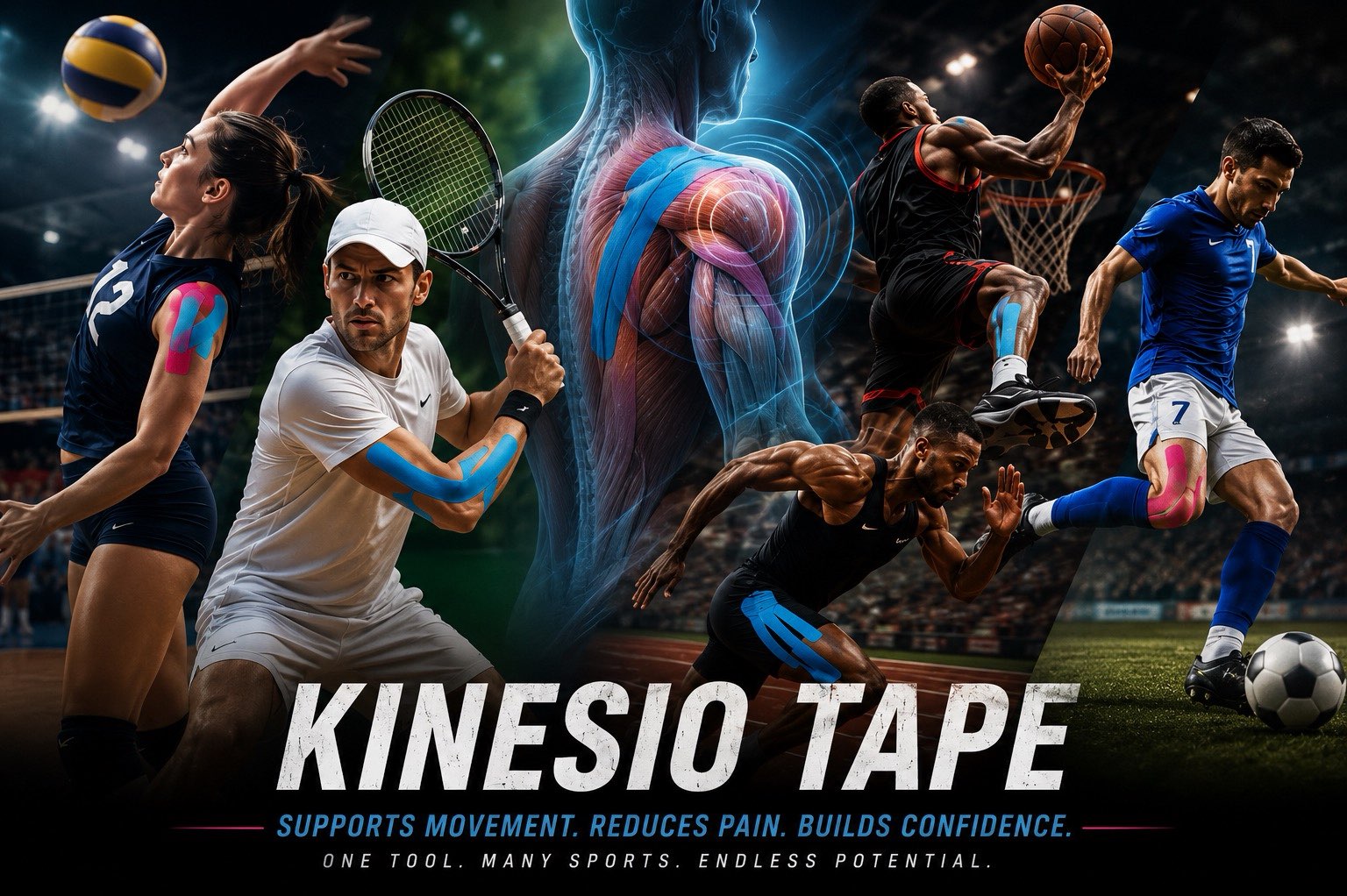
A strip across a volleyball player’s shoulder. 

Tape around a tennis player’s elbow. 

Bright lines running along a sprinter’s thigh. 

An ankle wrapped after a hard landing on the basketball court.


Kinesio tape has quietly become part of the modern athlete’s toolkit.

And athletes aren’t using it for just one reason.


**Pain. Swelling. Movement. Recovery. Confidence.**

As a physiotherapist who has used kinesio tape in clinical practice, I’ve always found that interesting. Because when you see an athlete competing with half their shoulder covered in tape, the natural question is:


**What is that tape actually doing?**

And the answer is more useful than simply calling it a miracle or a gimmick.


**It’s Not Just About Injury**

One of the biggest misconceptions about kinesio tape is that it’s simply there to “hold” an injured body part together.


That’s not really the point.


Unlike rigid athletic tape, kinesio tape is elastic and designed to move with the body. Developed in the 1970s by Japanese chiropractor Kenzo Kase, it was designed around the idea of influencing the body’s sensory system through the skin.


That matters in sport.


Think about a volleyball player repeatedly reaching overhead for a block or spike. Or a tennis player hitting hundreds of serves across a tournament. Or a basketball player repeatedly cutting, jumping, and landing on an ankle that’s still recovering.

The tape isn’t replacing the athlete’s strength or conditioning.


But it may provide **another layer of sensory feedback**, a reminder of where that body part is and how it is moving.

Sometimes that’s all an athlete needs from it.


**Pain, Swelling and the Things Athletes Actually Deal With**

Sport isn’t always about dramatic injuries.

Sometimes it’s the shoulder that starts aching during the third set.

The elbow that gets irritated halfway through a tournament.

The ankle that becomes swollen after an awkward landing.

The muscle that feels different after repeated sprinting.

This is where kinesio tape can have a practical role.


Some research supports short-term pain relief and improvements in certain functional outcomes for specific musculoskeletal conditions. That doesn’t mean the tape is repairing the underlying tissue, but reducing symptoms can sometimes make movement more comfortable while the athlete continues their rehabilitation.


For a tennis player dealing with lateral elbow pain, for example, tape may be used as part of a broader strategy to manage symptoms during training or competition.


For an overhead athlete, it may provide sensory input around a painful shoulder while strengthening and movement retraining continue in the background.


**Less pain doesn’t mean the injury is fixed.**

But less pain can sometimes make it easier to move well. And movement matters.


**What About Swelling?**

This is another reason you’ll see kinesio tape used around injured ankles, knees, and other areas.

Certain taping techniques are designed with the intention of influencing superficial fluid or lymphatic movement.

Imagine a basketball player landing awkwardly after a rebound and developing ankle swelling. Or a footballer taking a knock to the lower leg during a match.

The tape may be incorporated into the wider recovery strategy alongside appropriate loading, compression when indicated, elevation, and rehabilitation.

But this is where we need to keep expectations realistic.

Kinesio tape hasn’t consistently demonstrated a major advantage for reducing acute swelling, particularly after ankle sprains.

So I wouldn’t describe it as a guaranteed “drainage” tool.


**It may have a role. It just isn’t the whole recovery plan.**

And that’s an important distinction.


**Can It Actually Improve Performance?**

Now we get to the question every sports fan eventually asks.

Can the tape make an athlete better?

If you’re expecting it to suddenly give a sprinter more speed or a volleyball player more power, probably not.

There isn’t strong evidence that kinesio tape consistently improves strength, speed, or power in healthy athletes.

And honestly, that makes sense.

Tape doesn’t build muscle.

It doesn’t improve cardiovascular fitness.

It doesn’t replace thousands of repetitions in training.


**The tape isn’t doing the sprinting.**

But performance isn’t only about raw strength and power.

It’s also about how confidently an athlete moves.

A basketball player returning after an ankle injury may feel more secure with tape around the joint.

A volleyball player may feel more comfortable reaching overhead.

A tennis player may feel less protective of an irritated elbow.

The tape may not be dramatically changing their physical capacity.

But if it changes how they **perceive and approach movement**, that can still matter.


**The Confidence Factor**

This is probably one of the most overlooked parts of sports rehabilitation.

Athletes aren’t machines.

They remember injuries.

They remember the landing that hurt.

They remember the match where their shoulder started giving them trouble.

And when they return, that memory can influence how they move.

If kinesio tape makes an athlete feel more secure, it may reduce hesitation or protective movement.

That’s not the same as saying the tape is mechanically stabilizing the joint.


It’s about **confidence and sensory feedback**.

And at a high level of sport, where small differences in movement and decision-making can matter, confidence isn’t insignificant.


**Why Do Athletes Keep Coming Back to It?**

There’s another explanation that has nothing to do with physiology.

**Routine.**

Warm-up.

Music.

Shoes.

Strapping.

Taping.

Every athlete has rituals before competition.

For some, kinesio tape becomes part of that routine. It signals that they’re ready to train or compete.


And if something helps an athlete feel prepared without interfering with movement, there’s a reason they may continue using it.

Then there’s the obvious factor:

**You can’t miss it.**


Kinesio tape is highly visible in professional sport. Brands sponsor athletes and teams, and those bright strips have become part of the visual language of modern athletics.

So what we see on television can be a combination of clinical practice, athlete preference, psychology, routine and marketing.

Sometimes all of them at once.


**My Take as a Physiotherapist**

If an athlete asked me, **“Should I use kinesio tape?”**, I wouldn’t immediately say yes.

And I wouldn’t immediately say no.

I’d ask a different question:

**“What are you hoping it will do?”**


If the answer is to prevent every injury, dramatically improve performance, or heal damaged tissue faster, I’d set more realistic expectations.


But if the goal is short-term symptom management, better body awareness, sensory feedback, or using it as one part of a recovery strategy, I think there can be a reasonable place for it.

The key is knowing where it belongs.


**Alongside rehabilitation - not instead of it.**

The athlete still needs progressive strengthening.

They still need appropriate loading.

They still need conditioning, mobility, neuromuscular control, recovery, and sport-specific preparation.

The tape is the accessory.


**The rehabilitation is the work. The Bottom Line**

So, does kinesio tape have a place in modern sport?


**Yes but probably not for the reasons we once thought.**

It isn’t a magic performance enhancer, and it isn’t going to make an athlete stronger, faster, or injury-proof overnight.


Where it can be useful is much more practical: helping some athletes manage pain, providing sensory feedback, improving body awareness, and potentially supporting swelling management as part of a wider recovery strategy.


For a volleyball player managing shoulder symptoms, a tennis player dealing with elbow pain, or a basketball player returning from an ankle injury, that small difference can sometimes make movement feel more comfortable and controlled.

But the tape is only one piece of the picture.


**It can support rehabilitation. It cannot replace it.**

Because ultimately, the things that keep athletes performing aren’t hanging from a strip of tape.

They’re built through **training, recovery, progressive rehabilitation, and the work an athlete puts in when nobody is watching.**

And maybe that’s the most realistic way to look at kinesio tape:


**Not a miracle. Not a gimmick. Just another tool and sometimes, the right tool at the right time.**
ATHLETICS (TRACK & FIELD)

Taped Up: The Role of Kinesio Tape in Modern Sport

Like icon
1
Comments icon
Shares icon
rimshahealth.writer
A split-second change of direction.

A hard landing after a jump.

One foot plants, the body turns, and suddenly the knee gives way.

For an athlete, an ACL tear can change an entire season. Training stops. Competition disappears. Rehabilitation begins.

Female athletes face a higher rate of ACL injuries than male athletes in several sports, particularly those involving jumping, cutting, pivoting, and rapid changes of direction.

But why?

Sports scientists have spent years studying the question. Strength, biomechanics, landing technique, anatomy, neuromuscular control, previous injuries, and training demands can all influence ACL injury risk.


And now, researchers are asking another question:

**Could the menstrual cycle play a role too?**

## **What Does the Menstrual Cycle Have to Do With the Knee?**

The menstrual cycle isn’t simply a few days of bleeding.

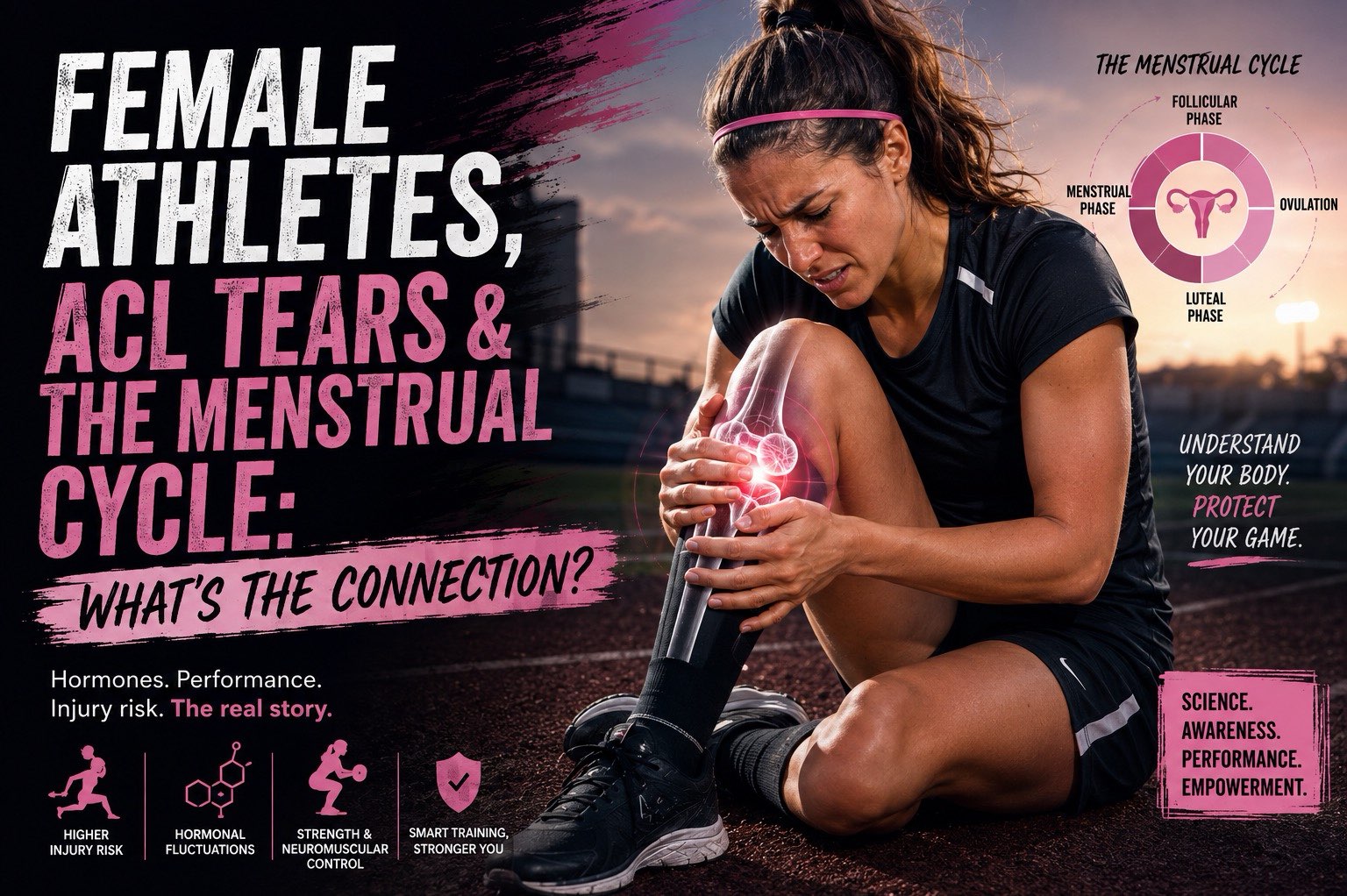
Hormones such as estrogen and progesterone fluctuate throughout the cycle. Researchers have investigated whether these hormonal changes can influence factors that matter to athletic movement, including joint laxity, neuromuscular control, and how the body responds to physical stress.


Some studies have reported changes in knee or ACL laxity during different phases of the cycle.

That sounds important.

But there’s a catch.

**Changes in laxity don’t automatically mean an athlete is going to tear her ACL.**


Research examining menstrual-cycle phase and ACL injury risk has produced inconsistent findings. Current evidence isn’t strong enough to identify one specific phase as a universal “high-risk” period for ACL injuries.


So, if you’re an athlete looking at your period-tracking app before practice, don’t assume it can tell you whether your ACL is in danger.

It can’t.

## **The ACL Doesn’t Know You’re Having a Bad Training Day**

Think about what happens during competition.

You’re sprinting toward the ball.

An opponent changes direction.

You plant your foot and cut.

Or you jump for a rebound and land while another player is closing in.

These movements happen quickly, often in fractions of a second.


Your ACL is part of a larger system that helps keep the knee stable during these demanding movements. The way your muscles fire, how you control your landing, your balance, coordination, fatigue, and the forces placed on the knee all matter.


That’s why ACL injury prevention can’t be reduced to one hormone or one phase of the menstrual cycle.

**Your cycle may be one piece of the puzzle. It isn’t the whole puzzle.**

## **Why Female Athletes May Face Greater ACL Risk**

The difference in ACL injury rates between male and female athletes is complex.

Researchers have identified several potential contributors.

Biomechanics can influence how an athlete lands, decelerates, and changes direction. Strength and neuromuscular control affect how the body manages those forces. Anatomical differences can also influence knee mechanics.


Then there’s the reality of sport itself.

Athletes don’t perform movements in controlled laboratory conditions.

They compete while accelerating, stopping, jumping, reacting to opponents, changing direction, and sometimes playing through fatigue.

That combination of factors is why ACL injury prevention needs to look at the **whole athlete**, rather than searching for one explanation.

## **Should Athletes Change Training Around Their Cycle?**

This is where things can easily become overcomplicated.

At the moment, there isn’t enough evidence to say that female athletes should avoid certain movements, reduce training, or completely change their programs because they’re entering a particular phase of their menstrual cycle.


Instead, athletes can use cycle tracking as another way of understanding their individual responses to training.

Maybe your energy feels different during certain days.

Maybe you notice more fatigue.

Maybe a hard training session feels harder than usual.

Maybe your recovery doesn’t feel quite the same.

Those patterns can be useful information.

But they shouldn’t become restrictions.

**Awareness is useful. Fear isn’t.**

## **What Actually Helps Protect the ACL?**

Whether you’re in the first week of your cycle or the last, the fundamentals of athletic preparation still matter.

### **Build strength**

Strength training helps athletes develop the capacity to handle the forces involved in sprinting, jumping, landing, and changing direction.

### **Train how you move**

ACL prevention isn’t just about being strong in the weight room. Athletes also need to practice controlling movements such as landing, decelerating, and cutting.

### **Improve neuromuscular control**

Sport is unpredictable. Your body has to react quickly when an opponent changes direction or a landing isn’t perfect. Training balance, coordination, and movement control can help athletes prepare for those demands.

### **Manage fatigue and training load**

A tired athlete may not move the same way as a fresh athlete. Training load and recovery therefore matter, not just for performance, but also for maintaining movement quality.

### **Don’t ignore previous injuries**

A previous knee injury can affect movement patterns and future injury risk. 

Returning to sport should involve appropriate rehabilitation and progression rather than simply waiting until the pain disappears.

These principles aren’t specific to one phase of the menstrual cycle.

They’re part of being a well-prepared athlete.

## **Listen to Your Body Without Limiting Yourself**

There is a difference between paying attention to your body and becoming afraid of it.

If you notice that your energy, recovery, or training response changes at certain points in your cycle, track it.

Look for patterns.

Talk to your coach, athletic trainer, physiotherapist, or other qualified professional if something consistently affects your training.

But don’t let a calendar convince you that you’re fragile.

Your menstrual cycle doesn’t determine whether you will tear your ACL.

And having a period doesn’t mean you need to sit out of practice.

## **The Bigger Picture**

The conversation around female athletes and the menstrual cycle is important but it needs to be approached carefully.


Researchers are still investigating how hormonal fluctuations may influence factors such as knee laxity, neuromuscular control, and movement.

What we don’t have yet is enough evidence to say:


**“This is the week female athletes are most likely to tear their ACL.”**


Sports are far too complex for that kind of prediction.

A better approach is to look at the athlete as a whole.

Build strength.

Practice quality movement.

Train for the demands of your sport.

Manage your workload.

Recover properly.

Pay attention to your body.


And if your knee hurts, swells, gives way, or feels unstable, don’t blame it on your cycle and push through. Get it assessed.


The goal isn’t to make female athletes afraid of their hormones.

It’s to give them better information about their bodies so they can train smarter.

Because protecting your ACL isn’t about finding one dangerous week.


**It’s about building an athlete who’s ready for the whole season.**
SPORTS SCIENCE

Female Athletes, ACL Tears & the Menstrual Cycle: What’s the Connection?

Like icon
2
Comments icon
Shares icon