
 $0.00$BUZZER


I've run 1000+ km, raced 12+ times in the past year, and cracked sub-2 hours in the half marathon,all self-coached. Now I'm writing about what actually works for runners.
 StravaLinkedInIG
4
Uploads
48
Followers
2
Following

Newbie•0 minutes•1,38 Karma



In 2028, that changes permanently. [**Cricket returns to the Olympic Games**](https://la28.org/en/games-plan/olympics/cricket.html) in Los Angeles for the first time in 128 years, and the USA men's team has already confirmed their spot as hosts.
Twenty-eight T20 matches, the best players in the world, and a gold medal decided on American soil. The sport that 2.5 billion people watch globally is about to land in the one major market that never fully let it in.
The obvious question is why it took this long. The less obvious question is why Americans are going to love it once they actually watch it.
### **It's Baseball. Kind Of.**
Here's what nobody tells you: cricket and baseball share the same DNA. Bat, ball, fielders trying to get you out, a batter trying to score before that happens.
Baseball fans who watch cricket for the first time almost never feel lost. They feel cheated that nobody showed them this sooner. The Olympics fixes that.
## What New York Already Figured Out
When the [**USA co-hosted the 2024 Cricket World Cup**](https://www.reuters.com/sports/us-co-host-2024-t20-world-cup-icc-maps-out-white-ball-schedule-2021-11-16/), something shifted. The stadiums filled. The crowds were loud, mixed, and genuinely electric in a way that American sports venues rarely are for anything other than the Super Bowl or a World Cup soccer match.
People who had never watched a cricket match sat in those stands and got it immediately. The energy did the explaining that no broadcast package ever could.
T20 cricket, which is the format heading to the Olympics, is specifically built for exactly this moment.
Matches run three to four hours. There's a result every single time. The action is fast, the hitting is aggressive, and the fielding is athletic enough that even a casual sports fan can appreciate it on instinct.
This isn't five-day Test cricket asking for patience and context. It's designed for the kind of crowd that shows up to an Olympic venue having never watched the sport before and leaves wanting more.
## What to Expect
In 2008, the Indian Premier League launched with eight franchises, a player auction system cricket had never seen before, and Brendon McCullum hitting 158 off 73 balls in the very first match.
It proved that T20 cricket, played by the best players in the world regardless of nationality, compressed into three hours, could compete with any sporting product on the planet.
Every major league that followed, [Australia's Big Bash](https://www.bigbash.com.au/), South Africa's SA20, the UAE's ILT20, [the Caribbean Premier League](https://www.cplt20.com/), and [Major League Cricket](https://www.majorleaguecricket.com/) right here in the USA, was built on that same blueprint.
### **But Nothing Is Decided Yet**

Six nations compete in each of the men's and women's T20 competitions at LA28.
On the women's side, Australia, Great Britain, India and South Africa are already confirmed through the ICC Women's T20 World Cup 2026.
The men's field is still being settled through ICC T20I rankings, with the cut-off at December 31, 2026.
Pakistan, currently ranked sixth, could still end up in a qualifier if they can't overtake the continental representative above them. The sixth and final spot in both competitions goes through a brand new ICC Olympics Qualifier in 2027.
Nothing is guaranteed. That's the point.](https://d32kj04sxj85qr.cloudfront.net/private/users/84e864c8-7051-70fb-6feb-43fe73f1b770/clips/bf86e636-f92f-4db8-b988-14d58a48169e.jpeg)


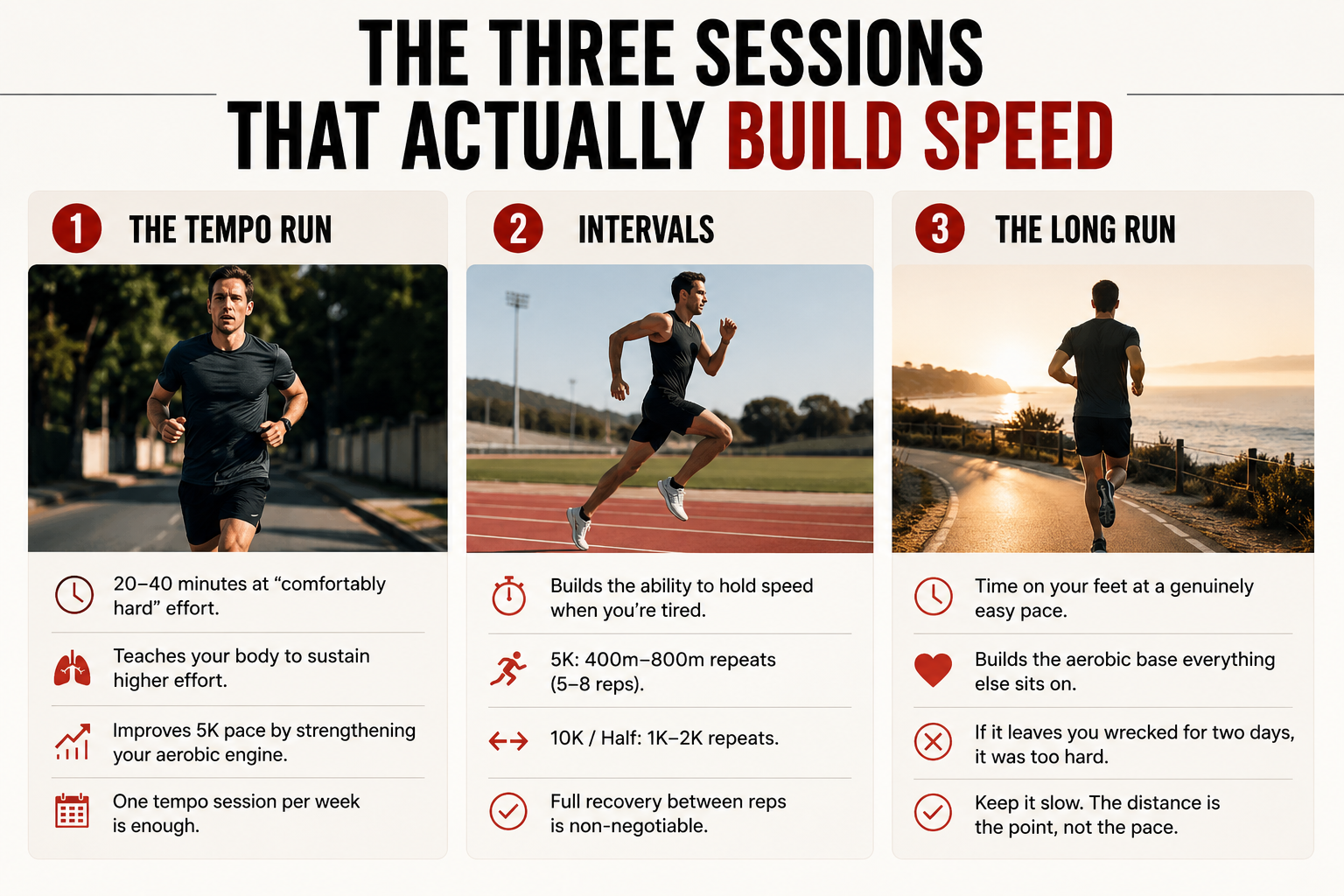
### 1. The Tempo Run
This is the session that does most of the work. You hold a pace that feels uncomfortably controlled for 20 to 40 minutes, depending on where you are in training. Not a sprint. Not a jog. The pace where you could say a few words but definitely not a sentence.
Tempo running teaches your body to sustain higher effort without falling apart.
Your 5K pace improves because your aerobic engine gets stronger at race-relevant speeds. Half marathon training uses them too but blends in more work at actual race pace to build the endurance bridge.
**One tempo session per week is enough.**
### 2. Intervals
Intervals teach your legs to hold speed when they're already tired, which is exactly what the back half of any race demands.
For a 5K, that's 400m to 800m repeats, five to eight times, with full recovery between each one. For a 10K or half marathon, the repeats get longer: 1K to 2K each.
**The recovery between intervals isn't optional.**
You go hard, you recover fully, you go hard again. If you're cutting recovery short because it feels lazy, you're turning intervals into a tempo run, and you're doing neither well.
### 3. The Long Run
The long run is just time on your feet at genuinely easy pace. It builds the aerobic base everything else sits on.
The mistake most runners make here is the same one they make everywhere: they run it too fast.
If your long run leaves you wrecked for two days, it was too hard. It should feel comfortable enough that you could have gone a little further.
**Keep it slow, because the distance is the point, not the pace.**
## What I'd Tell Someone Starting From Zero
Build your base before you add hard sessions. Eight to twelve weeks of just easy running and one longer run per week is not wasted time. It's the foundation that keeps you from getting injured the moment training gets serious.
After that, add one tempo run. Run it for four weeks before you add intervals. Don't stack new stressors on top of each other before your body has adapted to the first one. The runners who improve fastest aren't doing anything exotic.
***Pro runners don't skip the long run, keep the easy days easy, take diet and sleep seriously, and show up to the hard days and actually run them hard. That's genuinely it.***
## FAQs
### **Does running more make you faster?**
No, running more builds endurance, but speed comes from running hard sometimes, not just running often. If all your runs feel the same, your body adapts to that effort level and stops improving. More miles only helps when those miles have a purpose: easy days easy, hard days actually hard.
### **Does strength training help you run faster?**
Yes, strength training does help you run faster, but most runners skip it entirely. Stronger legs generate more power with each stride, which means you cover more ground without working harder. You don't need to lift heavy. Squats, lunges, and single-leg work two days a week is enough to notice a real difference in how your legs feel late in a run.
### **How long does it take to get faster at running?**
Most runners start noticing improvement in four to six weeks of consistent, structured training. That means easy runs actually easy, one hard session per week, and one long run. The first thing that changes is how effort feels, not your pace on paper. Your watch catches up a few weeks after your body does.](https://d32kj04sxj85qr.cloudfront.net/private/users/84e864c8-7051-70fb-6feb-43fe73f1b770/clips/cc9feeaf-c10c-498f-a215-2da0b51c8c7b.jpeg)

.
In 146 years of international cricket, no batter had ever been dismissed this way. On a November afternoon in Delhi, in a World Cup match already crackling with tension, it finally happened.
## 2. Handled the Ball: Graham Gooch, 1993
Gooch was 133 not out at Old Trafford, carrying England almost single-handedly in a match they were losing, when a delivery from Merv Hughes reared up off the pitch and lobbed dangerously toward his stumps. Instinct took over. He flicked it away with his hand, and as soon as he did, he knew. The next morning's papers were unanimous: Gooch hands the [**¬Ashes to Australia¬**](https://www.espncricinfo.com/series/australia-tour-of-england-and-ireland-1993-61338/england-vs-australia-1st-test-63609/full-scorecard).
## 3. Handled the Ball: Steve Waugh, 2001
Same law, same score, different era. At [**¬Chennai in 2001¬**](https://www.espncricinfo.com/series/australia-tour-of-india-2000-01-61425/india-vs-australia-3rd-test-63921/full-scorecard), with Australia sitting comfortably at 340 for 3, Waugh missed a sweep off Harbhajan Singh and watched the ball loop up and spin back toward his stumps. He swatted it away with his hand before it could hit them. The appeal went up, the finger went up, and one of the most unbreakable batters of his generation walked off for exactly the same instinct that had cost Gooch eight years earlier.
## 4. Obstructing the Field: Ben Stokes, 2015
England were chasing 309 at Lord's in an ODI against Australia when Stokes pushed a defensive shot back at Mitchell Starc, who fired the ball straight at the stumps. Stokes turned away and dived back for his crease, but his outstretched hand stopped the throw. The Australians appealed immediately, the third umpire reviewed it in slow motion, and amid a chorus of boos from the Lord's crowd,[ **¬Stokes was given out for 10¬**](https://www.espncricinfo.com/series/australia-tour-of-england-and-ireland-2015-743911/england-vs-australia-2nd-odi-743979/match-report). It was only the sixth such dismissal in the entire history of one-day internationals.
## 5. Hit the Ball Twice: Romania vs Malta
This dismissal has never happened in a Test match. It has never happened in an ODI. The only recorded instance in international cricket exists in[ **¬a T20I between Romania and Malta¬**](https://www.espncricinfo.com/story/unusual-dismissals-in-test-and-one-day-international-cricket-105321), a match most of the world never watched, featuring a dismissal almost no one will ever see again. The law dates back centuries. The dismissal barely exists.
## 6. Retired Out: Atapattu and Jayawardene, 2001
Marvan Atapattu was 201 not out and Mahela Jayawardene was also in the middle when both men, fully fit and with runs on the board, chose to walk off the field voluntarily.[ ¬They retired out¬](https://www.espncricinfo.com/story/unusual-dismissals-in-test-and-one-day-international-cricket-105321), becoming the only two Test players in history to be dismissed this way, and they managed to do it in the same match.
## 7. Hit Wicket: Roy Fredericks, 1975 World Cup Final
The first ball of the very first World Cup final. Dennis Lillee steamed in, the whole of Lord's watching, and West Indian opener Roy Fredericks hooked it clean out of the ground for six. The crowd erupted. And then the bails fell.
Fredericks had lost his footing mid-shot and his leg had clipped the stumps on the way through.[ ](https://www.espncricinfo.com/series/prudential-world-cup-1975-60793/australia-vs-west-indies-final-65049/full-scorecard)Six and dismissed, simultaneously, [**¬in a World Cup final¬**](https://www.espncricinfo.com/series/prudential-world-cup-1975-60793/australia-vs-west-indies-final-65049/full-scorecard). He walked off for 7, the ball still in the stands.
Cricket is a strange, beautiful, completely unreasonable sport.](https://d32kj04sxj85qr.cloudfront.net/private/users/84e864c8-7051-70fb-6feb-43fe73f1b770/clips/a471c343-cf0a-4cd9-8c15-6e9bbc7fc8bc.jpeg)
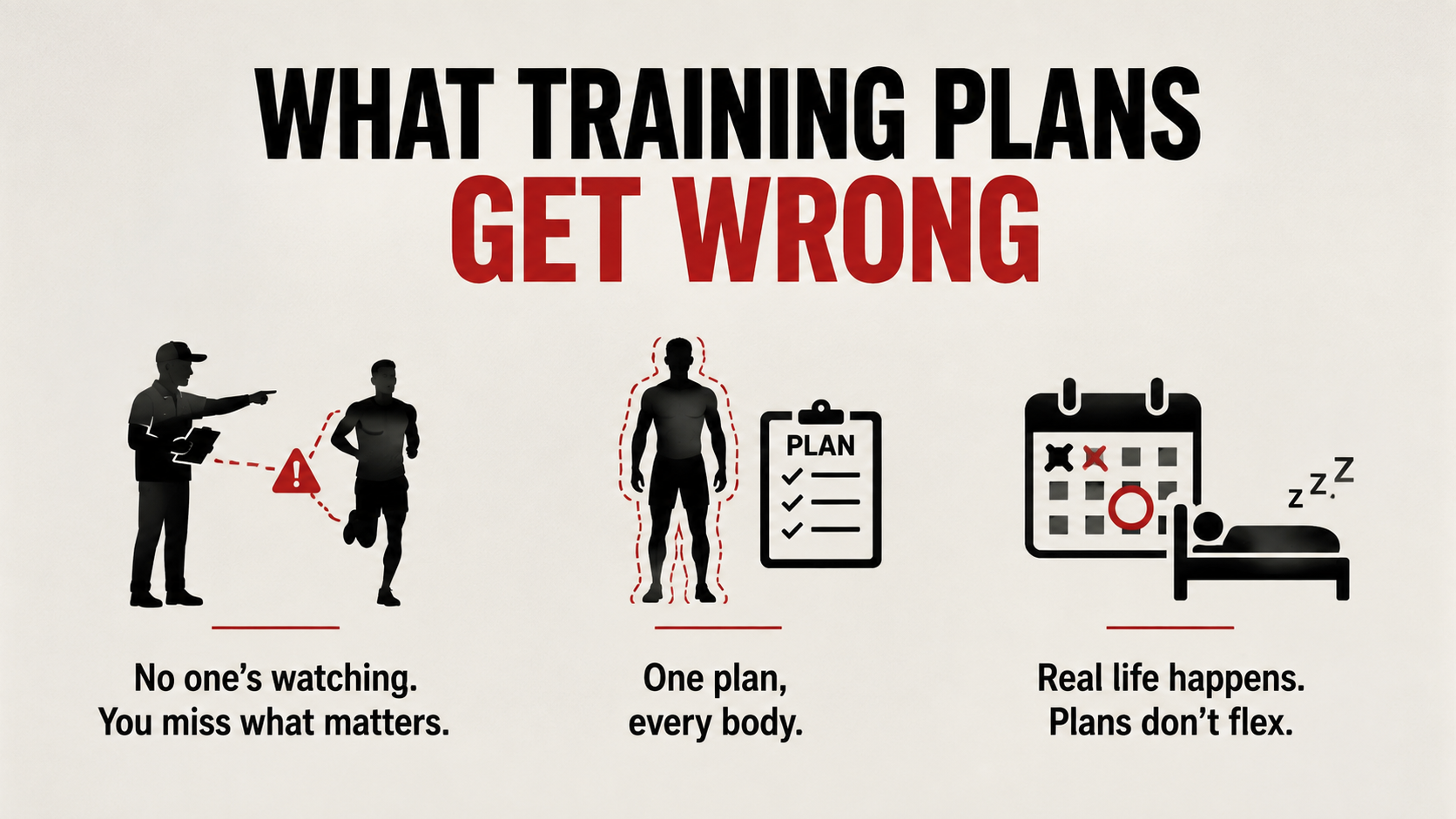
Most plans are built on assumptions that quietly fall apart if you're self-coached. They assume you have someone watching you.
A real coach reads your data and says your easy runs are too fast, or your form is breaking down late in the session. The plan can't do that. It just says "easy run, 45 minutes" and moves on.
You have to develop that eye for yourself, which takes longer but makes you a smarter runner in the long run.
They treat every runner like the same body. The plan says zone 2 for 60 minutes. It doesn't know that you need 90 minutes to actually settle into aerobic work, or that you recover more slowly than average, or that you thrive on back-to-back hard days instead of spreading out.
These aren't failures to follow the plan. They're your actual physiology, and a plan can't account for it.
They also just ignore real life entirely. You get sick. Work gets brutal. You sleep badly for a week. The plan says tempo run today, and you either suffer through it and dig yourself into a hole, or you skip it and spend the rest of the week feeling like you've ruined everything.
Neither is right.
## The Three Things Self-Coaching Actually Taught Me
### #1: Feel matters more than pace
When I started, I chased numbers obsessively. Hit this pace, hold that pace. But pace is a lag indicator. By the time your watch shows you're going too hard, you're already in trouble.
I started doing easy runs without looking at my watch at all. Just ran by effort. Felt easy, kept it easy. When I checked splits afterward, they were more consistent than when I was watching in real time. Your body already knows. The number just confirms it.
### #2: **You can coach your own form with a camera**
I recorded myself running on flat ground, uphill, downhill. I watched it back in slow motion. Saw exactly where my form was falling apart when fatigue hit, saw my knees drifting, saw my shoulders creeping up.
You don't need someone screaming cues at you from the sideline. You need to see it once. After that, you feel it before it becomes a problem.
### #3: **Recovery is yours alone**
The plan says run Monday, Wednesday, Friday, long run Sunday. But maybe you feel flat on Friday and strong on Saturday. Maybe you need three full days between hard sessions. Maybe you recover faster than average and can push more.
I found that after any genuinely hard effort, I needed almost a full week of easy running before I felt sharp again. A plan would have buried me in more hard work before I was ready.
Instead, I moved things around until the rhythm actually worked for my body.
## What I Did Differently on Race Day
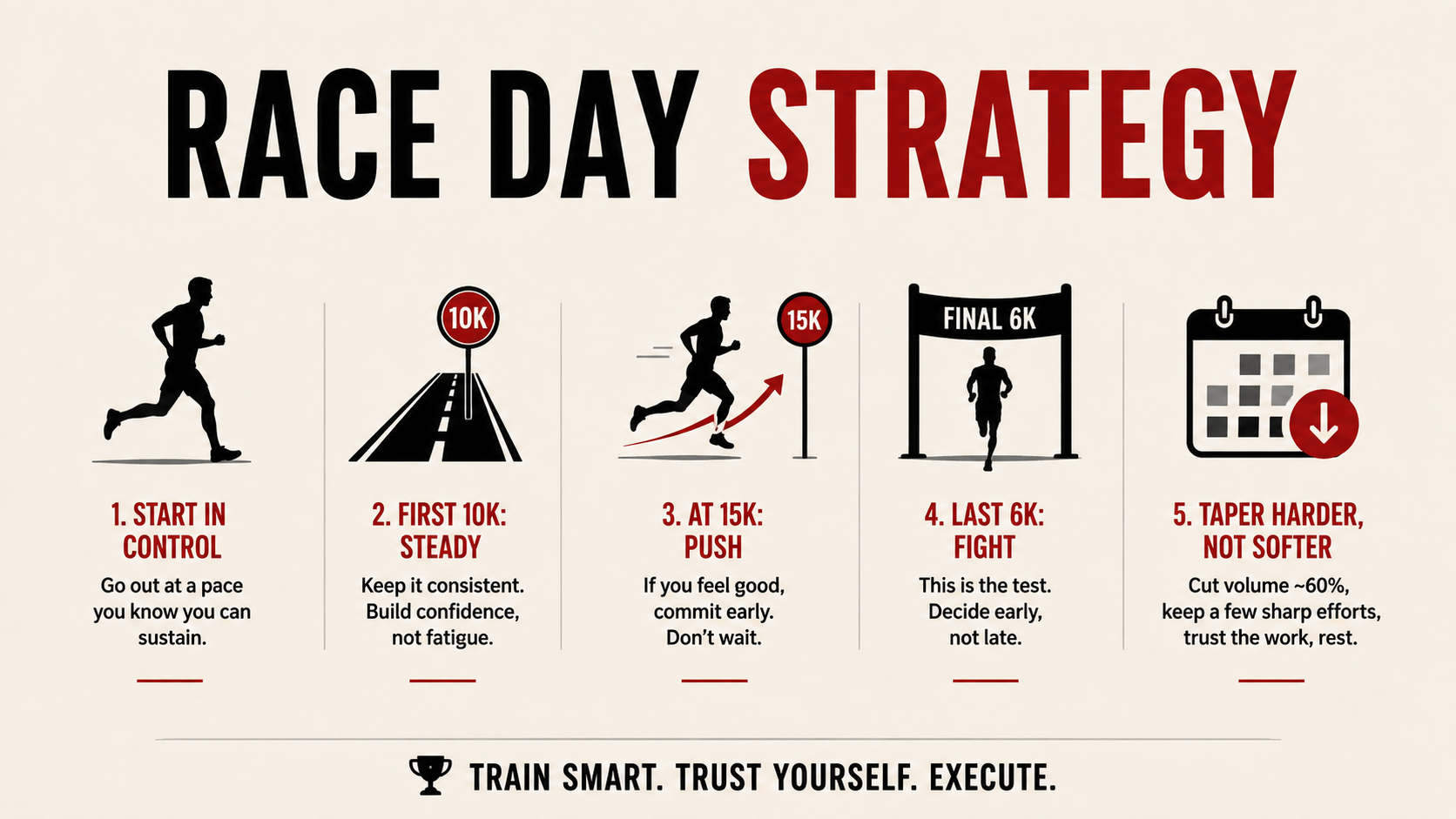
I didn't start conservative. Most plans push this advice hard, but I knew from training that I run better when I feel in control early. So I went out at a pace I knew I could sustain.
First 10K, steady. At 15K, I felt genuinely good, so I pushed slightly.
The final 6K is always a fight. I made the decision to commit at 15K, not at 18K hoping I'd have something left. Deciding early is psychologically easier than trying to summon courage when you're already deep in the pain.
I also tapered harder than the plan would have suggested. I cut volume by around 60% in the final week but kept a few short, sharp efforts to stay awake.
I wanted to feel hungry on race morning. The plan said taper a bit. I said trust the work and actually rest.
## What I Actually Used
Self-coaching works best when your tools do the observing for you.
**Here's what actually helped:**
- **Training plans:** [Strava's free running plans](https://www.strava.com/training-plans/running) are a solid skeleton. Use them to set structure, then adjust based on how your body responds week to week.
- **Running apps:** [Runna](https://runna.com/) builds adaptive plans that adjust when you miss sessions. [Nike Run Club](https://www.nike.com/nrc-app) is better for beginners who want guided audio coaching. [Adidas Running](https://www.runtastic.com/) is a decent middle ground if you just need basic tracking without a subscription.
- **Watches:** [Garmin Forerunner](https://www.garmin.com/) gives you the most training data for the price. [Coros Pace](https://www.coros.com/) is lighter and has better battery life if you're logging serious weekly volume. [Apple Watch](https://www.apple.com/apple-watch/) works fine for casual tracking but doesn't have the running-specific depth the other two do.
## What Self-Coaching Actually Is
You don't need a sub-2 finish on your first attempt either. You just need to stop going out and randomly suffering, and start actually paying attention.
That's the whole thing, honestly.
Most runners never do the feedback loop part. They follow the plan, the plan stops making sense around week six, and they either grind through it or quietly give up. Neither of those is training. Training is run, notice, adjust, repeat. The plan just gives you something to push against.
**Quick takeaways if you're self-coaching:**
- Run by feel, check splits later
- Film yourself running once. You'll never unsee what you see.
- Move sessions around your body, not the other way round
- Taper harder than feels comfortable
- Make your race day decision at 15K, not 18K
And past 17K, when your brain starts writing your retirement speech from running, just know it does that to everyone. The miles are already in your legs.
Your head is just running behind schedule.](https://d32kj04sxj85qr.cloudfront.net/private/users/84e864c8-7051-70fb-6feb-43fe73f1b770/clips/fe4b76eb-f7b3-46c4-9978-1d6703f0d020.jpeg)