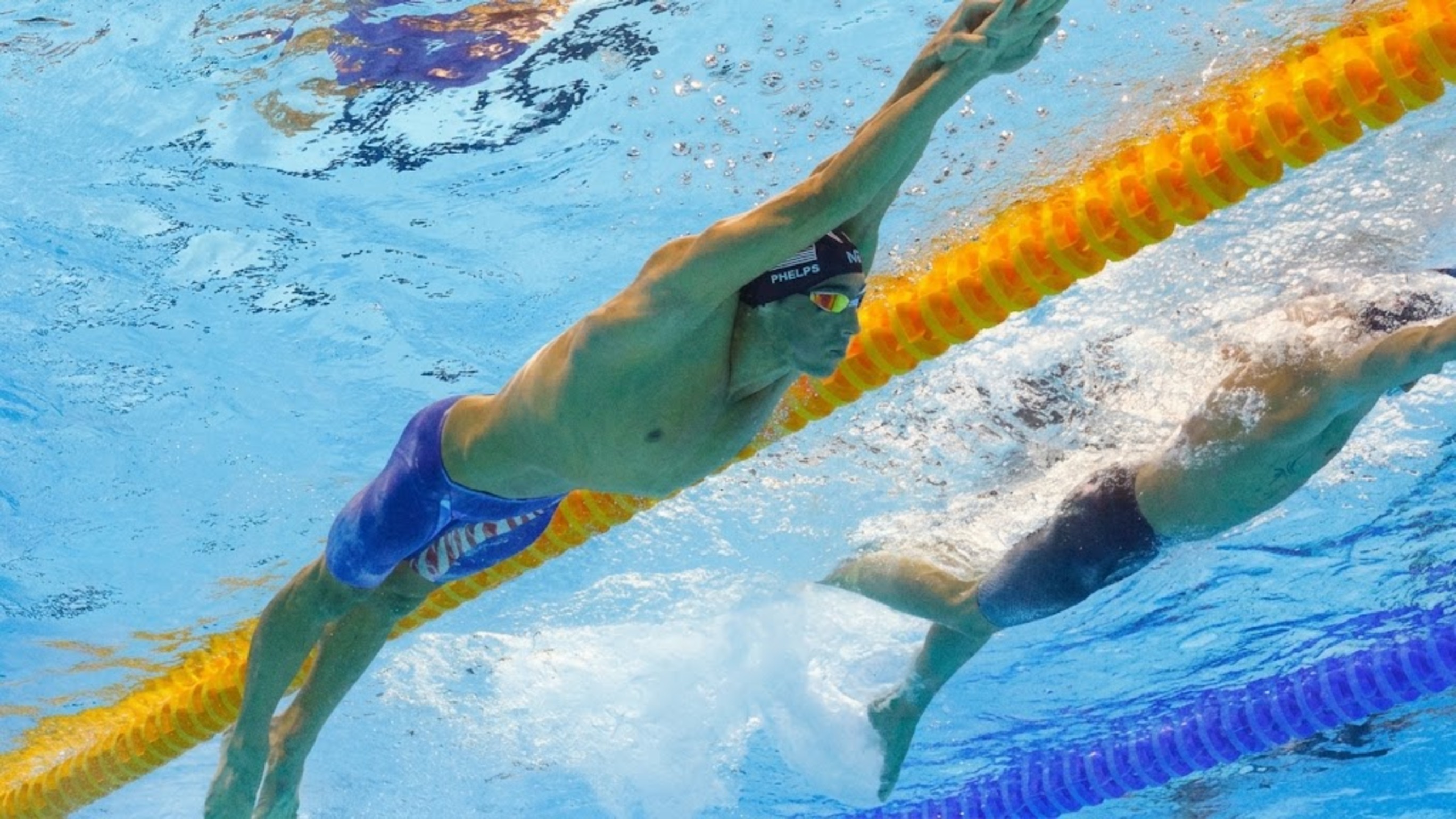
Michael Phelps was seventh at the turn in the 2008 Olympic 100 metre butterfly final. He won gold by 0.01 seconds, finishing in 50.58 to Milorad Čavić’s 50.59.
Čavić led at the 50 metres, then glided into the wall while Phelps took a half stroke. That race is usually told as a story about the finish. It also shows how little room a swimming race leaves for the faster surface swimmer to prove it.
A race is several sprints with walls between them
A 100 metre race in a 50 metre pool has one turn. In a 25 metre pool, it has three. World Aquatics keeps short-course and long-course records separate because the number of turns can help or hurt a swimmer.
A study of men’s short-course 100 metre breaststroke found that about 62 percent of finishing time came from the start, turn and finish segments. In the 200 metre race, turns made up about 39 percent of the total. Those figures predate a rule change that altered breaststroke starts and turns, so the exact shares have probably shifted.
One summary of elite start research puts the underwater phase at more than half the time from the gun to the 15 metre mark. That’s a lot of a race happening below the surface.
How the rules reshaped the underwater game
Swimmers can be fully submerged during the turn and for up to 15 metres after the start and after each turn. By that mark, the head has to break the surface.
The rule has a history. In the technical-suit era, Amaury Léveaux set world records of 44.94 seconds in the 100 metre freestyle, 20.48 in the 50 metre freestyle and 22.18 in the 50 metre butterfly, spending more than half of each race submerged. The governing body then capped how far swimmers could go underwater.
In 2014, breaststrokers were given a single butterfly kick after the start and each turn, before their first breaststroke kick. That changed what a good breaststroke turn looks like.
Why the faster swimmer can lose
Underwater kicking in a streamlined position can be substantially faster than swimming any of the strokes on the surface. That’s the reason the 15 metre cap exists. A swimmer who’s faster on the surface but loses a little off each wall can lose a close race. In a sprint decided by hundredths, a small edge off the wall, repeated across several turns, can add up to more than any plausible advantage in stroke speed.
That’s why top coaches spend so much time on turns and underwater work. It’s training that doesn’t look like swimming, and it can be where races are won.
The exception that proves the point
Phelps’ win in Beijing is the famous counterexample. He lost ground off the wall and still won, because his stroke and finish more than made up for it. That only works when one swimmer has a large edge in another phase. When two swimmers are closely matched, the phases they’re best at decide the result, and the turn is often the phase that separates them.
It also explains why a fast surface swimmer can look unbeatable in training and still be beaten at a major meet. Training in a long pool, with few turns, can hide the problem. The bigger question is whether the rules have it right. Fifteen metres is a long distance to travel without a full stroke.
Should the 15 metre cap be shortened to push races back towards surface speed, or is mastering the underwater phase exactly the skill the sport should reward?





 0