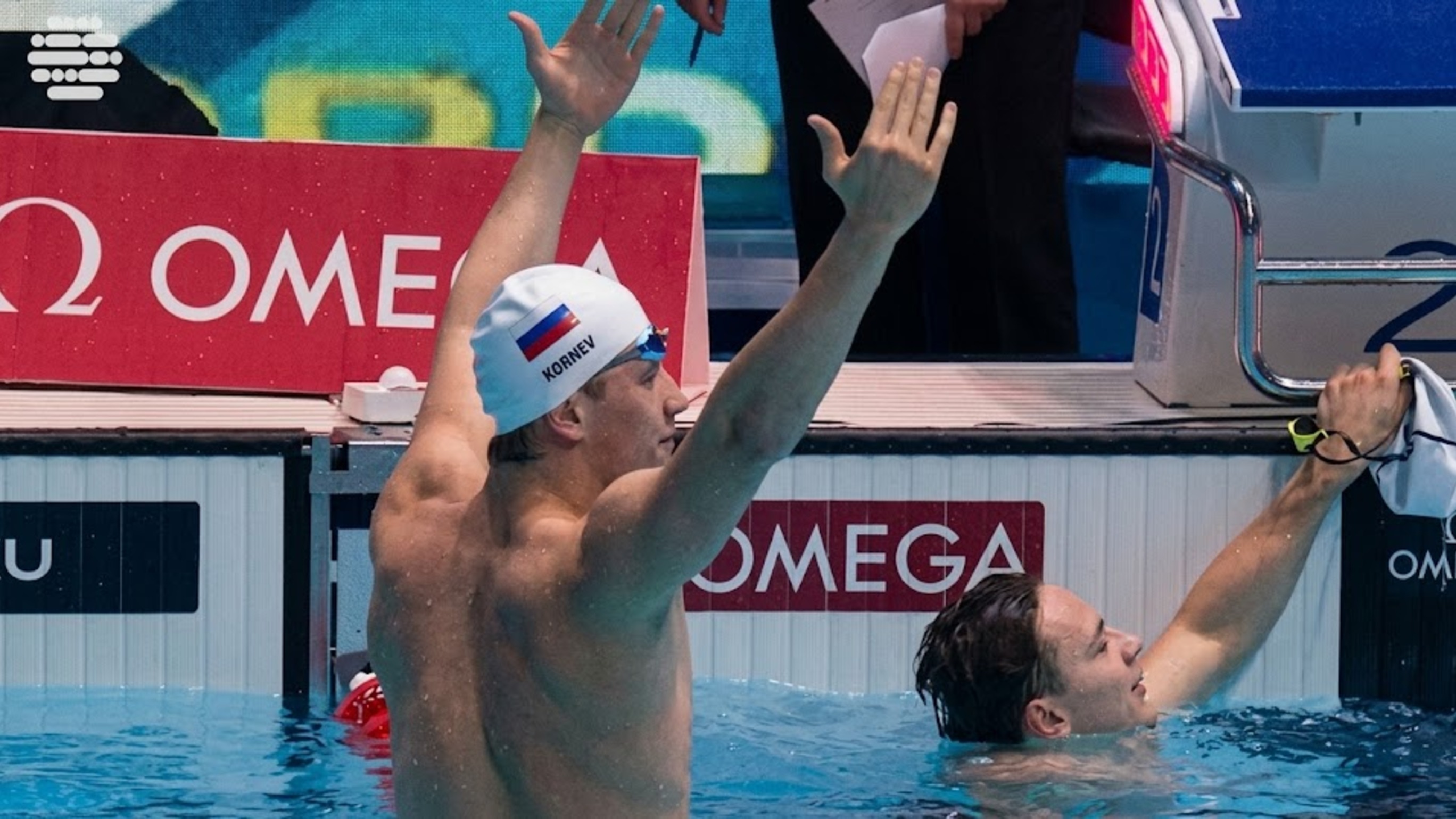
Egor Kornev touched the wall in Baku in 44.84 seconds and matched the short-course world record for the 100m freestyle. The mark had belonged to Australia's Kyle Chalmers since the 2021 World Cup in Kazan, and now it belongs to both of them.
The batch called it a record that fell. Strictly, it was equalled, which is slightly less dramatic but no less impressive.
Kornev is a 22-year-old Russian, and the swim came on day two of the opening stop of the three-meeting World Aquatics Swimming World Cup. He held off Australia's Cameron McEvoy, the world and Olympic 50m freestyle champion, who finished in 45.36.
A busy night
The 100m freestyle wasn't even the most unusual thing Kornev did that evening. He had already set a World Cup record in the 50m backstroke, swimming 22.23 and breaking the mark of 22.58 set by Australia's Isaac Cooper in 2024.
That 22.23 puts him third on the all-time list for the event, behind only Kliment Kolesnikov's 22.11 from 2022 and Florent Manaudou's 22.22 from 2014. For a swimmer best known as a sprint freestyler, it is a pretty good side project.
He earned a $10,000 bonus from World Aquatics for equalling the record. Not bad for a few seconds of work.
Why a 25-metre pool is faster
The reason short-course records fall so often is built into the pool. A 25-metre pool has more walls, and swimmers are faster off a wall than in open water.
In a long-course 100m freestyle, you turn once. In a short-course 100m freestyle, you turn three times. Every turn is a push-off and a stretch of underwater kicking, which is where the best swimmers in the world make their gains.
Kornev's 44.84 works out to about 11.2 seconds per 25 metres. That is a fast pace in any pool, but it is only possible when the wall keeps giving you a free boost.
Money and motivation
World Aquatics sweetens the deal. The $10,000 World Cup bonus for world records gives sprinters a reason to peak for a mid-season meet in Azerbaijan, rather than save everything for the long-course season.
That matters. Short-course meets used to feel like a break from the real thing, and the bonus gives them stakes.
Kornev's own year shows how seriously the best swimmers take it. In August he won silver in both the 50m and 100m freestyle and gold in the 50m butterfly at the European Championships in Paris, and he was fifth in both freestyle events at the 2025 World Championships in his long-course debut. Now he has a world record to his name, even if it is shared.
The asterisk problem
Here is the uncomfortable part. Fans and commentators tend to treat short-course records as the B-side. A long-course world record gets Olympic headlines, while a short-course one gets a brief mention.
I think that is slightly unfair, but not entirely. The events are measuring something different, because turns and underwater work count for more in a short pool. A great short-course swimmer is not automatically a great long-course one, and the reverse is also true.
Kornev's time was also close to a Russian mark. Vladimir Morozov's 44.95 from 2018 stood as the national record until Kornev beat it, with his previous best sitting at 44.99.
None of that makes 44.84 less fast. It does make the debate worth having, though.
So here is the question. Should a short-course world record carry the same weight as a long-course one, or does the extra wall make it a different sport?





 0