 0

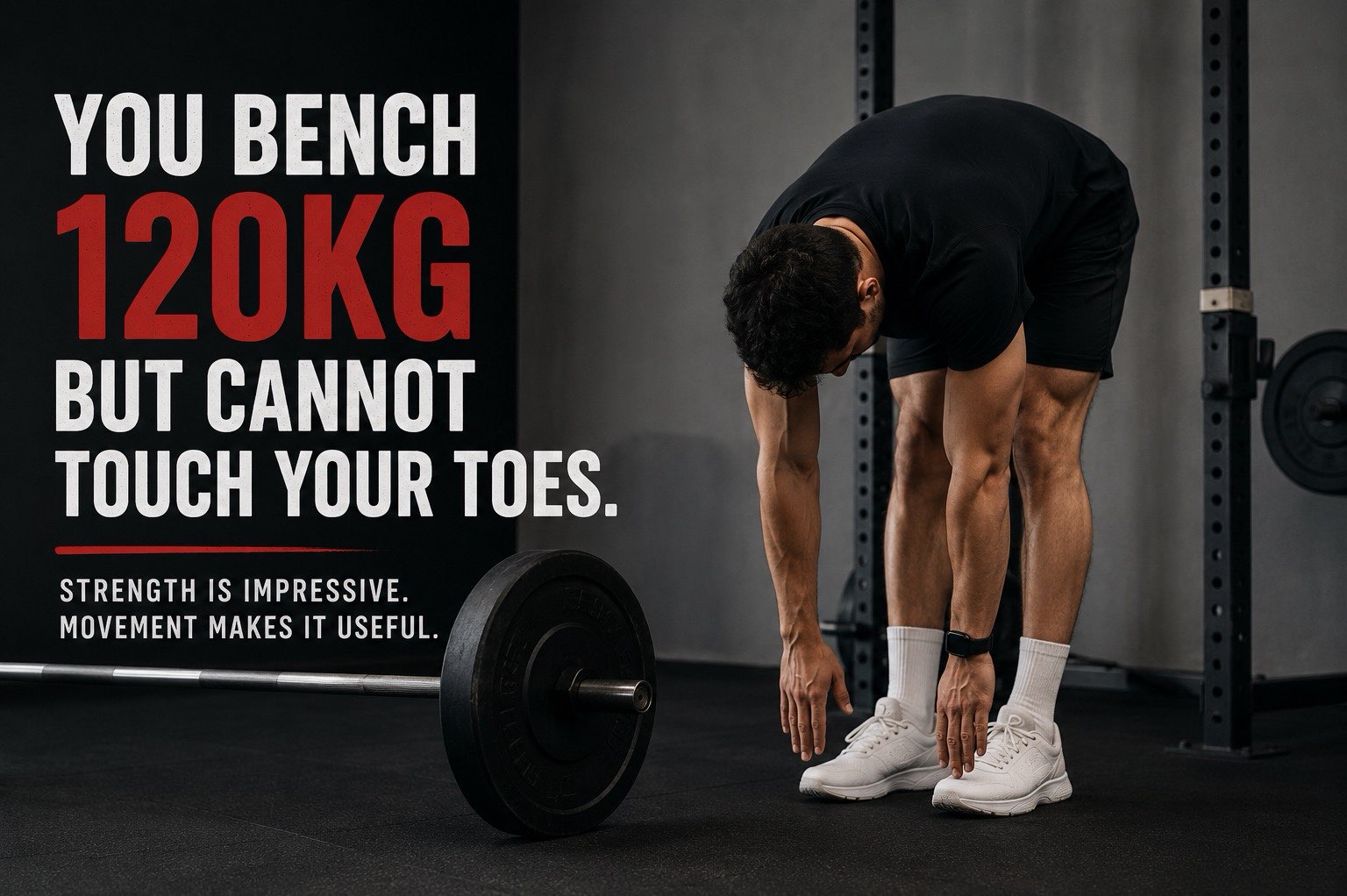
You Bench 120kg But Cannot Touch Your Toes
You load the bar, chalk your hands, and press 120 kg like it is nothing.
Then someone asks you to touch your toes, and suddenly you turn into a robot doing yoga for the first time.
Sound familiar?
Most lifters probably brush it off. Mobility work can feel like something for yoga classes, not for someone who can move serious weight.
But here’s the funny part:
being strong and being mobile are two different things, and you can absolutely be both strong and stiff.
Here’s why it happens.
Strength training makes you better at producing force in the movements you repeatedly train. But getting stronger doesn’t automatically increase your range of motion.
If your training rarely takes your joints through certain positions, those movements may continue to feel restricted.
That’s why someone can have an impressive bench press and still struggle to reach their toes.
And for a sportsperson, this isn’t just an embarrassing party trick.
Limited movement can affect how comfortably you perform certain skills.
Restricted ankle movement can make a deep squat more difficult. Limited hip movement can affect positions that require running, cutting or changing direction. And restricted shoulder movement can make overhead movements, throwing or reaching more challenging.
Your strength is there.
You just need enough movement and control to use it effectively.
Nobody posts their toe touch on social media. Everyone posts their max bench.
But training for mobility doesn’t mean giving up your heavy lifts or spending an hour stretching every day. It can be much simpler than that.
Give your body a few extra minutes
Before you lift, try some controlled leg swings or other dynamic movements to get your hips moving through a comfortable range. You’re not trying to force flexibility; you’re simply preparing your body for movement.
After training, you can spend a few minutes working on movements that feel restricted.
For example, a slow, comfortable hamstring stretch can help you work on reaching toward your toes without bouncing or forcing the movement.
And don’t forget your ankles.
A few minutes of controlled knee-to-wall or similar ankle mobility work a couple of times a week can help you gradually become more comfortable moving your knee forward over your foot.
That’s it.
No fancy equipment. No separate mobility day. No abandoning your lifting routine.
Just a few extra minutes added to the training you’re already doing.
And don’t expect a completely different body after one session. Mobility is something you build gradually.
With consistent practice, you may notice that movements such as squatting, reaching or getting down to the floor feel more comfortable and controlled.
None of this means your strength was the problem.
In fact, strength and mobility can work together.
Keep chasing the big numbers. Nobody is telling you to stop.
Just make sure your body can move well enough to use that strength when your sport actually demands it.
Because a huge bench with limited movement is a little like having a sports car with a very powerful engine but questionable steering.
All that power is great. Being able to control where it goes is even better.