Football tackles you.
Rugby throws you into a ruck.
Hockey sends you into the boards.
Basketball?
Basketball just gives you a little push.
Then another.
Then a grab.
Then a bump while you’re trying to get around a screen.
And somehow everyone goes:
“Play on.”
As a physiotherapist, I watch that and think:
Wait… we’re just pretending none of that happened?
Because basketball may not look like a contact sport, but watch a game closely and you’ll see contact everywhere.
The fight for a rebound.
The battle through a screen.
The hand-check.
The jersey grab.
The bump on a drive.
Basically, you’re trying to make a perfect play while another human being is doing their absolute best to make your life inconvenient.
And that’s where basketball gets interesting.
The contact is sneaky
Football has tackles.
Rugby has tackles, rucks, and people voluntarily running into each other at impressive speeds.
Hockey has players crashing into boards.
Basketball?
The contact is much sneakier.
It’s hidden inside the game.
Boxing out.
Fighting through screens.
Defending.
Cutting.
Jumping.
Landing.
And because it’s normal, nobody really stops to think:
“Hey, that’s contact.”
We just call it:
“Playing hard.”
But the little push adds up
When we picture a basketball injury, we usually imagine the dramatic stuff.
A hard foul.
A collision under the basket.
Someone getting wiped out on a fast break.
Those moments get the whistle, the replay, and probably 17 people yelling at the referee.
But not all contact looks dramatic.
Sometimes it’s the little push while boxing out.
The grab on a cutter.
The hand-check.
The tug while fighting through a screen.
One little push?
Probably nothing.
Keep doing it possession after possession, though, and your body might eventually file a complaint.
And the numbers are pretty interesting.
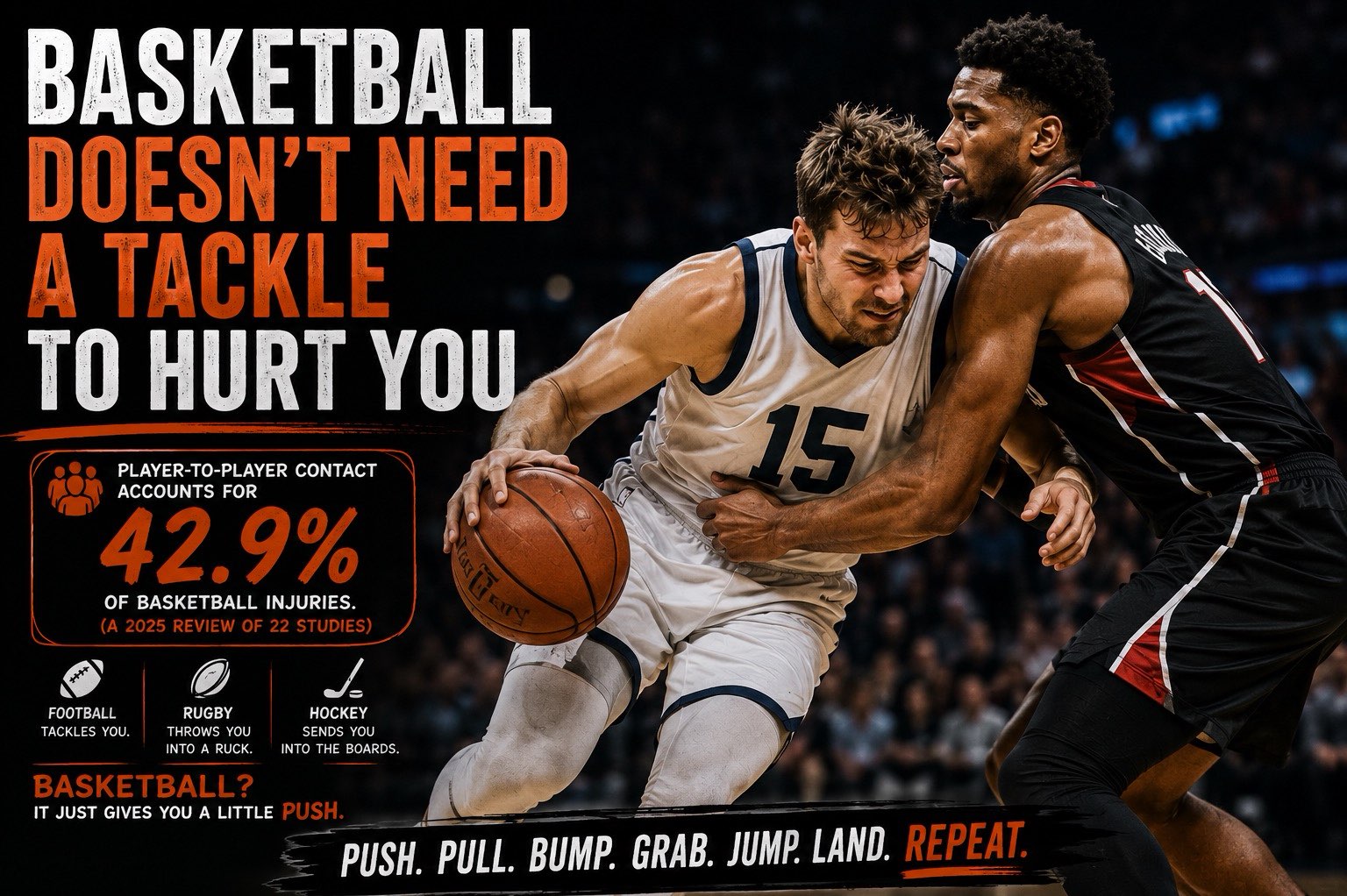
A 2025 systematic review and meta-analysis of 22 studies found that player-to-player contact accounted for 42.9% of basketball injuries, making it the biggest reported injury mechanism.
Non-contact mechanisms accounted for about 25%.
So no, basketball isn’t rugby.
But calling it “non-contact” is starting to feel a little generous.
And here’s the funny thing about a whistle
The referee decides whether something is a foul.
Your body doesn’t.
Your ankle isn’t sitting there thinking:
“No whistle? Excellent. Carry on.”
Your knee doesn’t care that the contact was “part of the play.”
And your head definitely doesn’t care whether someone meant to make contact.
Force is force.
And sometimes the contact doesn’t even get called.
Head contact has been observed during ordinary basketball situations like defending an attacker and fighting for rebounds, with much of that contact going unpenalized.
So:
No whistle ≠ no physical stress.
Push. Pull. Jump. Land. Repeat.
Basketball already asks a LOT from your body.
Sprint.
Stop.
Change direction.
Jump.
Land.
Rotate.
Do it all again.
Now add another athlete pushing, pulling, grabbing, or bumping you while you’re trying to beat them to the ball.
Congratulations.
Your musculoskeletal system has officially entered the group project.
And that’s what makes basketball different from the obvious contact sports.
The contact isn’t always one massive collision.
It’s thousands of tiny battles for space.
You fight for the rebound.
You fight through the screen.
You fight for position.
You fight for the lane.
Basically, everyone is fighting everyone else for approximately 2 square feet of floor.
So should basketball become a no-contact sport?
Absolutely not.
Please don’t make players ask:
“Excuse me, may I box you out?”
“Sure, but gently.”
That’s not basketball.
The physicality is part of what makes the game what it is.
The point isn’t to remove contact.
It’s to understand it.
Players need to be able to control their bodies when they’re bumped, pulled, pushed, and knocked off balance.
Coaches need to pay attention to how those battles happen.
And officials have a role too, because consistent enforcement of unnecessary pushing and holding isn’t about making basketball “soft.”
It’s about recognizing what’s actually happening on the court.
Because basketball might not have the tackles of rugby or the collisions of football.
But it has something else:
Push. Pull. Bump. Grab. Jump. Land. Repeat.
And sometimes, the contact that looks too ordinary to notice is exactly the contact worth noticing.
As a physiotherapist, that’s the part I’d want players, coaches, and parents to remember:
Your body doesn’t need the contact to look dramatic for it to matter.
Sometimes it’s not the big hit.
Sometimes it’s the little push you barely noticed…
repeated possession after possession.

 0

 $0.00$BUZZER