




 0
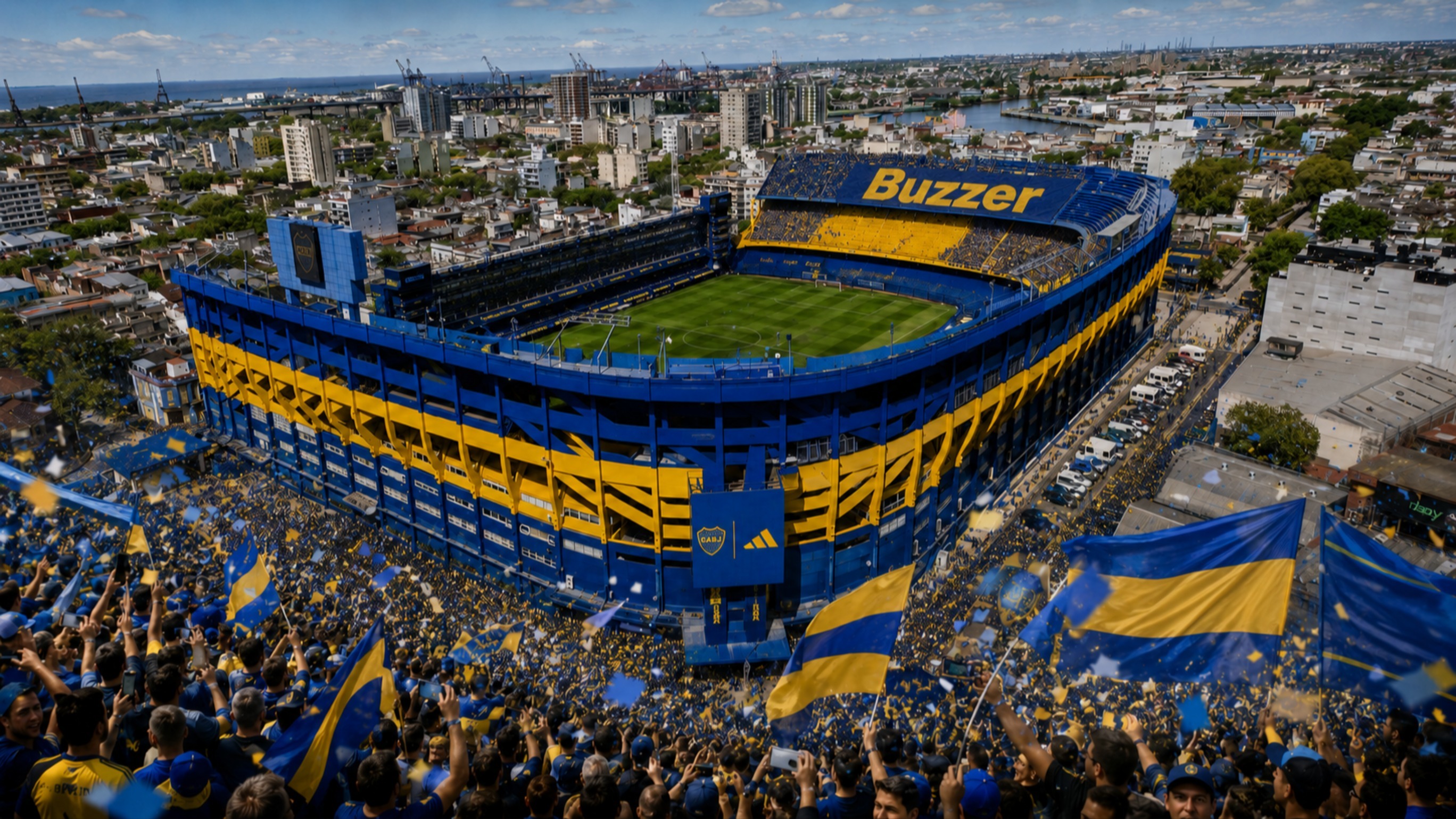
0Huge Transformation at La Bombonera as Legendary Stadium Set to Exceed 80,000 Seats
It is official. La Bombonera is set to grow
Boca Juniors are preparing one of the most ambitious transformations in the history of La Bombonera, one of football’s most recognisable stadiums. The club plans to increase its match-day capacity from approximately 57,000 spectators to more than 80,000.
The announcement was made by Boca Juniors secretary-general Ricardo Rosica, who revealed new details about the project designed to keep the team in its traditional La Boca home.
“We will reach 80,000 seats,” Rosica told Radio La Red.
The expansion would increase the stadium’s current capacity by approximately 40 percent. Demand for tickets regularly exceeds availability, particularly for major fixtures and the Superclásico against River Plate.
The pitch will be moved by four metres
One of the most important elements of the project involves moving the pitch approximately four metres towards the nearby railway tracks. This change would create the space required to rebuild the side of the stadium facing Del Valle Iberlucea Street, which has restricted expansion plans for decades.
The existing structure of boxes on that side is expected to be demolished and reconstructed. New seating areas, six levels of boxes and additional facilities for spectators would be built in its place.
The plan also includes a fourth tier above the stands at both ends of the stadium. These new sections would allow La Bombonera to exceed 80,000 seats without forcing Boca Juniors to abandon the neighbourhood where the club established its identity.
Boca Juniors want to remain in La Boca
Club officials have chosen to modernise the existing stadium instead of constructing a new arena elsewhere in Buenos Aires.
Alternative proposals included a completely new stadium with room for as many as 150,000 spectators. Boca’s management, however, did not consider those plans realistic.
Rosica argued that such projects promised an enormous stadium “in a place that does not exist”. For Boca Juniors, preserving the connection with La Boca is considered almost as important as increasing the capacity.
The club has already completed more than 90 improvements as part of its modernisation programme, with further work still underway.
“We are in the final stretch,” Rosica said.
A unique stadium built on a narrow plot
The stadium’s official name is Estadio Alberto José Armando, although it is known around the world as La Bombonera. It stands at 805 Brandsen Street in the heart of the La Boca district of Buenos Aires.
Its unmistakable shape was created largely out of necessity. Architects José Luis Delpini, Viktor Sulčič and Raúl Bes were asked to build a major stadium on a narrow site located beside railway tracks.
The limited space forced them to design tall and exceptionally steep stands positioned close to the pitch. Three sides of the stadium were constructed in this way, while the fourth was traditionally occupied mainly by private boxes.
Its vertical configuration allows supporters in the upper sections to remain close to the action. It also intensifies the noise generated by the crowd and creates an intimidating environment for visiting teams.
How La Bombonera got its famous nickname
The best-known story behind the name La Bombonera centres on architect Viktor Sulčič. He reportedly received a box of chocolates for his birthday and noticed that its shape closely resembled the arena he was helping to design.
Sulčič is said to have taken the box to project meetings to show his colleagues the similarity. The comparison became so popular that even club officials were using the nickname around the time of the stadium’s inauguration.
La Bombonera can be translated as “the chocolate box”. Although the ground subsequently received several official names, the nickname survived and eventually became famous across the football world.
The venue was originally called Estadio de Boca Juniors. In April 1986, it was renamed after Camilo Cichero, the club president under whom construction began.
In December 2000, the administration led by Mauricio Macri changed its official name to Estadio Alberto José Armando. Armando served two terms as Boca president and played an important role in the club’s rise during the 1960s and 1970s.
Boca raised money to build a permanent home
The journey towards the current stadium began long before its 1940 inauguration. Following a period of financial difficulty, Boca Juniors launched a fundraising campaign in 1921 to finance a new home.
The club initially rented and later purchased land previously used by the Ferro Carril del Sud railway company. The site was located close to the tracks connecting the port district with other parts of Buenos Aires.
Before settling on Brandsen Street, Boca had played at several grounds, including Dársena Sur and Isla Demarchi. In 1924, the team moved to a site at the intersection of Brandsen and Del Crucero, the street now known as Del Valle Iberlucea.
Boca’s board purchased the land from the Buenos Aires municipal authorities in 1931. The design of the new stadium was later entrusted to Delpini, Sulčič and Bes.
The old ground, which still featured wooden stands, staged its final match in April 1938. After its demolition, Boca temporarily moved their home fixtures to Ferro Carril Oeste’s stadium.
La Bombonera opened in 1940
La Bombonera officially opened on May 25, 1940, with a friendly between Boca Juniors and San Lorenzo. The home side won 2-0, with Ricardo Alarcón scoring both goals.
The stadium did not yet have floodlights, so the match lasted only 70 minutes and was divided into two 35-minute halves.
The first competitive match at La Bombonera took place on June 2, 1940, when Boca defeated Newell’s Old Boys 2-0 in the Argentine championship. Alarcón scored the first official goal at the new stadium, having already found the net twice in the opening friendly.
Development continued after the inauguration. A second tier was opened on the northern side near Casa Amarilla station in November 1941. The stand was named after Natalio Pescia, one of the most important players in Boca’s history.
The third tier and floodlight system were completed in 1953. Boca marked the occasion with a friendly against Hajduk Split, which ended in a 1-1 draw.
The major redevelopment of 1996
La Bombonera did not undergo another large-scale reconstruction until the 1990s. During Mauricio Macri’s presidency, Boca launched a programme to increase capacity and modernise several areas.
The lateral boxes facing Del Valle Iberlucea Street were demolished and replaced by a smaller stand and a modern structure containing new boxes. Press facilities, hospitality spaces, offices and administrative areas were also introduced.
The exterior was decorated with works by artists Rómulo Macció and Pérez Celis. The modernised stadium reopened with a friendly in which Boca Juniors defeated Universidad de Chile 3-1.
An electronic screen was installed in 2008, making La Bombonera only the third stadium in Argentina to feature the technology at the time, after the grounds of Vélez Sarsfield and River Plate.
Further improvements followed in 2012, when hundreds of seats were replaced and additional seating and boxes were created.
The stadium that “does not shake, it beats”
La Bombonera owes much of its reputation to the extraordinary atmosphere produced by Boca supporters. The steep stands, proximity to the pitch and compact structure amplify the sound generated by tens of thousands of fans.
During major matches, the movement of the crowd creates vibrations that can be felt throughout the arena. This phenomenon inspired the famous description that La Bombonera “does not shake, it beats”.
The stadium’s shape traps the noise inside and directs it towards the playing surface. For visiting teams, playing there is widely regarded as one of the most demanding experiences in South American football.
The atmosphere reaches its peak during the Superclásico between Boca Juniors and River Plate. Demand is so high that tickets are extremely difficult to obtain, particularly for supporters who are not club members.
Expanding the capacity beyond 80,000 would allow thousands more fans to attend while reducing some of the pressure created by the enormous demand.
Diego Maradona had his own box
Diego Maradona holds a special place in the history of both Boca Juniors and La Bombonera. The former world champion played for the club, supported it throughout his life and had his own private box inside the stadium.
Many other legendary footballers have appeared on its pitch. The list includes Lionel Messi, Pelé and Alfredo Di Stéfano, three of the most influential players the game has ever produced.
Argentina’s national team has also played friendly matches and World Cup qualifiers at La Bombonera. It was one of the country’s principal international venues until the Monumental was renovated for the 1978 World Cup.
By November 2024, Argentina had played 27 matches at the ground, recording 18 victories, seven draws and only two defeats. Argentina scored 67 goals and conceded 27 in those matches.
A museum, statues and murals
La Bombonera is far more than a collection of stands surrounding a football pitch. Beneath the terraces is the Museo de la Pasión Boquense, which opened in 2001 during Mauricio Macri’s administration.
Spread across two floors, the museum follows Boca Juniors’ history from the club’s foundation in 1905 to the modern era. Visitors can see trophies, photographs, shirts, historic objects and video displays celebrating the team’s greatest moments.
One of its attractions is a giant football featuring 360-degree footage of Boca’s players and supporters. The museum also includes a hall of fame and a large mural dedicated to Diego Maradona.
Several Boca legends have been honoured with statues around the stadium. They include Maradona, Juan Román Riquelme, Martín Palermo, Guillermo Barros Schelotto, Ángel Clemente Rojas, Silvio Marzolini and Antonio Rattín.
Carlos Bianchi became the first Boca manager to receive his own statue. He won nine trophies across two spells and guided the team through an unbeaten run of 40 matches.
The stadium and its surroundings are also decorated with blue-and-yellow murals. Some celebrate famous players, while others depict dockworkers, Italian immigrants and everyday life in the La Boca neighbourhood.
La Bombonera has also hosted major concerts
The stadium’s unusual design gives it distinctive acoustics, making it suitable for events beyond football.
Elton John, Lenny Kravitz, James Blunt, the Bee Gees and the Backstreet Boys are among the international artists who have performed at La Bombonera.
The club museum even displays a specially commissioned blue-and-yellow guitar used by Lenny Kravitz during his 2005 concert at the stadium.
These events have strengthened La Bombonera’s status as a cultural landmark of Buenos Aires, as well as one of the city’s most important sporting venues.
Boca are modernising their home without sacrificing its identity
The expansion project would significantly alter the stadium’s appearance, but Boca Juniors want to preserve the features that make La Bombonera unique.
For the club, the ground represents the bond between the team, its supporters and the neighbourhood where its identity was forged. Moving elsewhere might have provided more space, but it would have broken a relationship developed across several generations.
A capacity of more than 80,000 would place La Bombonera among the largest stadiums in South America. Beyond the numbers, however, the most important news for Boca supporters is that their team will remain in its traditional home, where every stand, mural and vibration tells a part of the club’s story.

From Hero to Enemy in Just One Year: Alexander Isak Faces a Hostile Newcastle Return

They Won the Champions League, but Are Now Free Agents Looking for a New Club

“My grandmother would have run more than you” - The harsh Mourinho remark that brought the best out

The World Cup Transformed His Career Djed Spence Completes One of Serie A’s Biggest Summer Moves

Juventus’ New Diamond Comes From Bosnia: Barbarez Believes He Can Become a Champion

Pio Esposito impresses Cristian Chivu and threatens Marcus Thuram’s place at Inter

Deadline Day Madness! 12 Transfers That Almost Went Unnoticed

Football’s Highest-Paid Stars - Who Are Europe’s Weekly Wage Kings

Paris Saint-Germain win the UEFA Super Cup

The Bavarian monster is ready to devour the Bundesliga again


