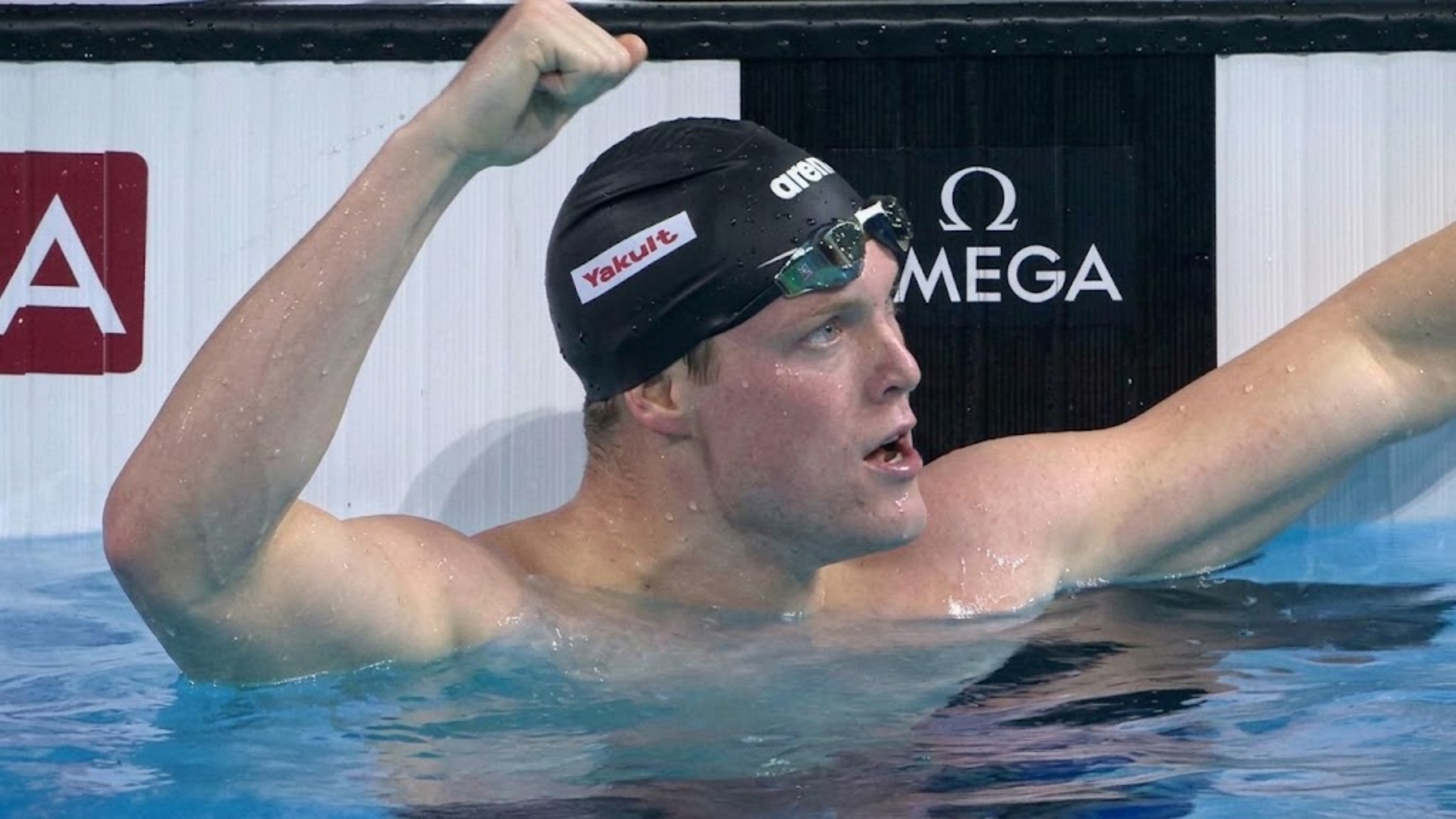
Luke Barr touched the wall in the men's 100m individual medley in Baku on Thursday in 51.57 seconds. Shaine Casas touched in 51.58. South Africa's Pieter Coetzé finished third in 51.60. Three swimmers, three hundredths of a second, in a pool in Azerbaijan that had never hosted a World Aquatics event until this week.
It's the opening stop of the World Aquatics Swimming World Cup's Silk Road Tour, a three-city circuit that continues in Tashkent, Uzbekistan from 8 to 10 October and finishes in Astana, Kazakhstan from 15 to 17 October. Last year's tour stayed in North America, with stops in Carmel, Westmont and Toronto.
Why go east
World Aquatics says the idea is to take the world's best swimmers to places where local audiences will cheer them on. There's also a practical carrot for the athletes. For the first time, any swimmer who finishes in the top three of an individual final and also hits an A standard time at any stop earns a wildcard place at the World Short Course Championships in Beijing in December.
That gives each stop real stakes. A swimmer chasing a spot in Beijing has a reason to race hard in Baku, rather than treating it as a warm-up.
The calendar choices are deliberate too. Tashkent's stop is the first international swimming competition Uzbekistan has hosted, at the Olympic City complex. Astana will be the fourth World Aquatics event in that city. More than 750 athletes from over 50 countries are expected across the three stops.
Does it widen the audience?
Reach is hard to measure from a single session. Ticket sales and television audiences will say more over the next three weeks, and neither number is public yet. What can be said is who gets to watch live. Baku, Tashkent and Astana don't often see swimmers of this level in person, and local broadcasters in Azerbaijan, Uzbekistan and Kazakhstan are carrying their own stops.
The best argument for moving the circuit is the simplest one. Short-course swimming is fast, loud and easy to follow, with finishes that look like Thursday's 100 IM. A sport that wants new fans should put that in front of people who've never seen it.
The best counter-argument is that a roaming circuit can feel like a string of pop-up events. A three-week sprint through three cities gives none of them time to build a habit, and a fan who loves what they see in Baku might wait years for the next chance.
What the road can and can't fix
Moving the World Cup doesn't solve every problem. It can't make swimming more visible in the weeks between meets, and it can't turn a first-time host into a swimming country overnight. What it can do is offer a first impression, and first impressions matter.
The first sign will be in the stands. If Baku fills its Aquatic Palace and Tashkent's new pool is loud, World Aquatics has a case that the model works. If the crowds are thin, the Silk Road becomes a nice map and not much else.
There's a competitive angle as well. A circuit that attracts swimmers from many countries gives smaller swimming nations a chance to race the best without a long trip to Europe or North America. That's good for the sport even if it never shows up in a ratings chart.
So should the World Cup keep chasing first-time hosts, or settle into a few reliable cities where the crowds already know what they're watching?





 1