Hellen Obiri owns the New York City Marathon course record at 2:19:51. Her personal best is 2:15:53. That’s almost four minutes between the runner and the course, and nobody has ever accused her of coasting.
New York is the marathon that doesn’t care about your training log. It turns 50 as a five-borough race this Sunday, and the course is the main reason people keep arguing about it.
Five bridges and almost no flat miles
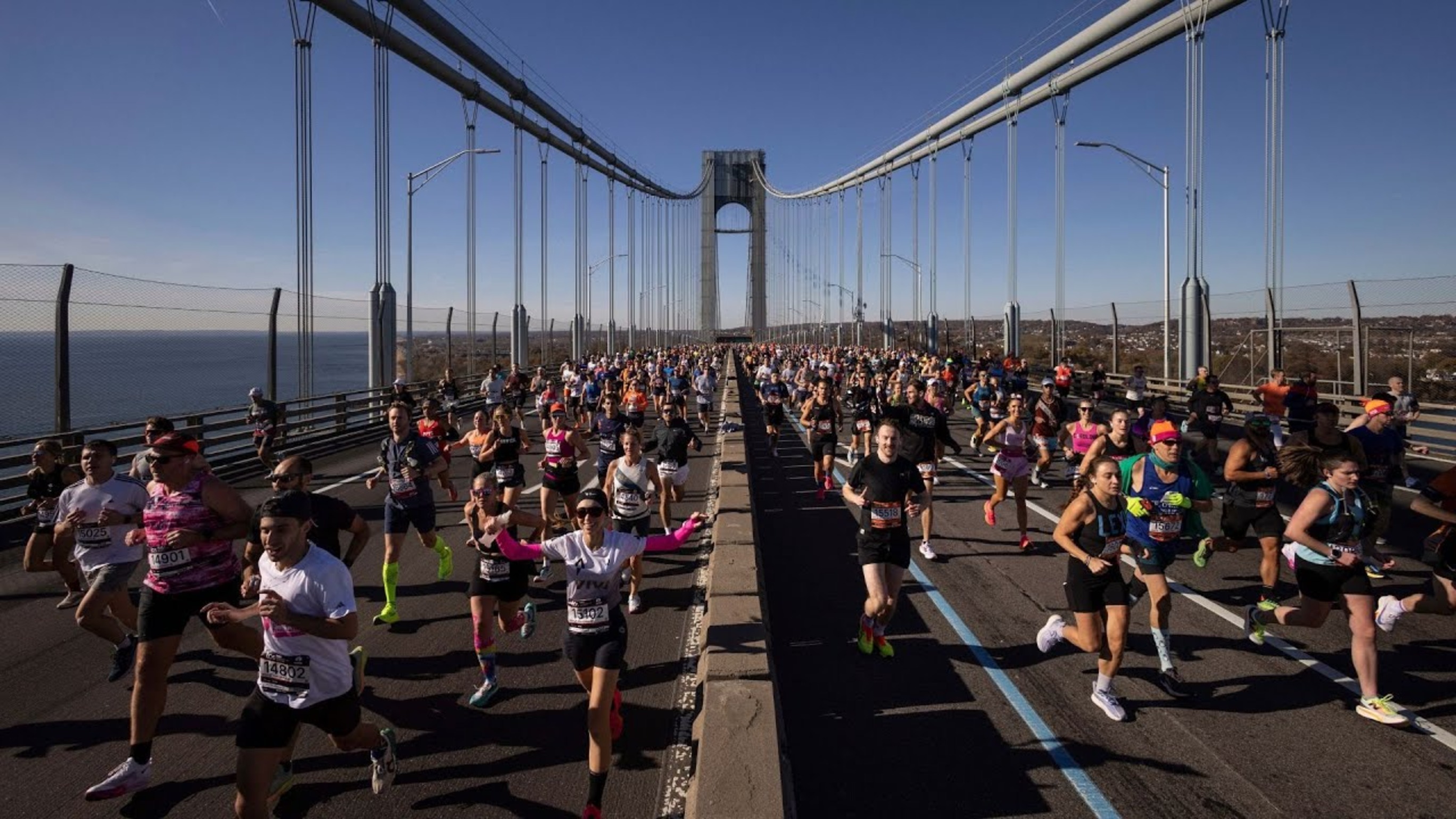
The race starts on Staten Island with the long climb over the Verrazzano-Narrows Bridge. Four more bridges follow: the Pulaski, the Queensboro, the Willis Avenue and the Madison Avenue. Every one is a hill dressed up as infrastructure.
The Queensboro is the famous one, because it arrives around mile 15 in near silence. Then the runners come off it onto First Avenue and the crowd hits them like a wall of sound. It’s a lovely piece of theatre, and it’s also a pacing trap for anyone who surges on the noise.
Then there’s the finish. After the Bronx and the long grind down Fifth Avenue, the last miles roll through Central Park, and nothing about them is gentle.
Fast courses and fighting courses
Look at where records live. The men’s world record, 2:00:35, was set in Chicago. The New York men’s course record, Tamirat Tola’s 2:04:58 from 2023, is more than four minutes slower. Berlin and Chicago are built to be quick, with flat roads and pacemakers on a schedule.
New York doesn’t work that way. The elite races here are tactical contests, so athletes run against each other rather than against a clock. Last November, Benson Kipruto beat Alexander Mutiso by three hundredths of a second, the closest men’s finish in race history.
That same day, Obiri broke a 22-year-old women’s record. Margaret Okayo’s 2:22:31 from 2003 had stood since before some of today’s contenders were teenagers. A hard course still produced a record, which tells you how good the winner was.
What the 50th race looks like
The anniversary celebrates the 1976 race, the first through all five boroughs and the first with a professional field. Bill Rodgers won it, and he’s due to join the celebrations this week. Nearly 60,000 runners are expected on Sunday.
The elite fields are strong but not perfect. Olympic champion Sifan Hassan withdrew from the women’s race after illness disrupted her preparation, and American Fiona O’Keeffe pulled out injured. That leaves Obiri as the defending champion with the fastest personal best in the field.
On the men’s side, Kipruto faces two former winners in Geoffrey Kamworor and Abdi Nageeye. Kamworor has won twice, in 2017 and 2019, and has finished on the podium in four of his five appearances. Nageeye took the 2024 title.
The case for the hard course
I’d argue the difficulty is the feature. A flat course with pacemakers gives you a fast time and a forgettable race, because the winner is whoever holds the metronome longest.
New York gives you hills, wind and a field with nobody to hide behind, and you can’t script any of that. When the finish comes down to hundredths of a second, as it did last year, you remember it for decades. Nobody remembers a split time from mile 18. That’s a fair price for a slower clock. Fans may not agree, and records matter to the sport.
Would you rather watch a world record on a flat course with pacemakers, or a three-hundredths-of-a-second finish on a course that fights back?





 0