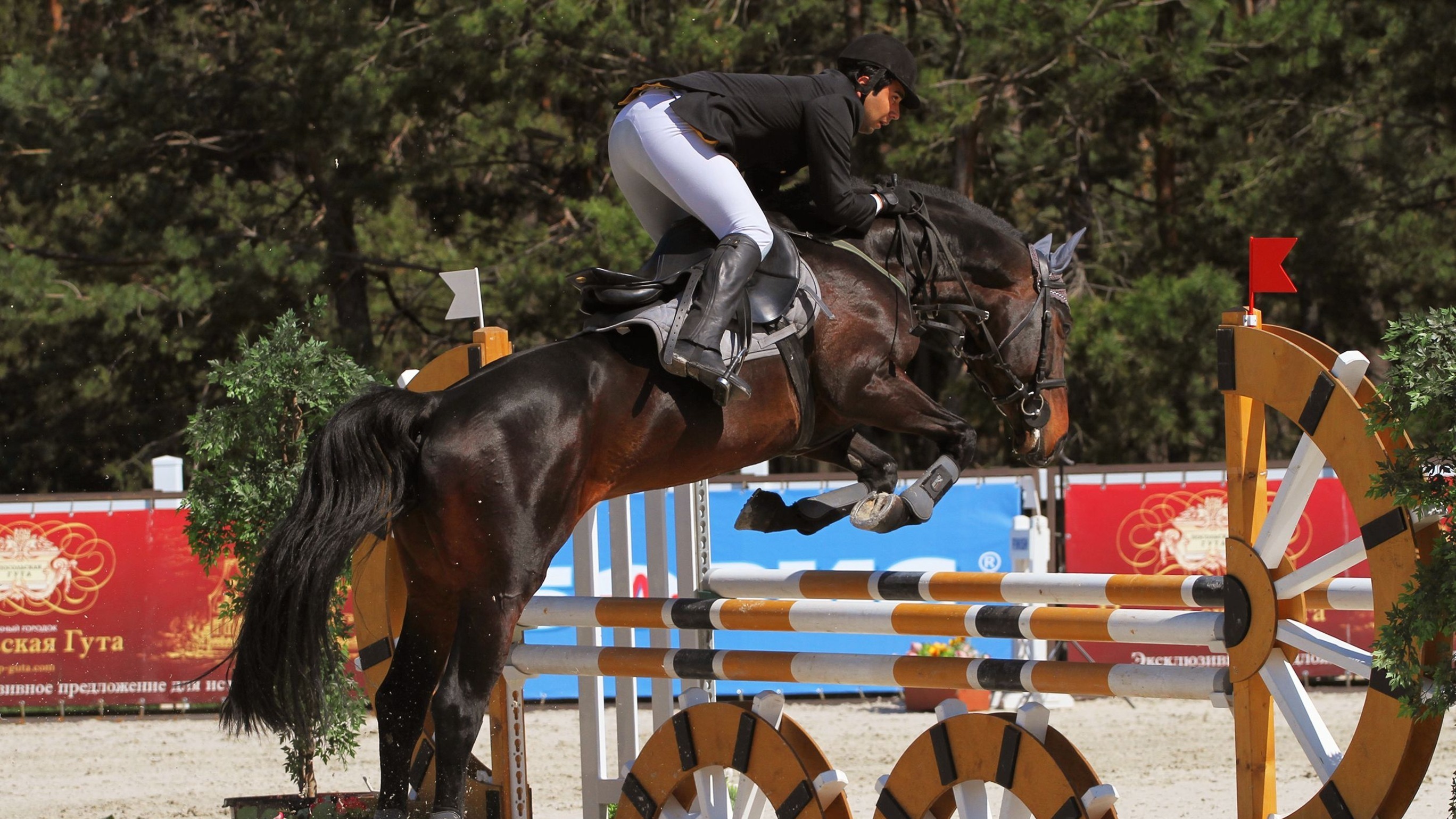
A show jumping jump-off is a shorter, timed course for the riders who are tied at the top after the first round, and the fastest clear round wins. At Lyon on 1 November, Julien Epaillard won one in 38.17 seconds, with Germany's Richard Vogel 0.03 seconds behind.
Forty started, fourteen came back
Forty riders started the first round of the Longines FEI Jumping World Cup class in Lyon, and 14 returned for the jump-off, according to the Chronicle of the Horse. Spain's Santiago Varela designed the course.
Switzerland's Edouard Schmitz was the first to get under 40 seconds. His 38.31 held for third. Then Epaillard turned back to the double combination and rode it at high speed, clear in 38.17 on Le Coultre de Muze.
That left Vogel. On Cloudio he took a risk on a tall vertical, slicing it, then regrouped in the turn and galloped to the last oxer. The clock stopped at 38.20.
Schmitz finished 0.14 seconds behind the winner. Vogel was 0.03 behind. Both are tiny numbers, and one of them cost a World Cup win.
How faults work, in about a minute
Under the most common scoring table, each knocked-down obstacle adds 4 penalties, according to Equestrian Australia. The first refusal, when the horse stops short of the jump or runs around it, also adds 4. A second refusal or any fall means elimination. Riders who go over the time allowed pick up 1 fault for every second or part of a second.
Riders are ranked by penalties. If the class has no jump-off, the fastest of the clear rounds wins. If it has one, tied riders jump a shorter timed course. The fewest penalties wins, and time breaks any tie that is left.
So a rail in a jump-off is usually the end of the story. Penalties count first, and time only separates riders who are level on penalties. There is a second scoring style, used in speed classes, where faults are converted into seconds and added to the time.
The stride Vogel did not need
Vogel said afterwards that margins at this level are shrinking and that "every detail and small decision matters." He added that he could have left a stride out in two places and still won.
That is the whole sport in one admission. Every shortcut in a jump-off saves time, and every shortcut that goes wrong can cost four faults. The Chronicle's headline says he thrilled his home crowd. Lyon is in France, and Epaillard rides for France.
Epaillard has history here. He won in Lyon in 2022 and finished second in 2023 and 2024, according to the Chronicle.
A horse he was still getting to know
Le Coultre de Muze is a 15-year-old Belgian Warmblood stallion owned by Christian Baillet. Epaillard took over the ride from Philippe Rozier in November 2025, and the horse had to overcome an injury early in the partnership. This was their first five-star Grand Prix win together.
"We had to get to know each other," Epaillard said. He says they are now "really in sync as a team." He also called Lyon one of the best shows of the year and said the World Cup Final is an objective.
He took the ride in November 2025 and won with it in November 2026.
Watching it unfold
Buzzer carries a free, 24-hour stream from EQUUS Television on Buzzer Arena TV, which Buzzer announced on 29 April. The network lists show jumping among its programmes, alongside polo, western sports, equine health and training. Viewers can watch on Smart TVs, mobile, tablets and the web, and Buzzer has the full announcement. Live events from other sports are on Buzzer Arena TV.
Vogel lost by 0.03 seconds. One rail down would have cost him four faults, and that would have been the end of it.





 0