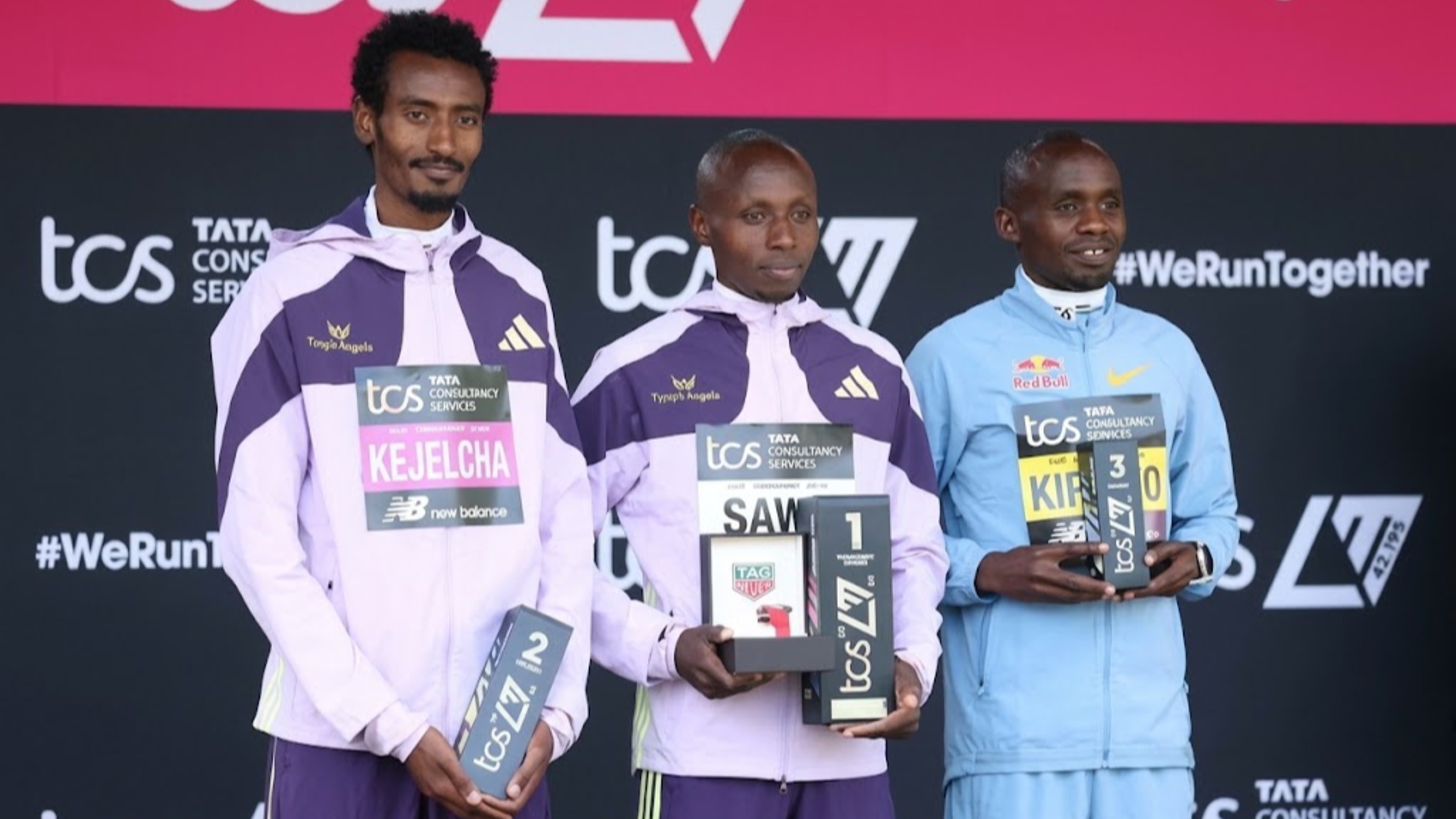
In a recent marathon in London, three men ran faster than the marathon world record in the same race. They came from three different countries.
Kenya’s Sabastian Sawe won in 1:59:30, the first sub-two-hour marathon in a record-eligible race. Ethiopia’s Yomif Kejelcha was second in 1:59:41 in his marathon debut, the fastest debut in history, and Uganda’s Jacob Kiplimo was third in 2:00:28. All three beat the previous mark of 2:00:35, set by the late Kelvin Kiptum in 2023.
That’s one race, one course and one afternoon, and it says more about distance running than a decade of altitude arguments.
The explanation everybody reaches for
Altitude and genetics get most of the credit when people talk about Kenya and Ethiopia. They make a tidy explanation, which is the main reason they last. They can’t account for a Ugandan finishing third, or for an Ethiopian running the fastest debut ever, or for the speed at which the record has been dropping.
A better explanation is that distance running at the top is a system. It has training groups, coaches, pacemakers, a calendar of races with prize money and a pathway that tells a teenager what the job looks like.
London showed the system at work. Sawe went through halfway in 1:00:29 with Kejelcha beside him, then ran the second half in 59:01 after the final pacemaker stepped off near 25 kilometres. His 24th mile, 4:12, was the fastest single mile split recorded in any marathon.
Sawe’s progress is a useful case study. His marathon debut, 2:02:05, was the second-fastest debut ever, 12 seconds behind Kiptum’s. Two years later he had the world record.
The part that can travel
If altitude were the whole answer, the record would belong to a short list of places and nobody else. Instead, the all-time top five now includes a Kenyan, an Ethiopian and a Ugandan, with Kiptum’s 2:00:35, Eliud Kipchoge’s 2:01:09 from Berlin in 2022 and Amos Kipruto’s matching 2:01:09 from Chicago this year close behind.
That’s not a story about a single place. It’s a story about a method that can be exported: groups that train together, athletes who race often against stronger fields, and organisers who put up prizes big enough to keep talent in the sport.
It also helps that the finish line keeps moving. Kipchoge ran 1:59:40 in Vienna in 2019 in an exhibition that didn’t count as a record, and Sawe’s run in London was ten seconds faster in an open race. The barrier everyone pointed at has been broken, and the next question is how much further the time can fall.
Women’s distance running is following a similar pattern. Tigst Assefa set a women-only marathon world record of 2:15:41 in the same London weekend, which is a reminder that the system isn’t limited to one gender or one country.
What reproducing it would take
Copying the system isn’t the same as copying a location. A country that wanted to build a distance-running pipeline would need coaches who understand the work, a calendar of races, a way to pay athletes enough to keep them running and a culture that treats the sport as a career.
None of that requires a specific altitude. It requires patience, because it takes years to build a group of runners good enough to push each other, and a federation willing to keep the structure in place when the early results are modest.
The risk is that a system that looks inevitable from outside is actually fragile. Take away the races, the prize money or the training groups and the results thin out quickly.
If three men from three countries can break the old world record in the same race, how long before the question stops being about Kenya and Ethiopia at all?





 3