Buzzer Coin$0.00$BUZZER
Search
americansports
americansports
66
Uploads
132
Followers
15
Following
Newbie
Newbie0 minutes20,81 Karma
Arrow Right
americansports

2 months ago

No debate gets football fans going quite like "Messi or Ronaldo?" It splits friend groups, fuels endless arguments, and even casual fans have an opinion.


This isn't a piece designed to dunk on Cristiano Ronaldo, he's one of the greatest athletes of his generation. But ask most neutral, well-informed observers who they'd pick if their career depended on one performance, and the needle tips toward Lionel Messi. This article is about why: the numbers, the feel of watching them play, the context they operated in, and what their peers have said. Both stories are remarkable. One is just slightly more remarkable.

## **Two Different Kinds of Genius**

Cristiano Ronaldo is the perfect modern athlete. He started as a flashy winger at Sporting Lisbon and Manchester United, all step-overs and showmanship, and through obsessive dedication to his body and his finishing, reinvented himself into a ruthless goal-scoring machine, still fast, still strong, able to finish with either foot or his head from almost any angle. His career is a testament to willpower: proof that talent plus obsession can produce something otherworldly.


Messi is different. Where Ronaldo built himself into a superhero, Messi looks like an ordinary man who happens to do impossible things with a ball at his feet. Not particularly tall, not blazing fast, doesn't dominate the air, and yet for two decades he's been arguably the least stoppable attacking player on the planet. His genius isn't built; it looks like it was just *there*. Close control, vision, balance, the ability to change direction in a way that seems to break physics. Ronaldo conquers the game; Messi dissolves into it and slips through gaps nobody else sees.

Both are valid forms of greatness. But watching Messi feels closer to art, and watching Ronaldo feels closer to engineering. Most people, when they think about what makes sport beautiful, gravitate toward the art.

## **The Trophy Case: Substance Over Symmetry**

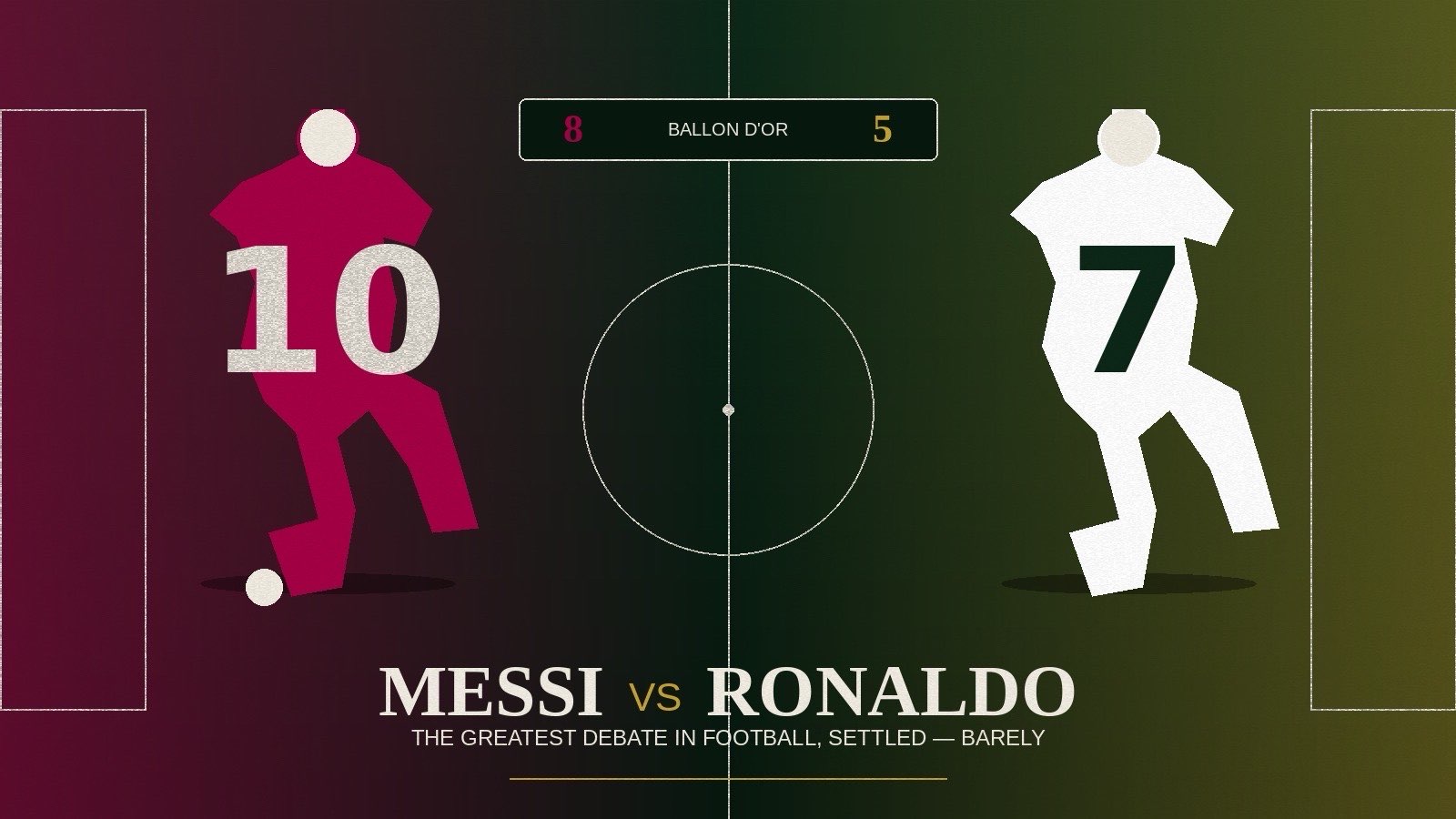
Messi has won the Ballon d'Or, football's most prestigious individual award, eight times, a record nobody else is close to touching. Ronaldo has won it five times, itself phenomenal. The gap is real, though individual awards can be shaped by narratives and marketing as much as merit.


Team trophies tell a more interesting story. Both have multiple Champions League titles, Ronaldo five, Messi four, plus stacks of domestic honors. Ronaldo edges ahead here, and that matters: the Champions League is the toughest club competition in the world.


But context matters too. Ronaldo won his five across two genuine super-clubs: Manchester United and Real Madrid, the most successful club in the competition's history, stacked year after year with elite talent assembled specifically to win it. Messi won his four entirely with Barcelona, where he was frequently *the* reason the team succeeded rather than one beneficiary among several world-class attackers.

Then there's the international stage, long considered Messi's glaring weakness.


## The World Cup: From Burden to Redemption

For years, the strongest argument for Ronaldo was simple: Messi hadn't won a World Cup, while Ronaldo's Portugal had at least claimed a European Championship in 2016. Messi had reached a World Cup final in 2014 and lost, and lost multiple Copa América finals with Argentina, sometimes heartbreakingly. The narrative calcified: the greatest player who could never win the big one for his country.


Then 2021 happened. Argentina won the Copa América, with Messi as captain and driving force, breaking a 28-year trophy drought. You could see what it meant to him on the pitch.


And then came Qatar 2022. Messi, in what was almost certainly his final World Cup, dragged a talented but inconsistent Argentina through the tournament, scoring crucial goals, controlling games with veteran composure, and capping it with arguably the greatest World Cup final ever played, a 3-3 thriller against France decided on penalties, with Messi scoring twice in regulation and once more in the shootout. He lifted the trophy that had eluded him his entire career, finally completing the one chapter critics said would always be missing.


Ronaldo has never reached a World Cup final; his best result remains a 2006 semifinal as a peripheral part of a talented squad. In Qatar 2022, the same tournament where Messi achieved redemption, Ronaldo was benched for crucial knockout matches, reportedly clashed with his manager, and watched Portugal exit in the quarterfinals.


This matters enormously. The World Cup is the purest test of what a player can do stripped of elite teammates assembled by billionaire owners, representing only their home nation's talent pool. Messi now has that trophy. Ronaldo does not. In a debate that hinges on complete résumés, that's arguably the deciding factor.


## The Eye Test: Watching Genius Happen

Trophies and stats can be argued over forever, but ask anyone who's actually watched both players for two decades, and you'll often hear some version of the same thing: Messi makes you gasp in a different way.


Ronaldo's greatness is often described in terms of power, precision, and consistency. His bicycle kicks are technically jaw-dropping. His headers, for a man who isn't especially tall, are legendary, a product of timing and a freakish vertical leap. His free kicks, when they're on, are unstoppable knuckleball strikes. Watching him is like watching a perfectly tuned machine execute difficult tasks with mechanical reliability, season after season, well into his late 30s. There's real beauty in that. Discipline as art form.


Messi's greatness operates on a different register. It's less about explosive power and more about an almost telepathic relationship with the ball and the spaces around him. He'll receive a pass in a crowd of three defenders, and somehow, in the space of a single touch, he's gone, not because he's faster than them, but because he saw an angle nobody else on the pitch saw, including the people watching live in the stadium. His dribbling isn't about speed; it's about disguise, rhythm changes, and a low center of gravity that makes him almost impossible to dispossess cleanly. Commentators have run out of new ways to describe it because it keeps happening in ways that defy fresh description.


This is part of why neutral fans, people with no club loyalty to either Barcelona or Real Madrid or Manchester United, so often end up gravitating to Messi. Ronaldo's brilliance feels earned and visible; you can see the gym sessions and the discipline behind every header. Messi's brilliance feels like a gift from somewhere else, something that can't quite be explained by hard work alone, however hard he's actually worked (and by all accounts, he's worked plenty). There's a mystery to it that keeps pulling people in.


## Team-Dependency: Who Elevated Whom?

One of the more sophisticated arguments in this debate is about team-dependency essentially, how much each player relied on elite teammates versus how much they single-handedly created success.


Ronaldo has often played in systems explicitly built to feed him the ball in dangerous positions, surrounded by elite creative players whose job, in large part, was to set him up. At Real Madrid in particular, the entire attacking structure under multiple managers was oriented around getting Ronaldo into positions where he could finish, and he did, with brutal consistency.


Messi, especially during his Barcelona prime, was often the **source** of the creation as much as the finisher. He wasn't just scoring goals; he was the one breaking lines, drawing three defenders, and laying the ball off to a teammate who then got the easy finish. His assist numbers across his career are extraordinary, rivaling or exceeding many of the best pure playmakers in history, while **also** being one of the greatest pure goal scorers ever. That dual production, being both the primary creator and the primary scorer for the same team over a fifteen-year stretch, is almost unheard of in football history.


There's also the Paris Saint-Germain test case, which is instructive precisely because it didn't go well for either player relative to their peaks. Messi's two seasons there were underwhelming by his own standards, and it's fair to use that as evidence that even Messi benefits from the right system. But it's worth noting Ronaldo's later-career stints, at Manchester United the second time around, and then in Saudi Arabia with Al-Nassr, also showed diminishing returns in terms of team success, even while his individual scoring numbers stayed gaudy. Both players, like all players, are shaped by their surroundings. The difference is that for most of their careers, Messi's surroundings were shaped *around* him in ways that maximized the team, not just his stat line.

## Longevity and Adaptability

Ronaldo deserves enormous credit for his longevity. Playing at an elite level into his late 30s, still scoring goals in major leagues, is a genuine testament to his professionalism and physical conditioning. Few athletes in any sport have maintained that level of output for so long.


But longevity isn't only about scoring goals in less competitive leagues later in a career, it's also about adaptability at the highest level. Messi, well into his mid-30s, was still being deployed as a creative hub for Argentina's national team and delivering at World Cups, not just padding stats in friendlies. His game has always relied less on pure athleticism and more on technique, vision, and game intelligence, qualities that, by nature, decline more slowly than raw speed and explosiveness. That's part of why his peak has, in some ways, lasted longer in terms of impact on genuinely difficult occasions, even if his sprint speed naturally isn't what it was a decade ago.


##  What the People Who Played With and Against Them Say

It's worth pausing on something that often gets lost in fan arguments: what actual elite footballers, the people who had to defend against these two, or play alongside them, tend to say.

Ask defenders who they'd rather face, and an overwhelming number will tell you Messi was the harder problem to solve, specifically because Ronaldo's threats, while devastating, were more predictable: get in behind, win the position, finish. Messi's threats were almost impossible to scout for, because he could beat you in five different ways from the same starting position, and the decision happened in a split second that defenders simply couldn't anticipate.


Managers across both their careers, including ones who coached against them dozens of times, have repeatedly described Messi as the more complete and more bewildering attacking puzzle. None of this is to say Ronaldo wasn't feared, he absolutely was, and remains one of the most lethal finishers the sport has ever produced. But there's a meaningful difference between "I know what he's going to do and I still can't stop it" (Ronaldo, often) and "I genuinely don't know what he's about to do" (Messi, almost always).


## Acknowledging the Strongest Counter-Arguments

A fair piece has to take the other side seriously, so let's do that directly.


**The longevity and goal-scoring volume argument**. Ronaldo's sheer career goal tally, especially when you fold in his prolific scoring well into his late 30s and into less competitive leagues, is staggering, and some would argue volume itself is a form of greatness that shouldn't be discounted just because the competition level varied across different chapters of his career.


**The peak-individual-season argument.** There are statisticians and fans who'll point to specific Ronaldo seasons, his 2014-15 Real Madrid form, for instance, as the single greatest scoring output in football history, arguably superior to any individual Messi season in pure scoring terms.


**The physical specimen argument.** Ronaldo's combination of strength, speed, leap, and two-footed finishing represents a more "complete" physical toolkit that some argue is simply harder to replicate or coach than Messi's more singular, almost freakish dribbling gift.


**The Champions League count.** Five versus four isn't a trivial gap, and Champions League pedigree carries real weight in any GOAT conversation.


These are legitimate points, made by serious, knowledgeable football people, and anyone telling you the debate is one-sided is oversimplifying. Ronaldo's case is strong. It's just, on balance, slightly less strong.

##  Why "Leaning Messi" Still Feels Like the Right Call

So why, after all that nuance, does the scale still tip toward Messi for most neutral observers?

It comes down to a combination of factors stacking in the same direction: the unmatched individual-award record, the dual goal-scoring-and-creating production that's nearly unprecedented in the sport's history, the way he's spoken of by the players who had to defend or play with him, and, perhaps most decisively, the completion of his international legacy with the 2022 World Cup, closing the one real gap that used to separate his résumé from a "perfect" one. Ronaldo's career, for all its brilliance, still has that World Cup-shaped hole in it, and in a debate this close, that detail carries real weight.


It also comes down to something harder to quantify: the feeling of watching him play. Football isn't just trophies and stat sheets — it's art, entertainment, collective joy. Ask people to describe the greatest moment of pure footballing magic they've ever witnessed, and an outsized share involve a small Argentine running through a crowd of opponents like they weren't there.

## **The Final Word (For Now)**

None of this is meant to diminish Cristiano Ronaldo, who will go down as one of the two or three greatest players to ever live, a generational athlete whose work ethic should be studied for decades. This isn't really "Messi good, Ronaldo bad." It's a recognition that in an era blessed with two transcendent talents pushing each other to historic heights for nearly two decades, one of them happened to be playing a slightly different, slightly rarer kind of game, one built on vision and improvisation rather than power and precision, and one that, by the end, also delivered the one trophy that used to be the asterisk on an otherwise perfect career.

The debate will never fully end, and honestly, that's part of what makes it fun. But if you're asking which side of the argument has slightly better footing, the numbers, the World Cup, the testimony of the people who actually had to deal with him on the pitch, it's Messi, by a narrow but real margin.
GENERAL

Messi vs. Ronaldo: Why the Magician Edges Out the Machine

Like icon
1
Comments icon
Shares icon