Buzzer Coin$0.00$BUZZER
Search
13
Uploads
126
Followers
11
Following
Newbie
Newbie0 minutes0,52 Karma
Arrow Right
marviblack

about a month ago

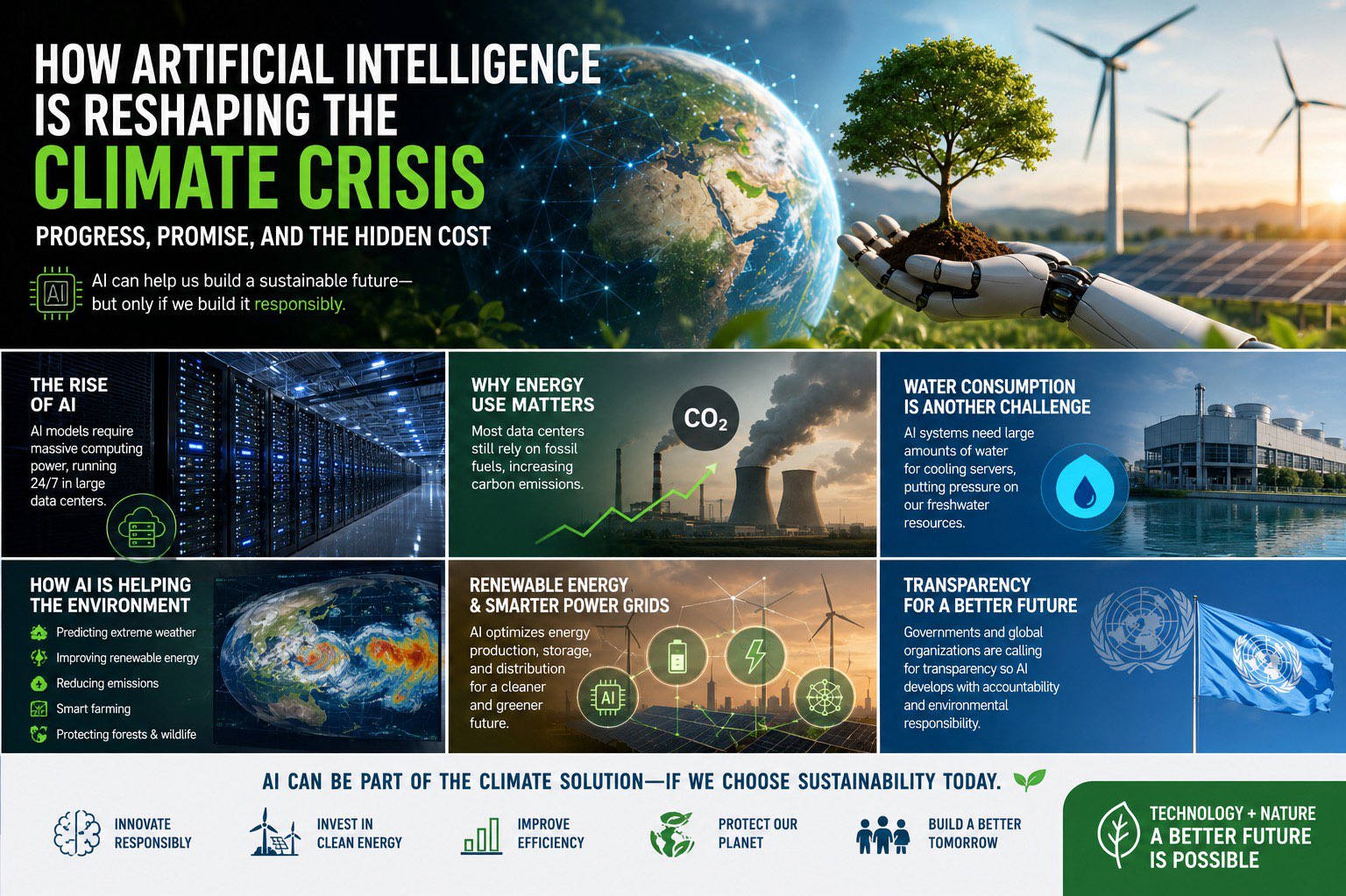
Artificial intelligence (AI) has rapidly become one of the most transformative technologies of the 21st century. From helping doctors diagnose diseases to creating digital art, AI is changing how people work, communicate, and solve problems. However, as AI continues to expand, scientists and environmental experts are raising an important question: Can AI help fight climate change while also contributing to it?


Recent reports show that the growing demand for AI is leading to the construction of thousands of new data centers around the world. These facilities require enormous amounts of electricity and water to operate and cool their servers. As companies race to build more powerful AI systems, their environmental impact has become a major global concern. At the same time, AI is also proving to be an important tool in predicting extreme weather, improving renewable energy systems, reducing waste, and helping researchers better understand climate change.  


The Rise of AI


Artificial intelligence has experienced unprecedented growth over the past few years. Millions of people now use AI-powered tools daily for education, business, entertainment, writing, and software development.


Technology companies are investing billions of dollars into developing smarter AI models capable of performing increasingly complex tasks. This rapid expansion requires massive computing power, which depends on large-scale data centers operating around the clock.  


What Are Data Centers?


Data centers are buildings filled with powerful computers that store information and process internet traffic. Every time someone asks an AI assistant a question, generates an image, or uses AI software, data centers perform the calculations behind the scenes.


Modern AI models require significantly more computing resources than traditional internet searches. This means more electricity, larger facilities, and additional cooling systems.


Experts estimate that electricity demand from AI data centers could rise dramatically over the next decade if current growth continues.  


Why Energy Use Matters


Most electricity around the world is still generated using fossil fuels such as coal and natural gas.


When AI data centers consume more electricity, they may indirectly increase carbon emissions unless they are powered by renewable energy.


Several leading technology companies have acknowledged that their greenhouse gas emissions have increased as they expand AI infrastructure, making it harder to achieve previously announced climate goals.  


Water Consumption Is Another Challenge


Many people don’t realize that AI also requires large amounts of water.


Servers generate enormous heat while processing information. Cooling systems often rely on water to prevent overheating.


Environmental researchers warn that global AI expansion could significantly increase freshwater consumption, especially in regions already facing water shortages.  


How AI Is Helping the Environment


Despite these challenges, AI also offers remarkable opportunities to protect the environment.


Scientists are using AI to:


* Predict hurricanes, floods, and wildfires earlier.

* Improve weather forecasting.

* Optimize renewable energy production.

* Reduce traffic congestion and fuel consumption.

* Detect methane leaks from oil and gas infrastructure.

* Improve farming by reducing water and fertilizer use.

* Monitor forests and wildlife.


Researchers believe these applications could help reduce emissions and make communities more resilient to climate change.  


Renewable Energy and Smarter Power Grids


AI is helping electricity companies manage power more efficiently.


Because solar and wind energy depend on weather conditions, AI analyzes forecasts and electricity demand to determine when energy should be stored or distributed.


This makes renewable energy more reliable while reducing waste.


Many experts believe AI-powered energy management will become increasingly important as countries transition toward cleaner electricity.  


Governments Want Greater Transparency


International organizations are beginning to call for greater openness about AI’s environmental footprint.


In June 2026, the United Nations announced an initiative encouraging AI companies to publicly disclose their carbon emissions, water use, land requirements, and renewable energy commitments. The goal is to ensure that technological innovation develops alongside environmental responsibility.  


The Debate Continues


Some researchers argue that AI’s environmental benefits could outweigh its costs if governments and companies invest heavily in renewable energy and energy-efficient technologies.


Others believe the rapid expansion of AI risks increasing global emissions before cleaner energy infrastructure is ready.


Both perspectives agree on one point: AI’s environmental impact depends largely on how governments, businesses, and consumers choose to develop and use the technology.  


Looking Ahead


Artificial intelligence is likely to remain one of the defining technologies of this century. It has the potential to revolutionize healthcare, education, transportation, agriculture, and scientific research.


However, its future success will not be measured only by how intelligent AI becomes, but also by how responsibly it is developed.


Balancing innovation with sustainability will be one of the biggest challenges facing governments, technology companies, and society over the coming years.


Conclusion


Artificial intelligence presents both opportunities and challenges for the environment. While AI consumes growing amounts of electricity and water through expanding data centers, it also offers powerful tools for addressing climate change, improving renewable energy systems, and protecting natural resources.


The coming decade will determine whether AI becomes part of the climate solution—or adds to the problem. Achieving the right balance will require investment in renewable energy, greater transparency from technology companies, and responsible use of AI by individuals and organizations alike.
GENERAL

How Artificial Intelligence Is Reshaping the Climate Crisis: Progress, Promise, and the Hidden Cost

Like icon
3
Comments icon
Shares icon 4
marviblack

about a month ago

* ⚽  2026 FIFA World Cup Quarterfinals: Two major quarterfinal matches are being played today:

    * Norway vs. England

    * Argentina vs. Switzerland

    The World Cup, hosted by the United States, Canada, and Mexico, has attracted record-breaking crowds and TV audiences across the U.S.  

* ⚾ Major League Baseball (MLB): A full slate of regular-season games is underway, including matchups such as:

    * New York Yankees vs. Washington Nationals

    * Boston Red Sox vs. New York Mets

    * Arizona Diamondbacks vs. Los Angeles Dodgers  

* 🏀 NBA Summer League: Young NBA players and recent draft picks are competing in Las Vegas as teams evaluate new talent ahead of the upcoming NBA season.  

* 🎾 Wimbledon: The women’s singles final is taking place today in London, one of the biggest matches of the tennis season.  

* 🚴 Tour de France: Stage 8 of the famous cycling race is also being contested today.  

At the moment, there are no live World Cup matches in progress. The next quarterfinals are:


* 🇳🇴 Norway vs England — kicks off later today.

* 🇦🇷 Argentina vs Switzerland — follows later tonight.


The first two quarterfinals have already finished:


* 🇫🇷 France 2–0 Morocco

* 🇪🇸 Spain 2–1 Belgium  


I’ll be happy to provide live score updates, goals, cards, and match statistics once either game begins.  

There aren’t any live updates yet because Argentina vs Switzerland has not kicked off. The quarterfinal is still scheduled to begin later today in Kansas City.  


Before kickoff:


* 🇦🇷 Argentina are the defending World Cup champions and are led by Lionel Messi.

* 🇨🇭 Switzerland reached the quarterfinal after eliminating Colombia in a penalty shootout.

* The winner will advance to the semifinal to face the winner of Norway vs England.  


For Argentina to reach the 2026 FIFA World Cup Final, they need to win two knockout matches:


1. Quarterfinal: 🇦🇷 Argentina vs. 🇨🇭 Switzerland.

2. Semifinal: If Argentina beat Switzerland, they will face the winner of Norway vs. England.


If Argentina win both matches, they will qualify for the World Cup Final.


Argentina’s route looks like this:


* ✅ Quarterfinal: Beat Switzerland

* ✅ Semifinal: Beat Norway or England

* 🏆 Final: Play the winner from the other side of the bracket (which could be France or Spain, depending on semifinal results).


Argentina have been one of the tournament favorites, but from the quarterfinals onward, every match is a single-elimination game—if they lose, they are out of the tournament.


Argentina’s last World Cup match before facing Switzerland was a Round of 16 game against Egypt.


Result:


* 🇦🇷 Argentina 3–2 Egypt 🇪🇬


Argentina staged a dramatic comeback after trailing 2–0 with about 11 minutes left. They scored three late goals to win 3–2 and advance to the quarterfinals against Switzerland.  


That thrilling victory set up today’s quarterfinal clash with Switzerland.


That match was one of the most dramatic of the tournament.


Argentina 3–2 Egypt (Round of 16)


* 🇪🇬 Egypt took a 2–0 lead, putting Argentina on the brink of elimination.

* 🇦🇷 Argentina mounted a late comeback, scoring three goals in the closing stages of the match.

* The winning goal came in the final minutes, completing a remarkable turnaround.

* The victory sent Argentina through to the World Cup quarterfinals, where they are scheduled to face Switzerland.


The comeback highlighted Argentina’s resilience and attacking quality under pressure, turning what looked like an imminent exit into a place in the last eight.
GENERAL

Here are today’s top U.S. sports highlights for Saturday, July 11, 2026:

Like icon
1
Comments icon
Shares icon 4