Buzzer Coin$0.00$BUZZER
Search
playbyvedika
playbyvedika
4
Uploads
106
Followers
2
Following
Newbie
Newbie0 minutes0,80 Karma
Arrow Right
playbyvedika

13 days ago

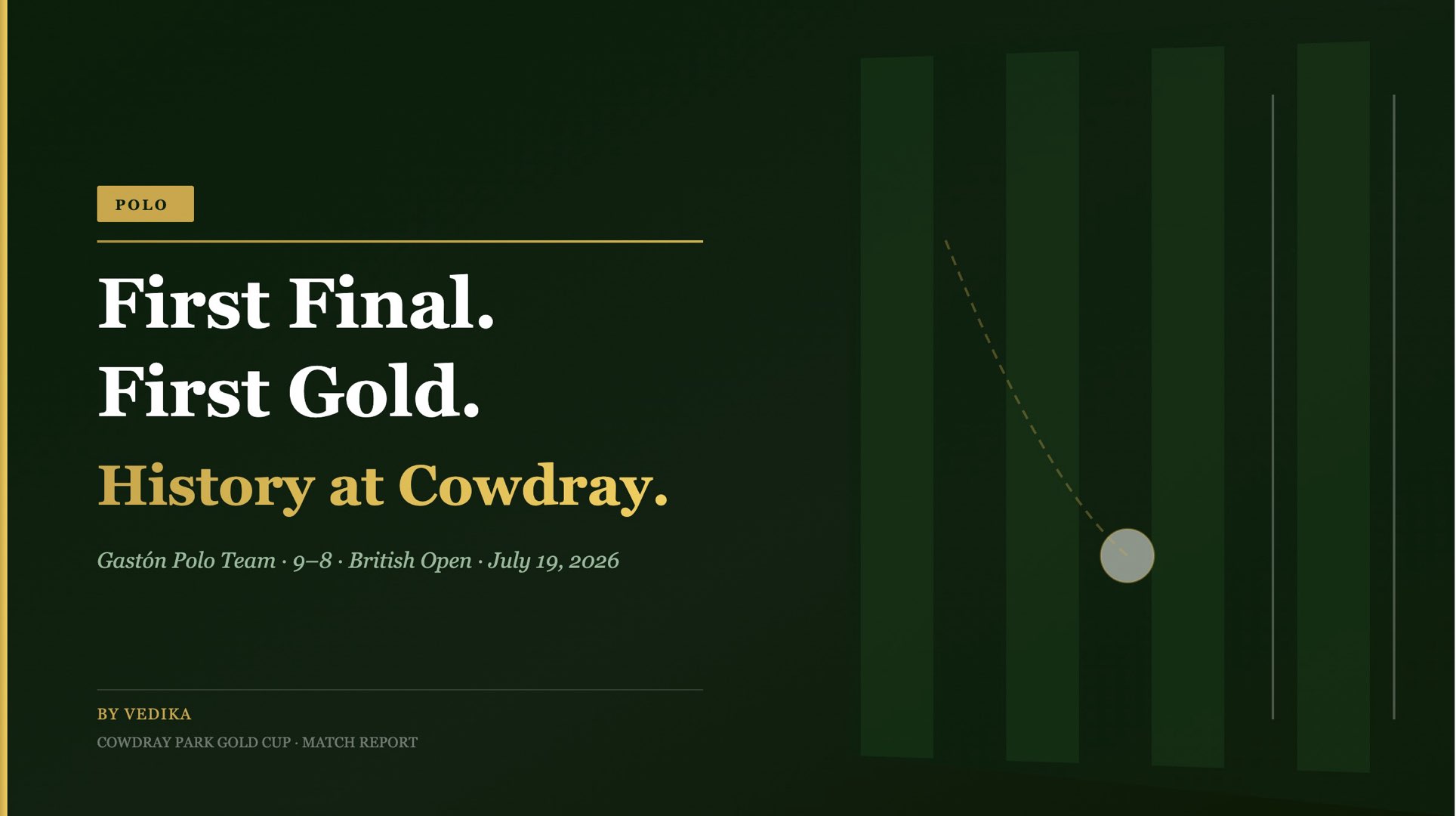
A breathless 9-8 victory in their debut Gold Cup final gave Gastón Polo Team one of

the most remarkable debut wins in the history of British polo.

The Cowdray Park Gold Cup — formally the British Open Polo Championship — is one of

the three tournaments that make up polo's unofficial Triple Crown, alongside the Argentine

Open and the US Open. To win it is to claim a place among the sport's most coveted

prizes. To win it in your first-ever appearance in the final is something altogether rarer —

and that is precisely what Gastón Polo Team achieved on July 19, 2026 in West Sussex.

The final, played at Cowdray Park Polo Club in front of a packed crowd, ended 9-8 in

Gastón's favour against a formidable Dubai Polo Team side that had every reason to

expect victory of their own. The margin was a single goal. The tension, by all accounts,

was considerable. But when the final bell rang, it was Gastón Polo Team raising the trophy

in what the sport will remember as a debut of extraordinary audacity.

The winning roster tells its own story. Jean Paul Luksic, the team's patron and owner,

anchored the side at a zero handicap — the non-professional slot typical of patron-funded

teams — while Cruz Heguy (handicap 7), Gonzalo Ferrari (8), and Beltrán Laulhé (7)

provided the competitive firepower. It was Heguy who was named Most Valuable Player of

the final, recognition for a performance that combined the physicality and precision the

Gold Cup demands at its highest level.

The Dubai Polo Team, meanwhile, brought one of the most formidable lineups in the

competition. Bartolomé Castagnola — rated at a nine handicap and among the world's elite

players — led their attack alongside Antonio Heguy (7) and Santos Merlos (6). That

Gastón's defence held and their attack ultimately proved the difference is a testament to

how well the team functioned as a unit under the specific pressures of championship polo.

Castagnola, despite being on the losing side, won the Best Player Pony award for his mare

Alberta Yaguara — a recognition of individual excellence even in defeat.High-goal polo, played at the 22-goal handicap level that the Gold Cup demands, is one of

the most physically intense team sports in the world. The game is played across six or

eight chukkas of seven minutes each, with players switching ponies between chukkas to

maintain the speed and aggression that the format requires. Each team's patron typically

provides the horses — often dozens of them across a tournament — and the logistical and

financial scale of competing at this level is considerable. The fact that 19 teams entered the

2026 tournament speaks to the Gold Cup's enduring appeal.

Cowdray Park itself, set in the West Sussex countryside beneath the ruins of a Tudor

castle, is one of sport's more atmospheric venues. The Gold Cup final draws a crowd that

blends serious polo enthusiasts with the broader spectacle of a summer occasion —

picnics on the hillsides, the divot-stomping tradition between chukkas, the particular hush

that falls when a game this close reaches its final moments.

For Gastón Polo Team, those final moments ended in celebration. For Dubai, in the narrow

frustration of a one-goal defeat in a match they were well-equipped to win. That is

high-goal polo in its purest form — the finest players and ponies in the world, a scoreline

settled by the smallest of margins, and a trophy that changes hands in ways that nobody

quite predicted.

First final. First Gold Cup. The name Gastón Polo Team is now written into the

history of British polo — and on evidence like this, it will not be the last time.
POLO

First Final, First Gold

Like icon
2
Comments icon
Shares icon 1
playbyvedika

13 days ago

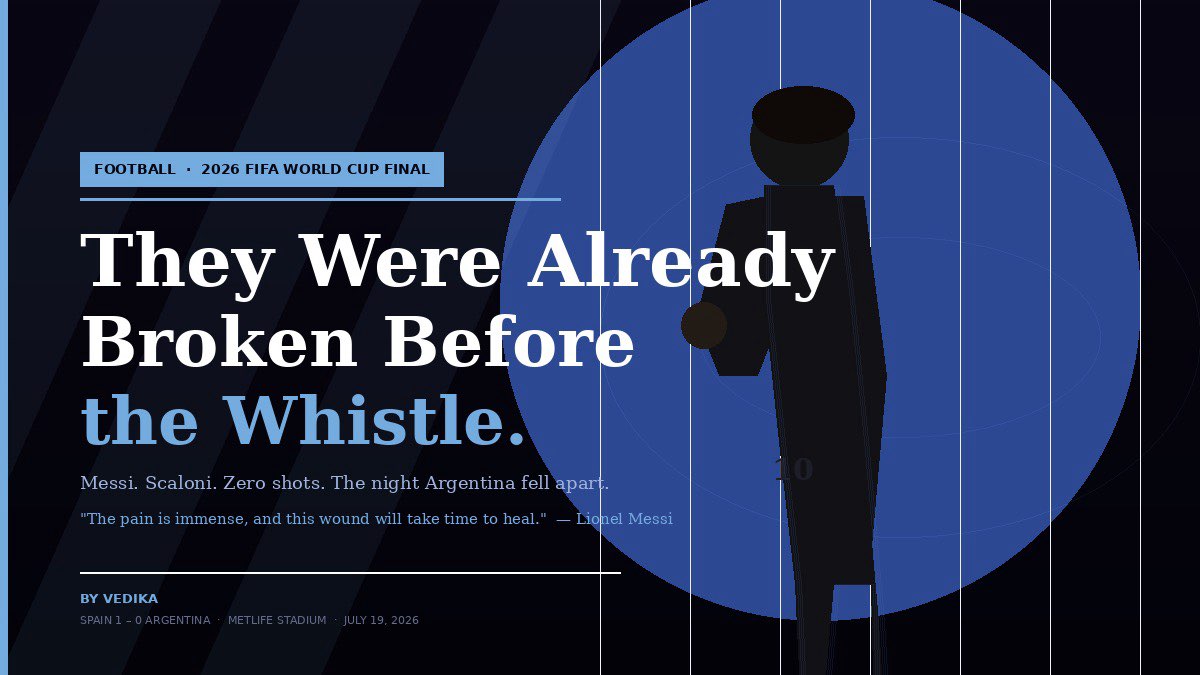
Argentina arrived at MetLife Stadium as defending champions. They left with zero

shots on target, a nation in tears, and the haunting sense that they knew,

somehow, before it even started.

The videos emerged before the match even kicked off. Players in blue and white, heads

bowed, some visibly emotional in the tunnel and the dressing room. A team that had

conquered the world four years earlier in Qatar, that had arrived in North America as the

most beloved footballing nation on the planet, looking in those pre-match moments not like

champions defending their crown but like men already carrying the weight of something

they sensed was coming.

Whether it was premonition or simply the pressure of the occasion, the match itself

confirmed what those images hinted at. Argentina — the defending World Cup champions,

one of the most technically gifted squads assembled in a generation — were barely

present. They registered zero shots on target across 120 minutes of football. They held

possession for just 32% of the game. Spain did not just beat them. They suffocated them,

so completely and so clinically that the only question by the second half was not whether

Argentina could win, but whether they could find any way back into the match at all.

They could not. Ferran Torres, a substitute, scored in the 106th minute after Enzo

Fernández had been dismissed for a second yellow card in the 93rd. The final score was

Spain 1, Argentina 0. But the scoreline did not come close to capturing the gulf between

the two sides.

"The pain is immense, and this wound will take time to

heal."

Lionel Messi was seen crying on the pitch during the trophy ceremony. For a man who has

learned, across a career of unmatched longevity, to carry triumph and heartbreak with

extraordinary composure, the tears told their own story. The following day, he broke hissilence on social media with a message that was raw and unguarded in a way his public

statements rarely are. "The pain is immense, and this wound will take time to heal," he

wrote. "But I also hold onto all the good things."

At 39, Messi almost certainly played his final World Cup match on that July night in New

Jersey. He has not confirmed retirement from international football, but the speculation is

loud and the arithmetic is unforgiving. If this was the end, it was not the ending anyone —

least of all Messi — would have written.

Nicolás Otamendi confirmed his retirement from the national team in the hours after the

final whistle. Emiliano Martínez, who made 12 saves in the match — a World Cup final

record — had already hinted this might be his last tournament cycle. The sense of an era

ending, of a generation of players taking their final bow on the largest stage in football,

hung over the Argentine dressing room with a weight that numbers alone cannot measure.

Coach Lionel Scaloni was barely able to speak at his post-match press conference.

"Forming a group like this again, which is hard to recreate, and it hurts my soul," he said,

pausing repeatedly. "I'm sorry. Bear with me. I don't know if I can continue." These were

not the words of a manager processing a tactical defeat. They were the words of someone

watching something irreplaceable come to an end.

There was controversy too, in the aftermath. During the trophy presentation, Argentine

players — including Messi — turned to face their supporters rather than the podium as

Spain received their gold medals, breaking with the traditional protocol of the ceremony.

Spanish players and fans were critical of the gesture. But reports suggested it was grief,

not protest, that drove it. These were men turning toward the people who had come to

support them because they could not bear to turn away from them. It was a small, human

moment in the middle of enormous pain.

None of which diminishes what Spain achieved. Their dominance was total, their defensive

record across eight matches — just one goal conceded — extraordinary. They became the

first nation to hold both the men's and women's World Cup titles simultaneously, and Luis

de la Fuente, at 65, became the oldest coach ever to win the tournament. The trophy was

deserved. The victory was comprehensive.But the story of the 2026 World Cup final will be told through two lenses, and they are not

equal in weight. One is the story of Spain's triumph. The other is the story of Argentina's

collapse — not just the tactical implosion on the pitch, but the images before it, and the

tears after it, and the sense that a golden generation took the field for the last time and

found that the moment they had waited for had already passed.

The videos of those players in the tunnel before kick-off will stay with people long

after the trophy lift is forgotten. Sometimes sport shows you exactly what it costs —

and on July 19, 2026, Argentina showed you everything.
FOOTBALL (SOCCER)

They Were Already Broken Before The Whistle Blew.

Like icon
4
Comments icon
Shares icon 1
playbyvedika

13 days ago

The 2026-27 season kicks off on August 22, with a supercharged transfer window and

a title race that already looks like a two-horse contest.

Every Premier League season arrives with a sense of occasion, but the 2026-27 campaign

carries something extra. The World Cup summer compressed the usual rhythms of

preseason and recruitment into a shorter, more intense window. Players returned from

North America carrying medals and memories — some rejuvenated, others fatigued — and

clubs had less time than usual to rebuild before the fixtures kicked in. The season starts on

August 22, one week later than usual, a concession to a summer schedule already

stretched to its limits.

Into that compressed window, Arsenal have made the boldest statement. The £75 million

signing of Bruno Guimaraes from Newcastle United is not simply the biggest deal of the

summer — it is a declaration of intent from Mikel Arteta's side. Guimaraes has been one of

the Premier League's finest midfielders since arriving in England in 2022, a player whose

combination of pressing intensity, defensive awareness, and creative distribution has made

him irreplaceable for every team he has represented. Arteta has not bought a midfielder.

He has bought the missing piece.

The significance of this signing goes beyond the individual. Arsenal have spent the past

three seasons as genuine title contenders without converting that promise into a

championship. Each year, questions have been raised about depth, about whether the

squad has the quality to sustain a title challenge across 38 matches and multiple

competitions. Guimaraes, in the engine room of midfield, directly addresses that question.

He can control the tempo of a match, win the ball back in dangerous areas, and carry the

team through difficult periods when the game needs managing rather than creating.

For Newcastle, the loss stings, but the £75 million provides ammunition to rebuild. The club

moved quickly to bring in Lukas Hornicek from Braga for £25.7 million, a signal that Eddie

Howe's side intend to remain competitive rather than simply absorb the blow. Newcastle'stransformation over the past four years has been one of English football's genuine success

stories, and how they navigate this summer will test the depth of that project.

Elsewhere in the window, the activity has been significant. Nottingham Forest continue to

impress with their ambition, landing Ousmane Diomande from Sporting Lisbon for £34

million. Liverpool have secured Ronald Araujo on loan from Barcelona to shore up a

defensive unit that showed vulnerability last season. Chelsea remain perennially active,

adding Pep Chavarria while moving Trevoh Chalobah to Como.

The title picture, however, continues to narrow to a familiar contest. Arsenal and

Manchester City, with Pep Guardiola still at the helm and his squad largely intact, are the

two clubs most analysts identify as the genuine favourites. City's consistency over the past

decade has been extraordinary, and despite the attempts of several clubs to close the gap,

they remain the benchmark against which all Premier League ambitions are measured.

But Arsenal, this summer, have done something they haven't always managed in the

transfer market: they have signed the best available player at a position of need, without

overpaying, without hesitating, and without settling for second choice. That, as much as

anything, is what makes the 2026-27 season feel different.

The fixtures land on August 17. The campaign begins on August 22. The wait, for

now, is almost over.
FOOTBALL (SOCCER)

The Premier League Returns

Like icon
2
Comments icon
Shares icon 1
playbyvedika

13 days ago

August is the quietest month in the NHL calendar. The draft is done, free agency has

largely settled, and training camps are still weeks away. It is the time of year when the

league breathes, when players recover, and when general managers sit with their rosters

and contemplate whether what they have built is truly good enough. But quiet does not

mean still — and the summer of 2026 has produced one storyline that has refused to go

away.

Connor Hellebuyck, the Winnipeg Jets' three-time Vezina Trophy winner and one of the

best goaltenders of his generation, is at the centre of persistent trade rumours that have

defined the offseason conversation. Hellebuyck holds a full no-movement clause, meaning

no deal can happen without his consent — and Winnipeg's management has insisted he is

not available. Yet the speculation has not quieted. The Jets reportedly engaged in

preliminary discussions with the Buffalo Sabres before those talks came to nothing, and

the ripple effect of even that rumour has kept the hockey world watching.

Why does a player with a no-movement clause generate this level of noise? Because

Hellebuyck represents the kind of difference-maker that genuinely contending teams build

around. In a salary-cap league, finding a goaltender capable of stealing playoff series is the

single hardest roster construction challenge in the sport. Teams that have him don't want to

let go. Teams that don't have him will always wonder if they could find a way in. The mere

possibility of availability is enough to generate weeks of speculation.

The Hellebuyck situation is not the only significant storyline. Dylan Larkin of the Detroit Red

Wings formally requested a trade, a development complicated by a management transition

in Detroit that has slowed any resolution. Larkin, a captain and one of the franchise's most

important players, has identified Minnesota as a preferred destination — but the Red

Wings, amid internal restructuring, have not moved quickly to accommodate the request.The situation has the feel of one that will drag into training camp.

Elsewhere, the offseason has produced movement of a cleaner kind. Connor McMichael

was traded to the St. Louis Blues, who wasted little time signing him to a six-year extension

— a clear statement of faith in a young forward they see as a cornerstone. Devon Levi, a

promising young goaltender, has landed in Edmonton, adding depth behind one of the

league's strongest squads as the Oilers look to maintain their position as Stanley Cup

contenders. Meanwhile, Mason Marchment signed a five-year, $6.75 million AAV deal with

San Jose, returning to a city with personal meaning — his late father Bryan played there —

in a move that carried genuine emotional weight alongside the contractual significance.

As training camps approach in mid-September, the free agent market is described by those

who track it as largely picked clean. The big names have landed. The extensions have

been signed. What remains is the fine-tuning — the two-way deals, the professional tryout

agreements, the last pieces of depth that separate a functional roster from a truly complete

one.

The Hellebuyck situation, though, will keep the hockey world engaged right up until

the puck drops on the new season. Because even when nothing is happening, the

possibility that something could is enough. That is the nature of the NHL's most

compelling offseason chess match. Everyone is waiting to see who blinks first —

and so far, nobody has.
ICE HOCKEY

The Hellebuyck Question That Nobody Can Answer.

Like icon
3
Comments icon
Shares icon 1