




 0

Kipchoge's Asterisk Is Getting Old
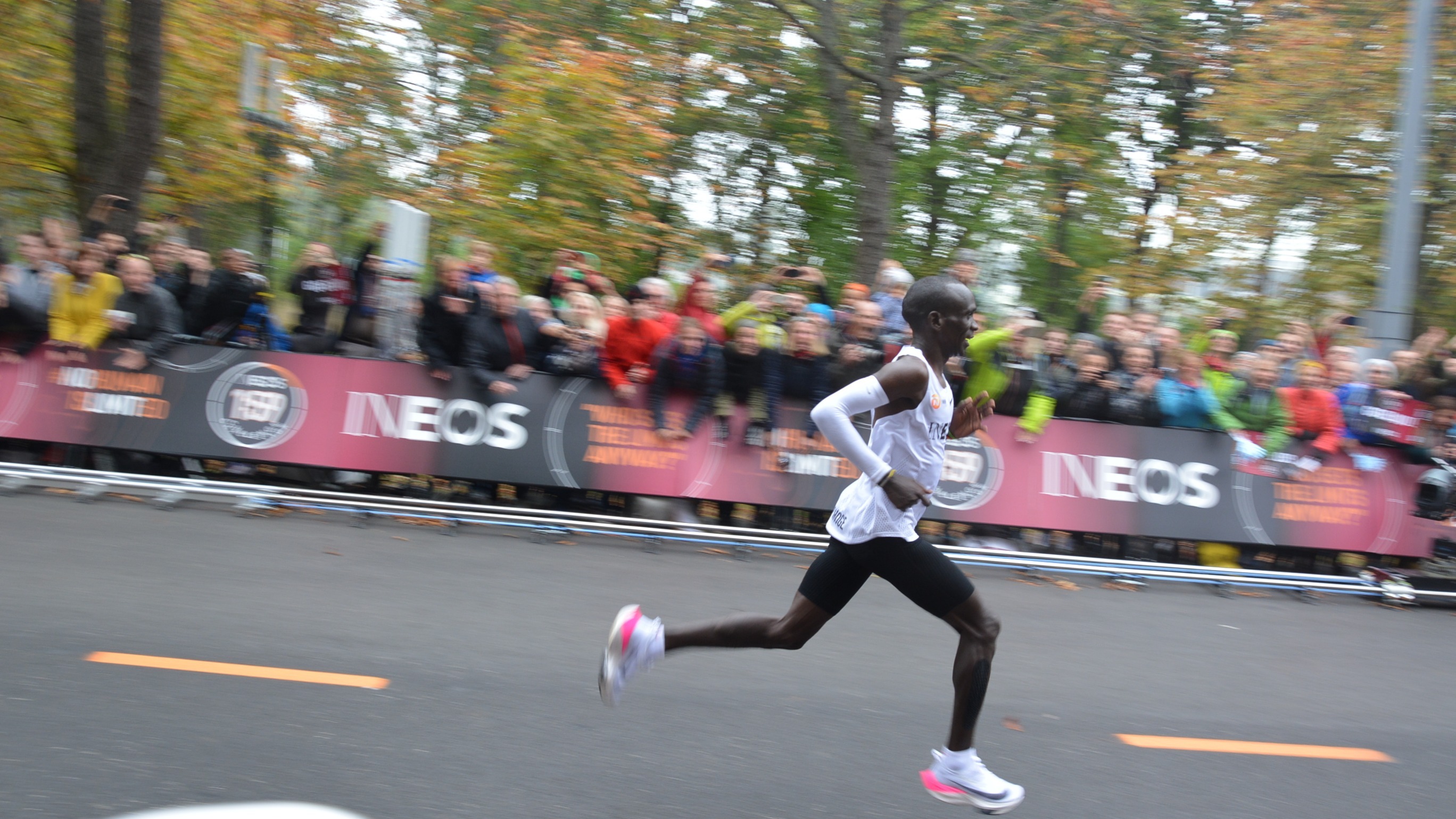
Seven years ago today, Eliud Kipchoge ran 1:59:40.2 through the Prater park in Vienna, and the sport's first reaction was to ask for the paperwork.
Fair enough, because the paperwork was a mess. Forty-one pacemakers ran in a V formation and swapped in and out in groups of seven. A team member on a bike handed him drinks so he never had to slow down at a table. He wore an unreleased Nike prototype, and there were no rivals, so technically there was no race. World Athletics didn't ratify it. The asterisk got stapled to his name, and it has been sitting there ever since.
Then came April 26 in London, where Sabastian Sawe ran 1:59:30 in an actual race, against actual rivals, with actual rules. It's a world record pending ratification, and it took 65 seconds off Kelvin Kiptum's 2:00:35 from Chicago in 2023.
After that, the 2019 arguments look a little different. The asterisk was always the least interesting thing about Vienna.
Look at what London actually needed. Sawe still ran behind pacers, who stepped off just after 25K. He went through halfway in 1:00:29 and came home in 59:01 for the second half, which is the fastest back half in marathon history. Once the pacers were gone, nobody rotated fresh legs in front of him. He did the hard part, and the hard part is the last 17 kilometres, where it's just a man and his own lungs.
Still, a few things in Vienna were never going to fly in a normal race, and the rule book was right to say so. Records need rules. Nobody serious is arguing otherwise.
But rules decide what goes in the record book. They don't decide what a human body can do, and that was the only question Vienna was ever asking. Before October 12, 2019, a sub-two marathon was a thing people debated in the way they debate whether a ball can curve around a wall. After it, the answer was known. Kipchoge said it himself at the finish: "I want to inspire many people, that no human is limited." It sounded like a slogan that day. Seven years on, it reads more like a forecast.
Sawe didn't need Vienna to run fast. He's 30, he'd won all four of his marathons before London, and an injury-hit winter hadn't stopped him. But everybody on that start line in London knew the thing could be done, and that matters. Chasing something nobody has done is one thing. Chasing something somebody already has is another.
The detail that makes it funny is further down the results. Yomif Kejelcha finished second in 1:59:41, in his marathon debut, the fastest debut ever recorded. On paper that sits less than a second behind Kipchoge's 1:59:40.2, the time with the asterisk. Kiplimo took third in 2:00:28, which also beats Kiptum's old record. That's three men under the old mark in a single morning.
Vienna never made the record book, and Kipchoge probably won't get an apology for the years of side-eye. He did get something odd and rather good, though: a time that doesn't count, in a sport that now behaves as if it does.
It might be the only reason London 2026 looked like a normal Sunday.
So when somebody asks you in ten years who broke two hours first, which date do you give them, and does the answer depend on who's holding the rulebook?
Cover photo: Triathlet 79, CC BY-SA 4.0, via Wikimedia Commons.
Peres Jepchirchir Won Sydney Easily. What Makes Some Marathoners Better at Managing the Final 10K?
England vs Argentina: Why This Rivalry Never Gets Old

Why Football's Transfer Window Always Turns Into a Last-Minute Auction
How Thailand Finally Reached the Olympics, and What Its Volleyball System Can Teach Other Nations

Why September Could Be One of Sport's Most Important Months of 2026
Arsenal Have Started the Title Defence Perfectly. Is Their Biggest Advantage Now Squad Depth?

The Clippers Lost Five First-Round Picks. What Happens When an NBA Team Breaks the Salary-Cap Rules?
Why Cricket's Impact Player Rule Has Become a Bigger Debate Than the Matches It Changes

Papua New Guinea Is Building a Rugby League Team From Scratch. Could It Change the Sport's Map?
Addisu Gobena Just Broke Sydney's Marathon Record. Why Are Marathon Times Falling So Quickly?


